
Long-beaked echidna (Genus Zaglossus)
Long-beaked echidnas (genus Zaglossus) are egg-laying monotremes native to New Guinea. Larger than short-beaked echidnas, they feed mainly on earthworms and face conservation pressures in montane forests.
Overview: The long-beaked echidnas belong to the genus Zaglossus, one of the two genera commonly called echidnas. These mammals are part of the egg-laying group of mammals known as monotremes and are closely related to the better-known platypus. Long-beaked echidnas are native to New Guinea and differ from the short-beaked echidna in size, snout shape and diet. The living group includes three extant species, and fossil evidence documents additional, now extinct, relatives.
Image gallery
10 Images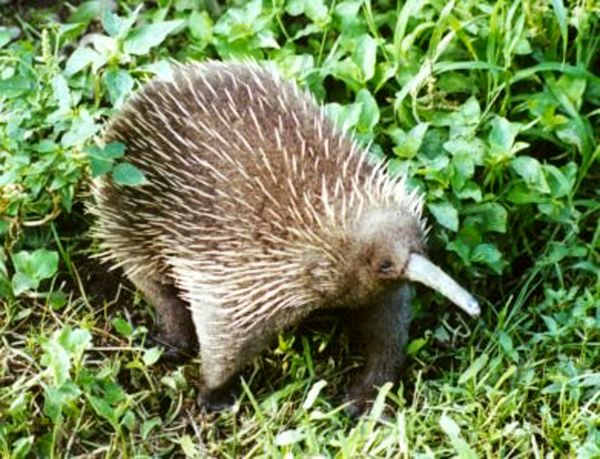




Physical characteristics
These animals are typically larger and heavier than the short-beaked echidna, with a pronounced, elongated snout and a slender, tubular mouth suited for probing. Their bodies bear coarse hair mixed with spines; the spines are modified hairs that provide protection but are not a continuous armored covering. Long-beaked species lack functional teeth and capture prey using a sticky tongue. Strong forelimbs and stout claws are adapted for digging and prising apart decaying wood.
Behavior and diet
Long-beaked echidnas are primarily solitary and forage by probing soil, leaf litter and rotten logs. Their diet is dominated by earthworms and other soft-bodied invertebrates rather than the ants and termites favored by short-beaked relatives. Foraging techniques and daily activity patterns vary with elevation and temperature: individuals at higher, cooler elevations may be active at different times than those in warmer lowland sites.
Reproduction and development
As monotremes, females lay a single leathery egg which is incubated in a temporary pouch or skin fold until hatching. The hatchling, commonly called a puggle, is tiny and dependent; it remains in the pouch or a protected burrow for some weeks while it grows and develops. This reproductive strategy, combined with relatively low reproductive output, contributes to slow population recovery after declines.
Taxonomy and evolution
The genus Zaglossus is one of two living echidna genera and represents an ancient lineage of monotremes. Extant taxa include species such as Zaglossus bruijni, Zaglossus bartoni and Zaglossus attenboroughi. The fossil record preserves other species that indicate a broader historical distribution in parts of Australasia; these fossils help clarify the group’s long evolutionary history and changing biogeography.
Distribution and habitat
Long-beaked echidnas are currently restricted to New Guinea, where they occupy montane and submontane forests, high-elevation grasslands and other habitats with abundant soil invertebrates. Their presence often signals intact soil and forest conditions because their prey and foraging requirements depend on healthy ecosystems.
Conservation and human interactions
Populations of long-beaked echidnas are under pressure from habitat alteration, agricultural expansion, and hunting in some areas. Their slow reproductive rate and specialized diet make them vulnerable to decline. Conservation actions emphasize habitat protection, surveys to establish population status, research on ecology and community-led measures to reduce hunting. International and local assessments and species accounts provide guidance for conservation planning.
Further reading
- General information on echidnas and monotremes can be found in broader accounts of echidna biology and natural history.
- Species lists and conservation summaries appear in specialist resources and databases referenced by researchers (extant species list).
- Regional faunal guides and field studies for New Guinea include notes on habitat and threats.
- Taxonomic treatments and genus-level summaries are useful starting points for scientific context (Zaglossus).
Ongoing fieldwork and local conservation initiatives continue to improve understanding of long-beaked echidnas; interested readers may consult specialist literature and conservation organizations for updates and detailed species accounts (monotreme and echidna entries).
Questions and answers
Q: What is a long-beaked echidna?
A: A long-beaked echidna is a type of echidna that belongs to the Genus Zaglossus and can be found in New Guinea.
Q: How many living species of echidna are there?
A: There are three living species of echidna.
Q: Are echidnas the only animals that lay eggs?
A: No, there are two types of mammals that lay eggs, and echidnas are one of them.
Q: How many genera of echidna are there?
A: There are two genera of echidna, one of which is Genus Zaglossus that includes the long-beaked echidnas.
Q: Where can long-beaked echidnas be found?
A: Long-beaked echidnas can be found in New Guinea.
Q: Are all species of echidna still living?
A: No, there are two extinct species of echidna.
Q: What is a monotreme?
A: A monotreme is a group of mammals that lay eggs instead of giving birth to live young.
Related articles
Author
AlegsaOnline.com Long-beaked echidna (Genus Zaglossus) Leandro Alegsa
URL: https://en.alegsaonline.com/art/59084
Sources
- edgeofexistence.org : (Zaglossus spp.) · web.archive.org
- web.archive.org : Facts