
London City Airport — Docklands single‑runway airport serving London's financial districts
Compact international airport in East London (Silvertown). Single runway, steep approach and noise limits restrict aircraft types; mainly used by business travelers with DLR links and a limited transatlantic service.
Overview
London City Airport is a compact international airport in the Docklands area of East London. Built on former dockland land in Silvertown, it lies in the London Borough of Newham and is notable for its single runway and concentrated, business‑oriented operation. Its proximity to Canary Wharf and central financial districts is a defining feature: it is used extensively by passengers working in London's finance and professional services sectors. The airport operates scheduled services across Europe and maintains a limited transatlantic link to New York (John F. Kennedy International Airport). Single-runway, STOL and short-field performance are central to its identity.
Image gallery
10 Images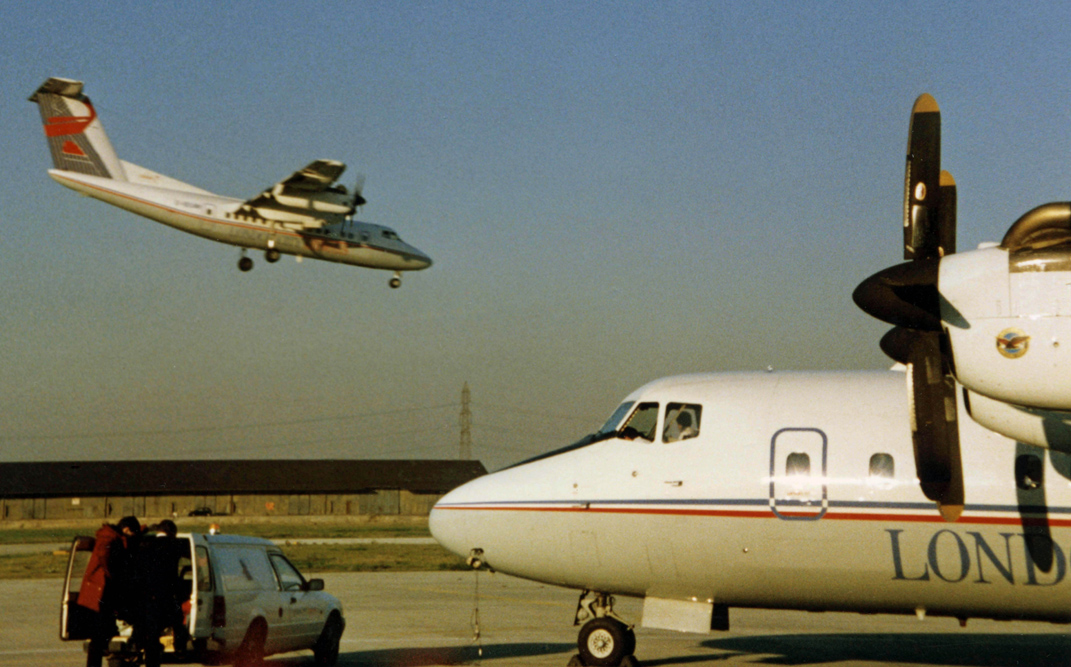


Characteristics and operations
London City is designed for short take-off and landing operations and enforces a steep approach angle that differs from most airports. This approach profile demands special pilot training and aircraft certification; only multi‑engine, fixed‑wing types that meet its performance and noise criteria may operate regularly. The airport holds a Civil Aviation Authority public use aerodrome licence (P728), allowing it to handle public transport passenger flights and certain other operations under regulated conditions. Operational rules intended to limit disturbance and fit the constrained site shape include strict aircraft type approval and daytime noise controls. Noise restrictions and the airport's limited runway length shape both the schedule and fleet mix.
Location, access and role
Located on a former dock site close to Canary Wharf and the O2 arena, the airport is unusually close to a major business district compared with other London airports. Its address in the London Borough of Newham places it in East London, with frequent public transport connections that make it convenient for time‑sensitive travelers: local rapid transit and road links connect passengers to central London and the wider transport network. This convenience is one reason business passengers favour the airport over larger, more distant hubs. Financial districts, Docklands, Newham and East London are commonly referenced when describing the site, and the close relation to Canary Wharf is often highlighted.
History and development
The airport was developed on reclaimed dockland in the mid‑1980s and opened to provide a fast link between London and key European destinations for business travelers. Construction and early development were associated with major engineering contractors, and the site evolved as the Docklands area regenerated. Ownership has changed over time; in 2006 a consortium including financial and infrastructure investors acquired the airport. Passenger numbers grew steadily from the early 2000s, reflecting demand for short‑haul business services; reported passenger counts rose from around 2.9 million in 2007 to over 4.5 million by 2017.
Capacity, planning and limits
The airport operates with a single runway and constrained boundaries, and its master planning has aimed to increase capacity without adding a second runway or substantially expanding the site. Proposals and plans have envisaged a phased increase in annual passenger capacity—subject to planning, environmental assessments and operational limits—while preserving the local environment and noise protections. It is commonly described as the fifth‑largest London airport by passenger numbers after Heathrow, Gatwick, Stansted and Luton. Gatwick, Stansted and Luton are larger regional competitors.
Uses, significance and notable facts
London City fills a niche for time‑sensitive travelers who prioritise quick transfers to the financial districts and a compact airport experience. Its policies result in short check‑in and transit times relative to larger hubs. The steep 5.5° approach angle and certification requirements make it an operationally specialised airport: airlines must demonstrate crew training and aircraft performance suitability before operating scheduled services. Its mix of scheduled European routes and a selective long‑haul service illustrates how a small, well‑located airport can play a strategic role in a major global city.
- Runway and operations overview
- STOL and short-field performance
- Connections to financial districts
- Docklands regeneration context
- Local authority information (Newham)
- East London transport links
- Nearby landmarks (Canary Wharf)
- Transatlantic service to JFK
- Noise and environmental controls
- Comparison: Gatwick
- Comparison: Stansted
- Comparison: Luton
Questions and answers
Q: What type of aircraft can operate at London City Airport?
A: Only multi-engine, fixed-wing aircraft with special crew and aircraft certification can operate at London City Airport.
Q: When was the airport developed?
A: The airport was developed by the engineering company Mowlem in 1986/87.
Q: How many passengers used London City Airport in 2007?
A: In 2007, London City Airport had 2.9 million passengers.
Q: What is the CAA Public Use Aerodrome Licence number for London City Airport?
A: The CAA Public Use Aerodrome Licence number for London City Airport is P728.
Q: How much did the consortium pay to purchase London City Airport in October 2006?
A: The consortium paid an undisclosed sum to purchase London City Airport in October 2006, though speculation suggests it was valued at over £750 million.
Q: What is the maximum capacity of passengers per annum outlined in the master plan up to 2030?
A: The master plan outlines a maximum capacity of 8 million passengers per annum up to 2030 without adding a second runway or significant expansion of current boundaries.
Q: How many passengers used London City Airport by 2017?
A: By 2017, 4,530,439 passengers had used London City Airport.
Related articles
Author
AlegsaOnline.com London City Airport — Docklands single‑runway airport serving London's financial districts Leandro Alegsa
URL: https://en.alegsaonline.com/art/59021
Sources
- gov.im : "Certification requirements for London City Airport"
- londoncityairport.com : londoncityairport.com/AboutUs/Default.aspx
- londoncityairport.com : "London City Airport Master Plan"