
London and Blackwall Railway
A 19th‑century East London railway linking central London to the docks, notable for early cable haulage, viaduct construction and later reuse in the Docklands Light Railway.
Overview
The London and Blackwall Railway (L&BR) was an early urban railway in East London that provided a direct link from the City to the docks. Originally promoted as the Commercial Railway, it opened in 1840 to carry passengers and goods between central London and the port areas, serving the growing need to move workers and freight to the docks and riverside wharves.
Image gallery
4 Images


Route and main places served
The line ran from the Minories area close to the City through Stepney to Blackwall, with a branch serving the Isle of Dogs. Key points on the route included Minories, Stepney and Blackwall, and the railway connected into the series of riverfront and dock facilities commonly described as London's docks. It operated across elevated viaducts and embankments that became a distinctive part of the east London townscape (East London).
Construction, engineering and characteristics
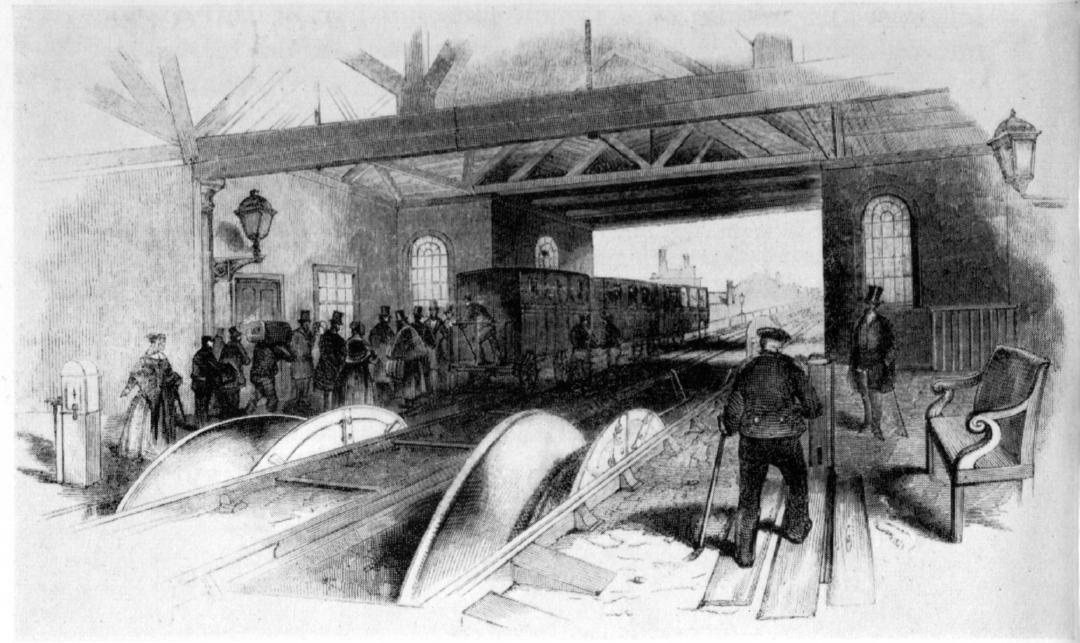
From the start the L&BR used prominent masonry viaducts, brick arches and ironwork to achieve an elevated alignment through built-up streets. Unusually for its time, the line was worked initially by stationary steam engines that hauled trains by rope or cable on certain sections, an early form of mechanised traction. Later developments allowed locomotives to replace or supplement the original system as technology and regulations evolved.
Operations, freight and passenger use
The railway carried a mix of traffic: commuter services for dock workers and City travellers, together with a significant quantity of goods and parcels linked to riverside industry. A branch to the Isle of Dogs gave direct access to wharves and warehouses. As road transport and other rail lines changed patterns of trade, the L&BR’s passenger and freight role declined through the late 19th and early 20th centuries.
History and later changes
Founded as the Commercial Railway and later known as the London and Blackwall Railway, the company and its infrastructure passed through a number of operational changes during its life. Much of the line’s original technology was superseded, and services were progressively reduced. In the late 20th century parts of the former alignment were reclaimed and reused as components of the Docklands Light Railway and other redevelopment projects, preserving sections of the route’s course through the redeveloped Docklands.
Legacy and surviving features
- Architectural legacy: surviving brick viaducts, arches and elevated structures remain visible in places and reflect Victorian industrial design.
- Transport impact: the L&BR was an early example of integrating rapid rail links with maritime commerce, influencing later urban rail development.
- Reuse: sections of the corridor have been adapted into modern light rail schemes and cycle or pedestrian paths during Docklands regeneration.
The London and Blackwall Railway illustrates how 19th‑century transport solutions were shaped by the docks and industry of the time, leaving a recognizable imprint on East London infrastructure and later redevelopment. For more on the line’s route and present traces see sources and local heritage material (East London resources, Minories, Blackwall, Stepney, Isle of Dogs, London’s docks).
Questions and answers
Q: What is the London and Blackwall Railway?
A: The London and Blackwall Railway (L&BR) is a historic railway in East London that connected the Minories to Blackwall with a branch line to the Isle of Dogs.
Q: Where did the London and Blackwall Railway run?
A: The London and Blackwall Railway ran in East London, England, from Minories to Blackwall via Stepney, with a branch line to the Isle of Dogs.
Q: What was the original name of the London and Blackwall Railway?
A: The original name of the London and Blackwall Railway was the Commercial Railway.
Q: What was the purpose of the London and Blackwall Railway?
A: The purpose of the London and Blackwall Railway was to connect central London to many of the docks in the city.
Q: When was the London and Blackwall Railway established?
A: The London and Blackwall Railway was established in the 19th century.
Q: Is the London and Blackwall Railway still in operation today?
A: No, the London and Blackwall Railway is not in operation today.
Q: What makes the London and Blackwall Railway significant?
A: The London and Blackwall Railway is significant because it was one of the first railways to connect central London to the city's docks. It played an important role in the growth and development of London as a major port city.
Related articles
Author
AlegsaOnline.com London and Blackwall Railway Leandro Alegsa
URL: https://en.alegsaonline.com/art/58975