
LOL — meaning, history, usage and variations
LOL is a widely used internet abbreviation for 'laughing out loud'. This article explains its meaning, history in online culture, common variants, usage nuances and unrelated meanings in other languages.
Overview
LOL, usually written as "lol" or "LOL", is a short, informal expression used in written digital communication to indicate amusement or laughter. It originated as internet slang and is commonly expanded as "laughing out loud". In casual conversation, it often signals that the sender found something funny, but it can also soften a message, indicate irony, or function as a conversational filler rather than a literal claim of laughter. Some readers mistakenly interpret it as "lots of love", but that meaning is separate and far less common in digital chats.
Image gallery
6 Images



History and development
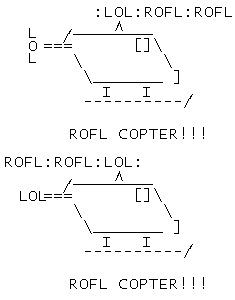
The abbreviation emerged from early online communities, bulletin boards, and chat rooms in the late 1980s and 1990s as people adapted shorthand to the constraints of typing and slow connections. Over time, the term moved from niche technical forums into mainstream texting, instant messaging and social media. Its diffusion was aided by the growth of mobile messaging and the playful, meme-rich culture of the web. Debates about whether it is an acronym or a word gradually faded as "lol" became a conventional part of internet vernacular rather than a formal abbreviation to be expanded.
Usage and variations
Writers use LOL in many ways: to mark genuine amusement, to signal light-heartedness, to soften criticism, or even sarcastically. Capitalization can convey tone — all caps "LOL" often implies louder laughter or stronger emphasis, while lowercase "lol" reads more subdued. Common related forms include emotive and emphatic variants such as:
- lolz — playful or mocking plural form
- lmao — "laughing my ass off", a stronger variant
- rofl — "rolling on the floor laughing", another emphatic option
- :) and emojis — often used alongside or instead of text abbreviations
Other languages and meanings
Identical letter sequences appear in other languages with unrelated meanings. For example, the Dutch noun "lol" is a native word meaning fun or amusement. Because such overlaps exist, context is important: in multilingual exchanges the same three letters may be interpreted differently depending on language and local usage.
As a cultural artifact, LOL illustrates how written shorthand can evolve into conventionalized expressions with subtle pragmatic roles. It remains one of the most recognizable pieces of digital slang worldwide and continues to adapt as communication platforms and norms change.
Questions and answers
Q: What does LOL stand for?
A: LOL stands for "laugh(ing) out loud."
Q: What is the common misconception about LOL?
A: The common misconception about LOL is that it stands for "lots of love."
Q: What is the common usage of LOL in messages?
A: The common usage of LOL in messages is to indicate that something is really funny.
Q: What is the meaning of LOL in Persian?
A: In Persian, LOL means "mute."
Q: Is LOL an acronym in the Dutch language?
A: No, LOL is not an acronym in the Dutch language. Instead, it means "fun" and "lollig" means "funny."
Q: What does LOL mean in Welsh?
A: In Welsh, LOL means "nonsense." For example, "rwtsh lol" means "utter nonsense."
Q: Where is LOL commonly used?
A: LOL is commonly used on the Internet or when text messaging.
Related articles
Author
AlegsaOnline.com LOL — meaning, history, usage and variations Leandro Alegsa
URL: https://en.alegsaonline.com/art/58929
Sources
- cs.cf.ac.uk : "Welsh-English Lexicon"
- urbandictionary.com : "Urban Dictionary: used in chat and text messaging"
- netlingo.com : "LMAO"
- urbandictionary.com : "Lel"