
Logarithmic spiral
A self-similar plane curve with constant angle between radius and tangent, occurring in nature and used in mathematics, engineering and art. Also called equiangular or growth spiral.
Overview
A logarithmic spiral, sometimes called the equiangular spiral or growth spiral, is a plane spiral whose distance from the origin increases exponentially with angle. It is characterized by the property that the angle between a radius drawn from the center and the tangent at any point of the curve is constant. That constant-angle property gives the shape a steady, self-similar appearance: magnifying any part of the spiral reproduces the whole form up to rotation.
Image gallery
10 Images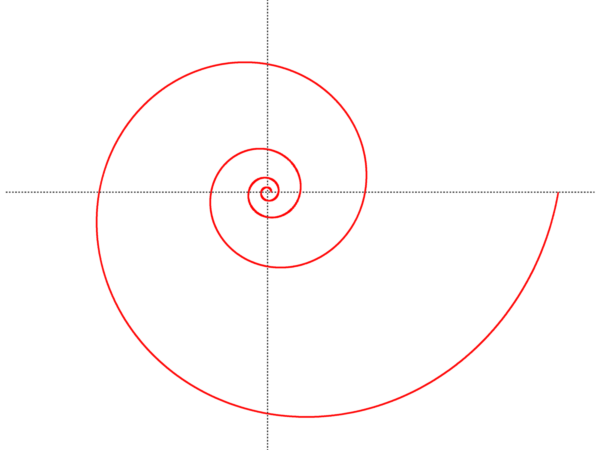





Mathematical description and properties
In polar coordinates the logarithmic spiral can be written as r = a e^{bθ}, where a and b are real constants and θ is the polar angle. If b = 0 the curve is a circle; nonzero b produces the spiral. The constant angle ψ between the radius vector and the tangent satisfies tan ψ = 1/b, so choosing b fixes the tightness of the spiral. One full turn (an increase of θ by 2π) multiplies the radius by the factor e^{2πb}, giving a fixed growth factor per revolution. In the complex plane a convenient parametrization is z(θ) = a e^{(b + i)θ}, which highlights its exponential and rotational elements.
History
The logarithmic spiral was noted early in the study of curves: René Descartes gave descriptions, and Jakob Bernoulli later investigated it intensively and admired its invariant, "marvelous" quality, calling it Spira mirabilis. Bernoulli famously wished the spiral engraved on his tombstone; a spiral was indeed used, though a different form was carved on his grave. Historical discussions emphasize its surprising ubiquity and mathematical elegance.
Occurrences in nature and applications
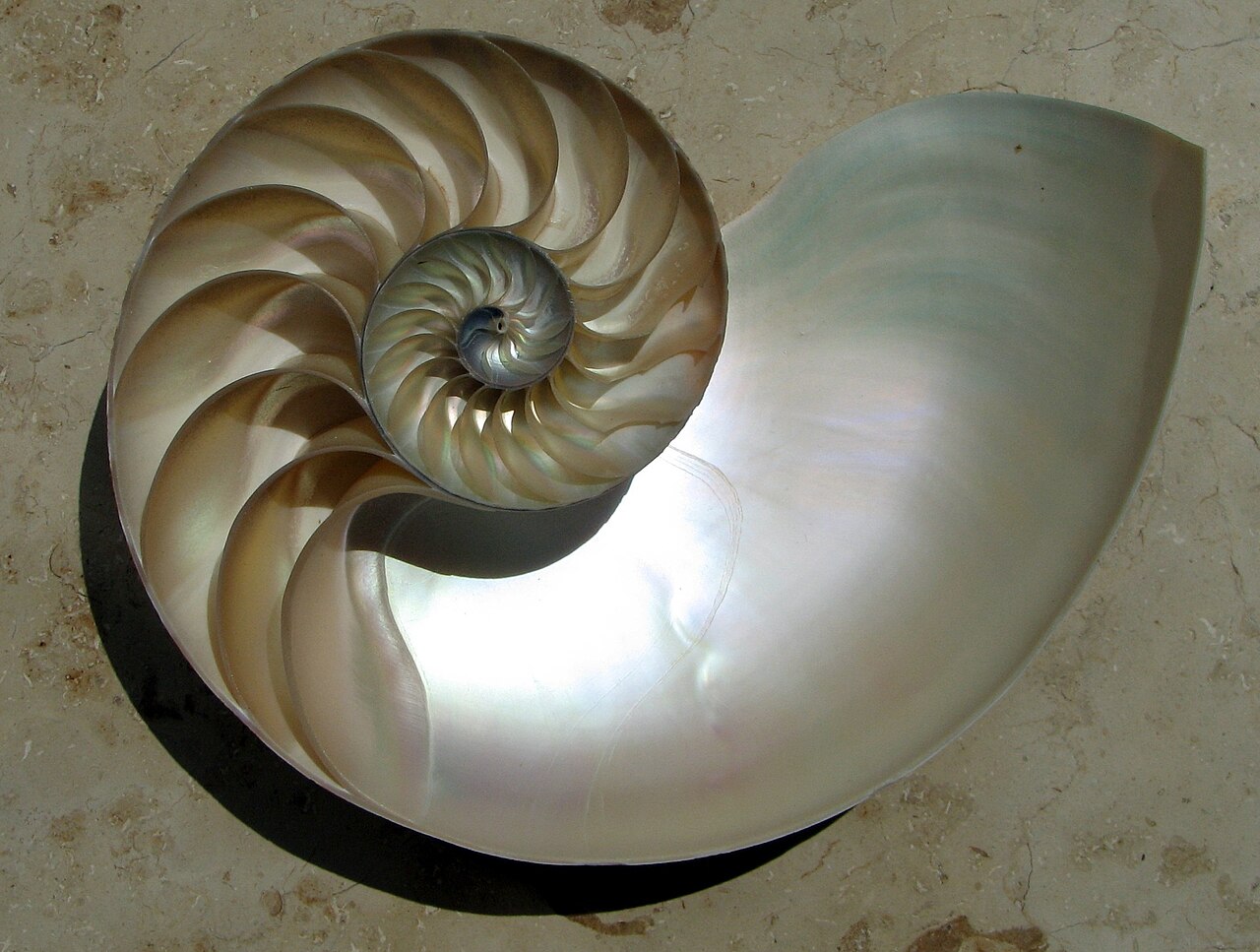
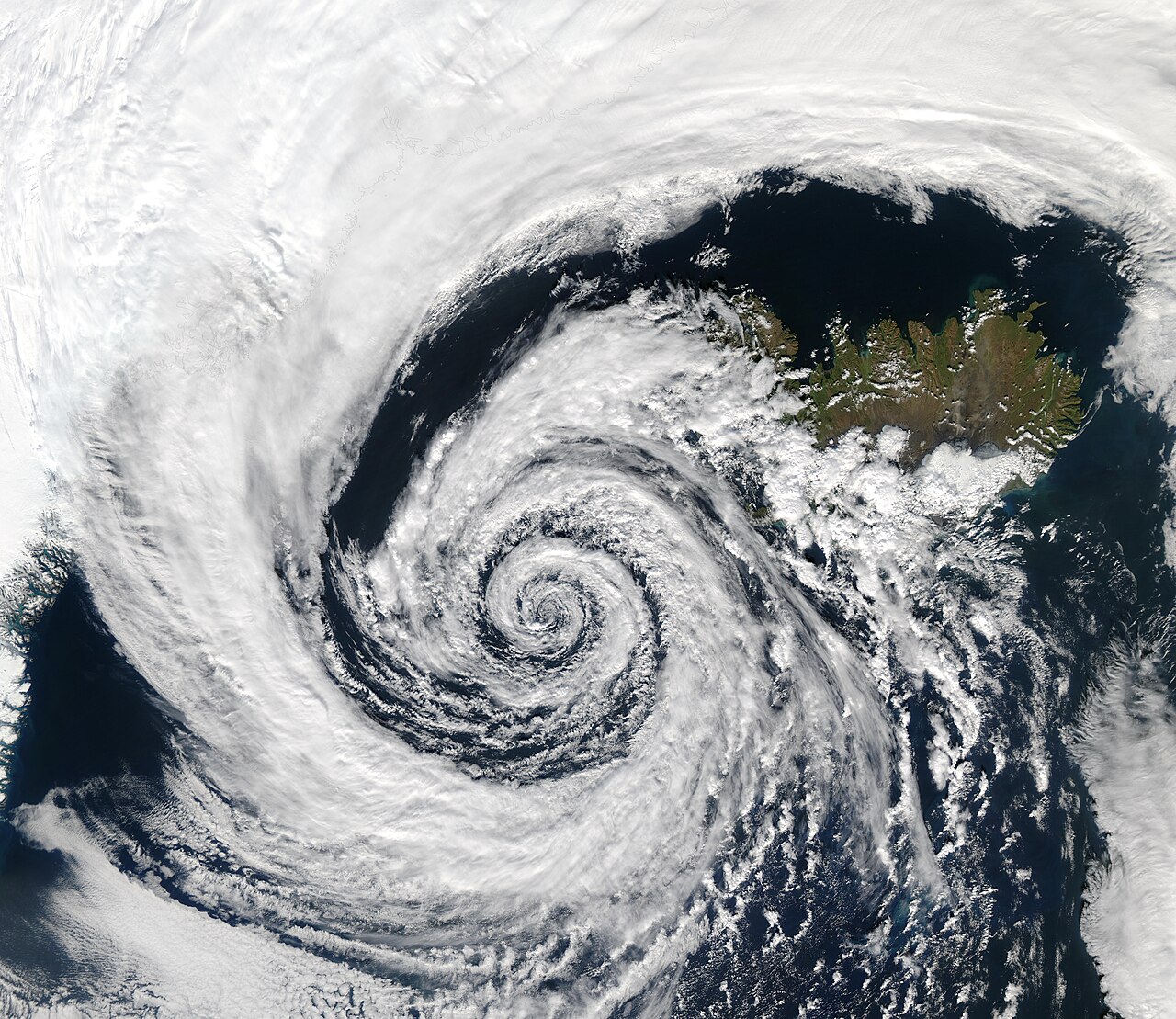
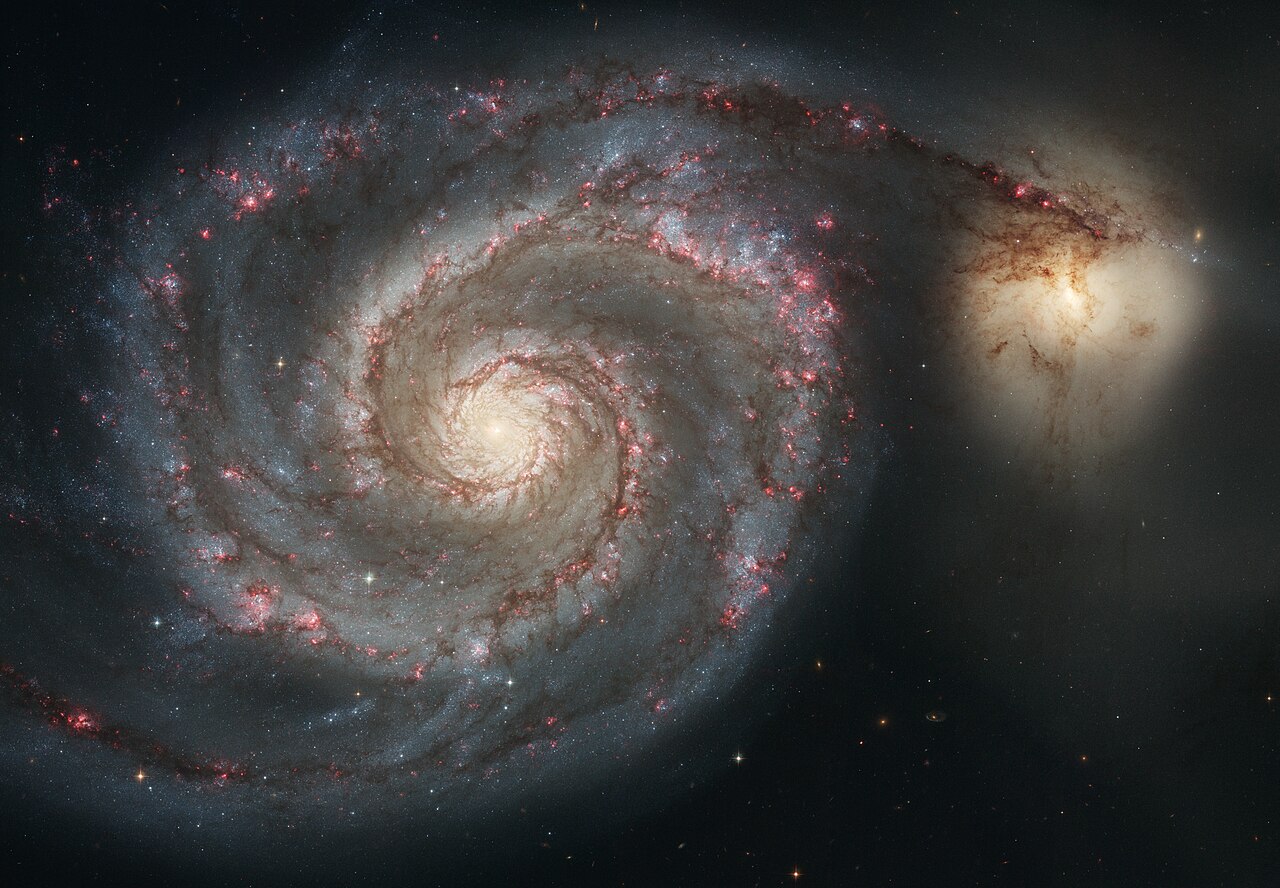
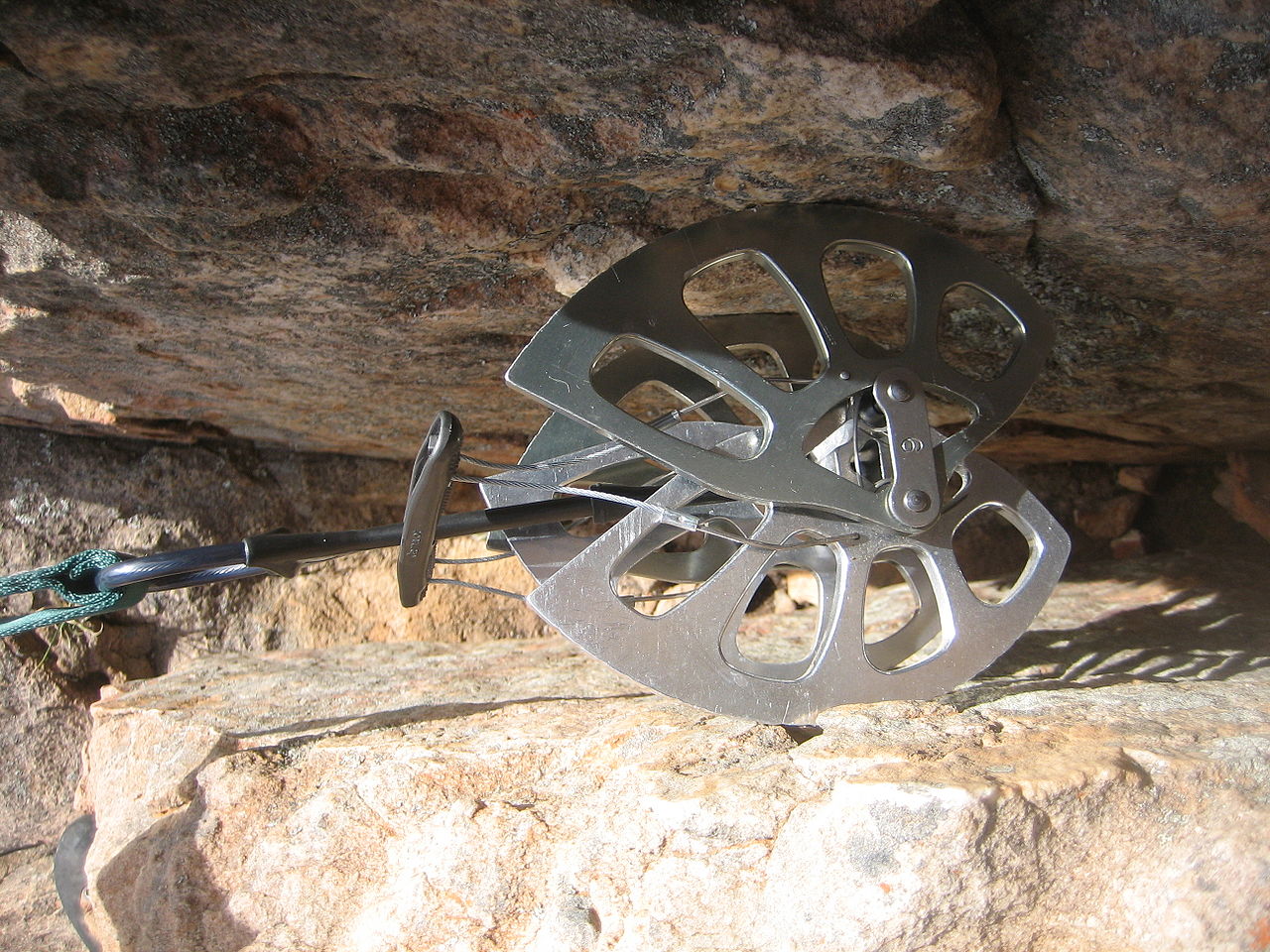
The form appears widely in natural growth patterns and fluid dynamics. Nautilus and other mollusk shells, certain insect horns, the tracks of some animals, and the outline of tropical cyclones and spiral galaxies approximate logarithmic spirals because the shape can arise from steady proportional growth at every stage. Engineers and designers exploit related properties: logarithmic (or log-periodic) spiral antennas provide frequency-independent behavior over wide bands, and the spiral appears in architecture and visual composition for its aesthetic scaling.
Distinctions and notable facts
- The logarithmic spiral differs from the Archimedean spiral: an Archimedean spiral increases radius linearly with angle, producing equal spacing between turns, while the logarithmic spiral spaces turns geometrically.
- Under similarity transformations (combinations of rotations and scalings) a logarithmic spiral maps onto itself; under inversion in a circle it maps to another logarithmic spiral. These symmetry properties make it a useful example in complex analysis and geometric studies.
- The so-called "golden spiral" is a particular logarithmic spiral often used in art and design because its growth per quarter turn approximates the golden ratio; it is therefore a special case rather than a distinct class.
For further mathematical details and visual examples see formal treatments of plane curves and historical notes on Descartes and Bernoulli at relevant sources: Descartes and Bernoulli references.
Questions and answers
Q: What is a logarithmic spiral?
A: A logarithmic spiral is a type of spiral curve that is often seen in nature.
Q: Who first described the logarithmic spiral?
A: The logarithmic spiral was first described by Descartes.
Q: Who conducted extensive investigations on the logarithmic spiral?
A: Jakob Bernoulli extensively investigated the logarithmic spiral.
Q: What is the name that Jakob Bernoulli gave to the logarithmic spiral?
A: Jakob Bernoulli named the logarithmic spiral "Spira mirabilis," which means "the marvelous spiral."
Q: What other names are used for the logarithmic spiral?
A: The logarithmic spiral is also known as the equiangular spiral or the growth spiral.
Q: What are some examples of logarithmic spirals in nature?
A: Some examples of logarithmic spirals in nature include the shape of seashells, pinecones, and the pattern of galaxies.
Q: What makes the logarithmic spiral unique?
A: The logarithmic spiral is unique because its curve expands or contracts at a constant rate, creating an angle that remains the same at every point along the spiral.
Related articles
Author
AlegsaOnline.com Logarithmic spiral Leandro Alegsa
URL: https://en.alegsaonline.com/art/58855
Sources
- mathworld.wolfram.com : Logarithmic Spiral
- jwilson.coe.uga.edu : Equiangular Spiral (or Logarithmic Spiral) and Its Related Curves
- cut-the-knot.org : Spira Mirabilis - Wonderful Spiral