
LiveJournal: social blogging platform and community network
LiveJournal is an early social blogging platform and the name of its server software. Launched in 1999, it combined personal journals with friend networks, communities, and distinctive privacy and interaction features.
Overview
LiveJournal (often abbreviated LJ) is a web-based journaling and community platform that blends personal blogging with social-network features. First created as a simple online diary, it grew into a site where users publish entries, follow one another, and participate in group-run communities. The term "LiveJournal" also refers to the original software developed to run the site and manage its distinctive features; that software and the hosted service share a long, intertwined history. For a basic description of the site’s primary function, see blog.
Image gallery
2 Images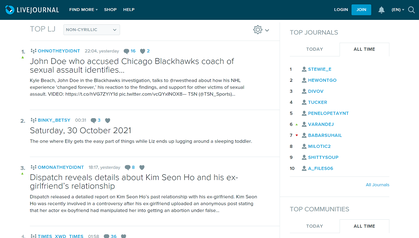

Key characteristics and features
LiveJournal’s design emphasizes interaction between authors and their social circles. Users maintain a friends list that determines whose posts appear in a personalized feed. Posts can be marked public, friends-only, or private, offering a range of privacy choices uncommon in early blogging systems. The platform supports threaded comments, profile pages, user icons and interests, and tools for hiding portions of long entries. It also historically offered instant messaging-style features (often referred to as LJ Talk) so users could communicate in real time.
Communities are a central structural element: group journals that aggregate posts from multiple contributors around a shared subject, such as hobbies, fandoms, news topics, or local events. Communities can be moderated, invite-only, or open, and they became a major way users met, organized discussions, and hosted collaborative projects.
Origins and development
LiveJournal began in 1999 as a private project by programmer Brad Fitzpatrick to share updates with friends from high school; that origin is often cited in histories of early social web services. The site and its operating company later formalized and expanded into a public service. In January 2005 LiveJournal’s parent company was acquired by the blogging software firm Six Apart. The name LiveJournal continued to refer both to the hosted site and to the software platform that powered it. For background on the founder, see Brad Fitzpatrick, and for the early personal context of the project see his high school.
Over time the service underwent technical and organizational changes as ownership and priorities evolved. The platform introduced paid account tiers, new moderation tools, and design updates while maintaining legacy features that kept a dedicated user base. The software heritage of the site is summarized at the LiveJournal software entry.
Use cases and cultural impact
LiveJournal played a notable role in the development of online social practices: it helped popularize friends-as-a-primitive social graph, friends-only content, and community-run discussion spaces. The site became especially important in online fandoms, creative writing circles, grassroots activism, and personal journaling communities where pseudonymity and sustained conversation were valued. It influenced how later social platforms handled user networks, privacy, and community moderation.
Distinctions and later trends
Unlike simpler blogging tools, LiveJournal combined a publishing model with persistent social ties and community governance. That combination produced a distinct culture—sometimes intense and self-reinforcing—that set LJ apart from single-author blogs. In the wider ecosystem, LiveJournal’s popularity waned as newer social networks and microblogging services emerged, but it remains historically important as an early example of a social blogging network and for the long-lived communities that formed there.
- Service and software: LiveJournal refers both to a hosted service and the underlying server software (software).
- Privacy model: posts can be public, limited to friends, or private—one of the platform’s long-standing features.
- Communities: group journals provided a collaborative forum model used heavily by fandoms and interest groups.
Questions and answers
Q: What is LiveJournal?
A: LiveJournal is a website where users can keep a blog and interact with friends in unique ways.
Q: What makes LiveJournal different from other blogging sites?
A: LiveJournal allows users to interact with friends in unique ways such as instant messaging in LJ Talk.
Q: Who started LiveJournal?
A: LiveJournal was started by Brad Fitzpatrick in 1999 as a way of keeping his high school friends updated on his activities.
Q: Where is LiveJournal based?
A: LiveJournal is based in San Francisco, California.
Q: Who owns LiveJournal?
A: LiveJournal is owned by a blogging software company called Six Apart, which bought Danga Interactive, the company owned by Fitzpatrick that operates LiveJournal.
Q: What is the name of the software designed to run LiveJournal?
A: LiveJournal is the name of the software designed to run LiveJournal.
Q: What is the purpose of LiveJournal?
A: The purpose of LiveJournal is to provide a platform for users to keep a blog and interact with friends in unique ways.
Related articles
Author
AlegsaOnline.com LiveJournal: social blogging platform and community network Leandro Alegsa
URL: https://en.alegsaonline.com/art/58594