
Linear A: The Undeciphered Script of Bronze Age Crete
Linear A is an undeciphered Bronze Age writing system used in Minoan Crete. This article outlines its signs, corpus, relation to Linear B, discovery, language hypotheses, uses, and ongoing research.
Overview
Linear A is an undeciphered writing system attested mainly on the island of Crete and in a few nearby Aegean contexts during the Bronze Age. First recognized in modern archaeology in the late nineteenth and early twentieth centuries, it is a primary source for the administrative and material culture of the society commonly called Minoan. The script has resisted full decipherment, and its underlying language or languages remain unknown. Linear A is closely associated in time and form with two other Aegean systems: the earlier Cretan hieroglyphic signs and the later script known as Linear B, the latter of which records early Greek and has been successfully deciphered.
Image gallery
3 Images

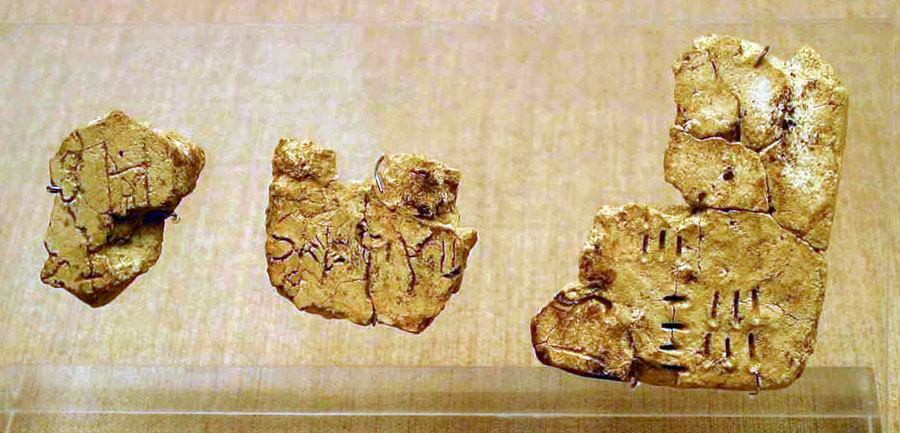
Signs and basic corpus
Linear A inscriptions combine signs that function syllabically with a set of ideograms or logograms that appear to denote commodities, measures and ritual items. Scholars working from excavated finds and sign catalogs estimate roughly sixty to eighty syllabic signs and about a hundred ideographic signs, together with a small set of numerals and fraction signs. Most surviving texts are short: administrative lists, tablet records, single-word or short phrases on sealings and labels, and brief dedicatory inscriptions. The preservational bias of archaeology means many longer or more varied records written on perishable materials like papyrus or parchment are lost.
Chronology and relation to other scripts
Linear A was used from the second millennium BCE until the late Bronze Age reforms and contacts that brought stronger Mycenaean influence to Crete. It shares many sign shapes with Linear B; some signs appear directly related in form. However, applying the sound values known from Linear B to Linear A inscriptions generally produces sequences that are not intelligible in Greek, indicating that the language encoded by Linear A was different from Mycenaean Greek.
Language hypotheses and decipherment attempts
The language recorded by Linear A is uncertain. Scholars have proposed a variety of hypotheses, ranging from a non‑Indo‑European Aegean language (sometimes called "Minoan" in broad usage) to links with Anatolian, Semitic or other families, but none of these proposals has achieved wide consensus. The absence of a clear bilingual inscription comparable to a Rosetta Stone, the brevity and formulaic nature of most texts, and uncertainty about sign values make decisive progress difficult. Researchers use comparative paleography with Linear B, frequency analysis, contextual archaeology, and computerized pattern‑finding to test proposals.
Uses and archaeological contexts
Most Linear A material appears to be administrative: inventories of goods, accounting entries, lists of offerings and place or personal names. Ideograms often represent commodities such as textiles, oils, metals, or measures, while numerals indicate quantities. Short ritual texts and labels have been recovered from shrine contexts and vessels, suggesting multiple functional domains for the script. Because many likely compositions were made on perishable writing support, the preserved corpus is skewed toward those items inscribed on clay, stone, or durable objects.
Discovery, study and resources
Important early finds of Linear A were produced by excavations led by archaeologists including Sir Arthur Evans, who also excavated the Knossos palace and later identified Linear B and Cretan hieroglyphs. Modern study combines epigraphic cataloging, archaeological context, linguistic hypothesis testing and computational methods. For introductory summaries and sign lists see general introductions and corpus databases. Comparative surveys of Cretan hieroglyphs and related Aegean systems are available at research overviews.
- Origins and early forms (Cretan hieroglyphs)
- Relation of Linear A to Linear B
- Notable excavators and key finds
- Sign lists, charts and palaeography
- Syllabic signs and proposed values
- Ideograms and commodity inventories
- Ritual inscriptions and dedications
- Libations, vessels and cult contexts
- Media and preservation: clay and perishable supports
- Comparative studies with later scripts
- Current research directions and computational work
Linear A remains a central problem in Aegean archaeology and historical linguistics: it preserves direct documentary traces of Bronze Age Crete while withholding a clear linguistic key. Continued excavations, careful cataloging of inscriptions, and advances in analytic techniques keep open the possibility of further insights and, potentially, eventual decipherment.
Questions and answers
Q: What is Linear A?
A: Linear A is an ancient script used on Crete that has not yet been translated. It was one of the writing systems used in Minoan Crete and was used from about the 17th century BC until the 15th century BC.
Q: How does it compare to Linear B?
A: Linear B is a script based on Linear A, and has been translated. There are about fifty signs in Linear A that are similar to those in Linear B, but around 80% of the signs in Linear A are unique. Using knowledge from Linear B to read Linear A produces text which cannot be read.
Q: What language does it use?
A: The language used for this script has been called Eteocretan and does not seem to be related to any known language.
Q: How many characters are known?
A: About 70 characters (probably representing syllables) are currently known, as well as around 100 ideographic characters which can be combined with the syllables. Additionally, there are a few numerals whose value is known.
Q: What do most texts seem to be about?
A: Most texts seem to be lists, although a few may be short dedications found on libations. So far, no long texts have been found.
Q: What materials were typically used for writing these scripts?
A: Straight lines such as those used for linear A were not very practical for clay tablets so most writing was probably done on other things such as papyrus or parchment instead; however, these materials do not last as long as clay so much of this writing has likely been lost over time.
Related articles
Author
AlegsaOnline.com Linear A: The Undeciphered Script of Bronze Age Crete Leandro Alegsa
URL: https://en.alegsaonline.com/art/58255
Sources
- people.ku.edu : "Linear A texts in phonetic transcription"
- books.google.com : Minoans.
- books.google.com : Writing and script: a very short introduction
- scribd.com : "The Danube script and other ancient writing systems: a typology of distinctive features"
- books.google.com : Literacy and history: the Greeks
- books.google.com : Spoken and written discourse: a multi-disciplinary perspective
- books.google.com : The origins and character of the ancient Chinese city, volume 2: The Chinese city in comparative perspective