
Lincoln Castle: Norman fortress with double mottes and civic heritage
Lincoln Castle is a late 11th‑century Norman fortress built on a Roman site. Noted for its two mottes, well‑preserved walls and long legal use, it houses historic documents and is open to visitors.
Overview
Lincoln Castle stands on a hill in Lincoln, England, overlooking the city and its cathedral. Constructed in the decades following the Norman Conquest on the footprint of an earlier Roman fortification, the castle became a military stronghold, centre of local government and a symbol of royal authority. Its compact inner defences and position on high ground made it a prominent element of Lincoln's landscape for nearly a millennium.
Image gallery
9 Images



Layout and main features
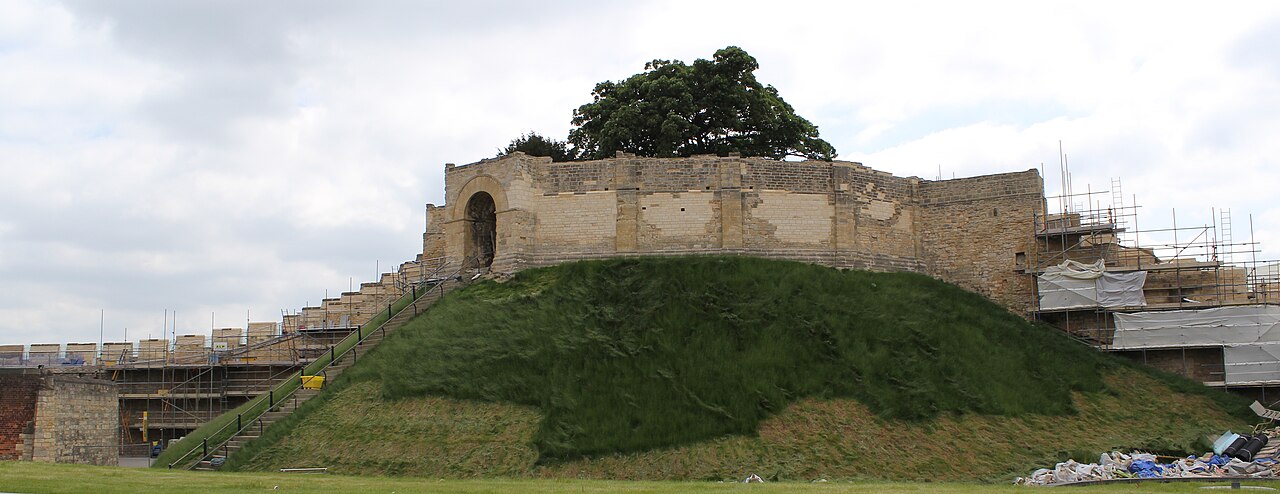
The castle is notable for a number of architectural and functional features that survive in readable form today. Most strikingly, it has two separate mottes—raised earthworks crowned with fortifications—an uncommon arrangement among English castles. Visitors can still trace the curtain walls that link the works and examine gatehouses, towers and the remains of domestic and administrative buildings.
- Double mottes: two distinct elevated strongpoints offering overlapping fields of defence.
- Curtain walls and towers: substantial masonry enclosures that define the castle precinct.
- Law and prison buildings: spaces adapted over centuries for courts, gaols and civic administration.
- Document displays: the site conserves and interprets important legal charters and manuscripts.
History and development
Built in the late 11th century by the Normans on top of an earlier Roman fort site, the castle reflects successive phases of construction and reuse. Its defensive role was foremost in the medieval period, but it also developed administrative and judicial functions as the surrounding town grew in importance. Over the centuries, the castle complex was modified to meet changing military techniques and civic needs, including adaptations in the post‑medieval and Victorian eras.
Because it occupied a site with long strategic value, the castle and its precincts remained relevant beyond purely military use. The presence of courts and official buildings meant the site continued to be associated with governance and law, and parts of the complex were used as a prison into modern times. Conservation work in more recent decades has aimed to stabilise the stonework, interpret the remains and present the castle to the public.
Uses, access and interpretation
Today the castle functions as a heritage attraction, a venue for community events and a repository for historical documents. Visitors can walk large sections of the battlements to gain panoramic views of the city and Lincoln Cathedral, explore a Victorian prison display and view exhibitions on the castle’s past. Educational programmes and guided tours focus on military architecture, medieval governance and the everyday lives of those who lived and worked in the castle precinct.
Notable distinctions and facts
Lincoln Castle is one of only a very small number of English castles with twin mottes; the arrangement is sometimes contrasted with the two‑motte site at Lewes. The castle also retains an unusually long connection with the administration of justice and the detention of prisoners, and it houses important medieval legal documents, including an original early copy of the Magna Carta, which is displayed and interpreted for visitors. The site combines military archaeology, civic history and archival collections, making it a significant focus for studies of Norman and later England.
Further information and visitor details are available from local resources and heritage authorities: see entries on the castle itself via the main site, materials discussing its Roman antecedents at the Roman fortress, technical descriptions of its twin mottes at features of the mottes, historical commentaries on its prison function at prison history, and guided trails that link the castle, cathedral and city walls at city heritage routes.
Questions and answers
Q: Where is Lincoln Castle located?
A: Lincoln Castle is located in Lincoln, England.
Q: When was Lincoln Castle constructed?
A: Lincoln Castle was constructed during the late 11th century.
Q: What is the history of the site where Lincoln Castle was built?
A: Lincoln Castle was built on the site of a pre-existing Roman fortress.
Q: How many mottes does Lincoln Castle have and how does it compare to other castles in the country?
A: Lincoln Castle has two mottes, and it is only one of two such castles in the country; the other is at Lewes in Sussex.
Q: What has Lincoln Castle been used for in the past?
A: Lincoln Castle has been used as a prison and law court into modern times.
Q: Is Lincoln Castle preserved well?
A: Yes, Lincoln Castle is one of the better preserved castles in England.
Q: Can the public visit Lincoln Castle?
A: Yes, Lincoln Castle is open to the public most days of the week, and it is possible to walk around the walls from which there are views of the castle complex, cathedral, the city, and surrounding countryside.
Related articles
Author
AlegsaOnline.com Lincoln Castle: Norman fortress with double mottes and civic heritage Leandro Alegsa
URL: https://en.alegsaonline.com/art/58128