
Lil Freak — Usher song featuring Nicki Minaj (2010)
Overview, composition, production and reception of Usher's 2010 single “Lil Freak,” featuring Nicki Minaj, its use of Stevie Wonder elements, and its place on the album Raymond v. Raymond.
"Lil Freak" is a 2010 single by American singer Usher, issued as the second official release from his album Raymond v. Raymond. The recording features a guest appearance by Trinidadian-born rapper Nicki Minaj and was written and produced in collaboration with songwriters and producers including Ester Dean, Blac Elvis and Polow da Don. The track incorporates elements from Stevie Wonder's 1973 song "Living for the City," credited through an interpolation of melodic and rhythmic material from that recording and its writers Stevie Wonder.
Image gallery
2 Images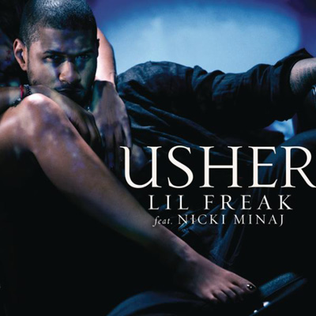

Musical style and lyrics
Musically, "Lil Freak" blends contemporary R&B with club-oriented hip hop production: programmed beats, prominent synth lines and processed vocal hooks create a glossy, late-2000s pop-R&B sound. Lyrically the song is frank and sexual in tone, addressing themes of desire and nightlife, with Usher delivering smooth, seductive verses and Minaj contributing a high-energy rap verse that contrasts with his crooning. The production emphasizes groove and repetition, designed for radio and dancefloor play.
Creation and collaborators
The song was developed as a collaborative effort: songwriting credits include the artists themselves along with established pop and R&B writers. Producers Polow da Don and Blac Elvis are known for creating dense, beat-driven backdrops; Ester Dean provided songwriting input that helped shape the hook and melodic structure. The acknowledged use of material from a 1970s soul classic links the modern track to an earlier generation of American popular music.
Release and reception
Released in early March 2010, "Lil Freak" attracted attention for its guest spot from a then-rising Nicki Minaj and for its explicit lyrical content. Critics offered mixed-to-positive assessments, often praising the chemistry between the two performers and noting the song's suitability for contemporary radio and club settings. It achieved chart presence in several markets and received airplay and streaming during the album's promotion cycle.
Legacy and notable facts
- It appears on Raymond v. Raymond, an album that marked a transitional period in Usher's career; the song was one of several that leaned into commercial club sounds.
- The collaboration helped raise Minaj's profile in mainstream R&B and pop contexts during the early stage of her career.
- The track's linkage to a Stevie Wonder composition demonstrates how modern songs often borrow melodic or rhythmic elements from earlier works, requiring clear credits and licensing.
For more details on the artists and the album, see the artist and album pages: Usher, Nicki Minaj and Raymond v. Raymond. Background on the sampled material is available via the credited songwriter Stevie Wonder.
Questions and answers
Q: Who is the singer of "Lil Freak"?
A: Usher is the singer of "Lil Freak".
Q: What is "Lil Freak"?
A: "Lil Freak" is a song by Usher featuring Trinidadian rapper Nicki Minaj.
Q: When was "Lil Freak" released?
A: "Lil Freak" was released on March 2, 2010.
Q: From which album is "Lil Freak" released?
A: "Lil Freak" is released from Usher's album Raymond v. Raymond (2010).
Q: Who wrote "Lil Freak"?
A: "Lil Freak" was written by Nicki Minaj, Usher, Ester Dean, Blac Elvis, and Polow da Don.
Q: What song does "Lil Freak" sample?
A: "Lil Freak" samples Stevie Wonder's 1973 hit, "Living for the City".
Q: Is "Lil Freak" a popular song?
A: It cannot be determined whether "Lil Freak" is a popular song or not as the text only provides information on its release and background details.
Related articles
Author
AlegsaOnline.com Lil Freak — Usher song featuring Nicki Minaj (2010) Leandro Alegsa
URL: https://en.alegsaonline.com/art/58009
Sources
- zobbel.de : "Chart Log UK: New Entries Update"
- billboard.com : "Usher Album & Song Chart History"
- itunes.apple.com : "Lil Freak (feat. Nicki Minaj) - Single by Usher"