
Arnold Sommerfeld: German theoretical physicist and influential teacher
Arnold Sommerfeld (1868–1951) was a German mathematician and theoretical physicist known for extending the Bohr model, developing quantization rules, and training a generation of 20th‑century physicists.
Arnold Johannes Wilhelm Sommerfeld (5 December 1868 – 26 April 1951) was a German mathematician and theoretical physicist. Born in Königsberg, he became a central figure in the transitional era between classical physics and quantum theory. He spent most of his career in Munich, where he led a prominent school of theoretical physics and helped shape modern atomic and wave mechanics. Munich
Academic life and teaching
Sommerfeld combined rigorous mathematical skill with physical intuition. Trained in mathematics and physics, he held professorships that emphasized applying advanced analysis to physical problems. He was a noted lecturer and mentor: his seminars attracted many young scientists who later became leading researchers and Nobel laureates. His reputation as a pedagogue and group leader is a defining part of his legacy. mathematician teacher
Image gallery
5 Images
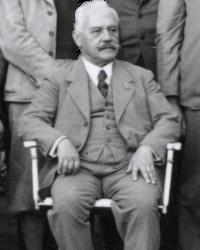


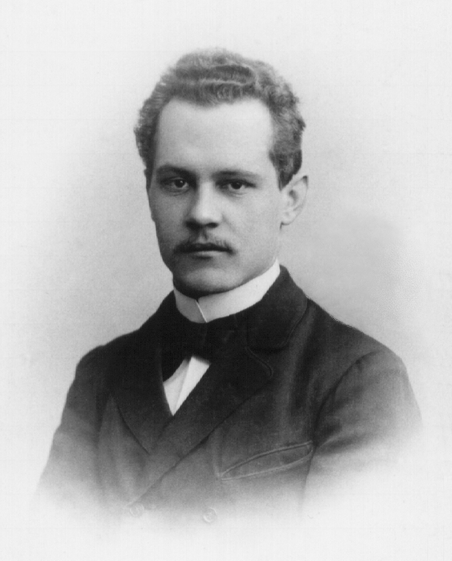
Major contributions
- Atomic structure and fine structure: Sommerfeld extended Niels Bohr’s model by allowing elliptical electron orbits and including relativistic corrections, which explained fine-structure splittings in spectral lines.
- Sommerfeld (quantization) rules: He formulated generalized quantization conditions for action integrals that guided work in the old quantum theory before full wave mechanics emerged.
- Mathematical physics: He applied advanced mathematical methods to electrodynamics, optics, and the electron theory of metals, influencing techniques used across theoretical physics.
Sommerfeld played an important role during the development of early quantum mechanics: he engaged with emerging ideas, encouraged students to explore new formalisms, and helped bridge classical and quantum descriptions. He authored influential lecture volumes on theoretical physics that were widely used as references and textbooks.
Influence and legacy
Beyond his own research, Sommerfeld’s greatest impact was through mentorship. A generation of physicists who studied with or were influenced by him carried his methods into nuclear physics, solid-state theory, and quantum mechanics. His career illustrates how a mathematically skilled theorist can shape both problems and people in physics. theoretical physicist
Questions and answers
Q: Who was Arnold Johannes Wilhelm Sommerfeld?
A: Arnold Johannes Wilhelm Sommerfeld was a German mathematician and theoretical physicist.
Q: When was he born?
A: He was born on December 5, 1868 in Königsberg, East Prussia.
Q: Where did he live?
A: He lived in Munich.
Q: What nationality was he?
A: He was German.
Q: What accomplishments did he have?
A: He made contributions to the field of mathematics and theoretical physics.
Q: When did he die?
A: He died on April 26, 1951 in Munich.
Related articles
Author
AlegsaOnline.com Arnold Sommerfeld: German theoretical physicist and influential teacher Leandro Alegsa
URL: https://en.alegsaonline.com/art/5800