
Light-emitting diode (LED): principles, design, history and uses
A light-emitting diode (LED) is a semiconductor device that emits light when electrically biased. This article explains how LEDs work, their structure, development, common uses and notable distinctions.
Overview
A light-emitting diode, commonly abbreviated LED, is a solid-state electronic component that emits light when an electric current passes through it. The light is produced by radiative recombination of electrons and holes inside a semiconductor material. LEDs are widely used because they convert a large portion of input energy into light rather than heat, they are mechanically robust, and they have long operating lifetimes compared with many traditional light sources.
Image gallery
10 Images




Basic principle and characteristics
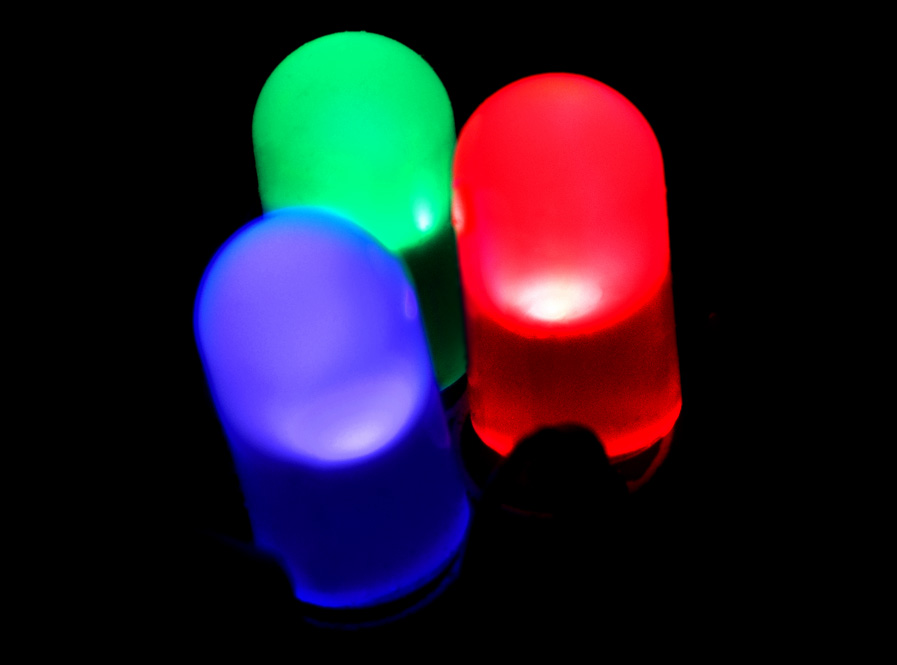
An LED is a form of diode that allows current to flow in one direction and emits photons in the process. The emission is a type of electroluminescence: when a suitable forward voltage is applied, electrons recombine with holes in the device’s active region and release energy as photons. The specific wavelength — and therefore the perceived color — depends on the semiconductor materials and their band gap.
Typical LEDs can produce near-ultraviolet, visible, and infrared light. White light is often produced either by combining multiple colored emitters or by coating a blue or ultraviolet LED with a phosphor that shifts part of the spectrum to longer wavelengths; this conversion process is described by some suppliers as a means to obtain white illumination.
Structure and packaging
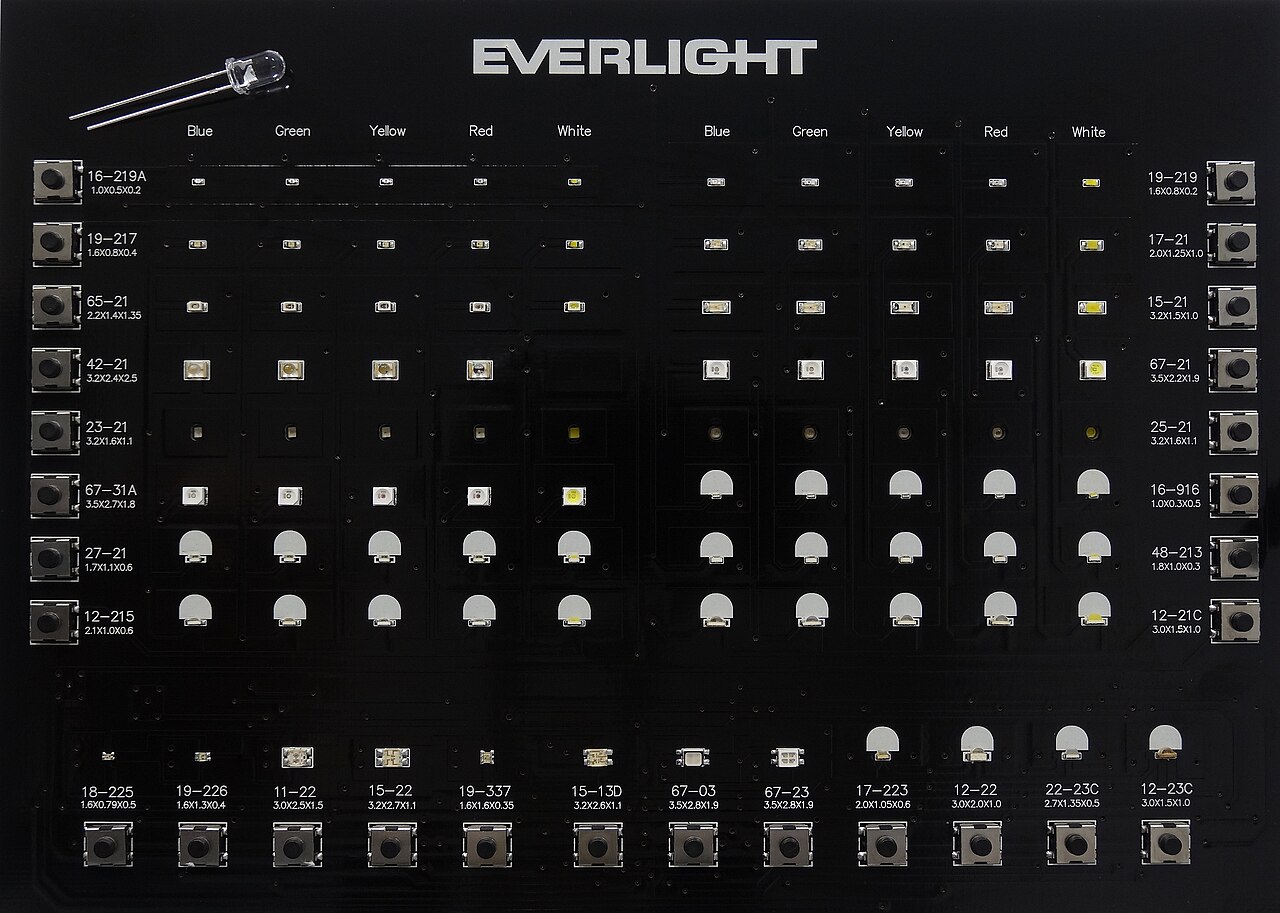
LEDs are manufactured from crystalline semiconductor layers chosen for their electronic and optical properties; composition and doping control determine emitted wavelengths and efficiency. Devices are commonly mounted in packages with lenses, reflectors, and thermal paths to manage light extraction and heat dissipation. In modern electronics, many LEDs are produced as compact surface-mount components (SMD) that can be densely placed on circuit boards.
History and development
The discovery of electroluminescence and subsequent development of practical LEDs occurred over several decades as semiconductor materials and fabrication techniques improved. Early LEDs emitted low-intensity red light; advances in compound semiconductors led to green, yellow, and blue emitters, and the combination of blue LEDs with phosphors enabled practical white illumination. Continuous research has improved luminous efficacy, color rendering, and lifetime.
Applications and examples
LEDs appear in a wide range of uses, from small indicator lights on consumer electronics to high-brightness arrays for signage and automotive lighting. They serve as backlights for displays and are integrated into TV and monitor panels; in some systems LEDs are used as the light source behind an LCD, while in others LED pixels provide direct emission. Examples of common applications include:
- Indicator and status lamps on devices.
- Architectural, street and domestic lighting using white LEDs.
- Traffic signals, vehicle brake and tail lights.
- Display panels, billboards and stage lighting.
- Infrared LEDs for remote controls and sensing.
Advantages, limitations and notable facts
Advantages of LEDs include high energy efficiency, long service life, fast response times, and compact size that allows flexible design. They produce little infrared radiation and can be designed for narrow spectral outputs, which is helpful in applications such as horticulture, sensing, and communications. Limitations can include higher initial cost for high-quality white-light fixtures, thermal management needs (performance and lifetime decline with excessive heat), and variations in color rendering between different phosphors or emitter mixes.
Because LEDs are sources of light rather than light modulators, they are often contrasted with liquid-crystal displays; LEDs generate photons directly while technologies such as LCDs modulate or block an existing light source. Innovations in packaging, phosphors, and semiconductor alloys continue to expand the range of LED applications and to improve their efficiency and color quality.
For additional technical details and standards, consult manufacturer datasheets and technical resources: see links on semiconductor materials, diode behavior and device packaging such as semiconductor, diode, and SMD technologies. Further reading often covers chemical composition, optical conversion with phosphor, and wavelength-specific topics like near-ultraviolet or infrared emitters. Additional resources: color selection, electroluminescence, white conversion, and display comparisons involving LCD.
Questions and answers
Q: What is a light-emitting diode (LED)?
A: A LED is a semiconductor device that produces light from electricity.
Q: How long do LEDs last?
A: LEDs last a long time and are more durable than incandescent lightbulbs.
Q: What colors can LEDs produce?
A: LEDs can produce many different colors, including near-ultraviolet, visible or infrared.
Q: How does the color of an LED affect its energy usage?
A: The color of the LED affects how much electricity it uses.
Q: How do white LEDs work?
A: White LEDs usually have two or three different colored LEDs inside them, or one single-color LED combined with a phosphor that converts it to white.
Q: Where are LEDs used?
A: LEDs are used in many places such as electronic devices, advertising signs, brake lights on cars, TVs and recently for home lighting.
Q: Are surface-mount devices (SMD) small enough to be used as an LED? A: Yes, some modern day SMDs are small enough to be used as an LED.
Related articles
Author
AlegsaOnline.com Light-emitting diode (LED): principles, design, history and uses Leandro Alegsa
URL: https://en.alegsaonline.com/art/57933
Sources
- green.rpi.edu : "Greenlighting: a greener world"
- hyperphysics.phy-astr.gsu.edu : "Light emitting diode structure"
- invention.smithsonian.org : "inventors"
- facstaff.bucknell.edu : "Light emitting diodes (LEDs)"
- nature.com : nature.com/articles/nphoton.2007.34?error=cookies_not_supported&code=00fba5d1-fae4-4d0e-a…
- orc.soton.ac.uk : orc.soton.ac.uk