
Arno Schmidt: German experimental writer and translator
German author and translator (1914–1979) noted for radical typography, dense linguistic play and the monumental novel Zettel’s Traum (Bottom’s Dream), a landmark of postwar German literature.
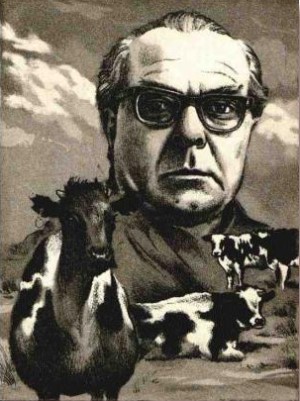
Arno Schmidt (18 January 1914 – 3 June 1979) was a German novelist, essayist and translator whose work is widely regarded as a key achievement of post‑World War II literature in Germany. Born in Hamburg, he produced a body of writing that moves from relatively conventional short fiction to deliberately difficult and highly original experimental prose. Schmidt combined linguistic ingenuity, satirical energy and an interest in book design; his name is often associated with the extremes of twentieth‑century literary innovation.
Image gallery
4 Images


Stylistic features and major works
Schmidt’s writing is known for its compressed syntax, playful neologisms, extensive footnoting, and typographical experimentation. He pushed the boundaries of what a novel could look and sound like: inserting marginalia, diagrams and nonstandard layouts to force readers to negotiate multiple levels of text. The best‑known example of this approach is Zettel’s Traum (commonly translated as Bottom’s Dream), an encyclopaedic and polyphonic work for which Schmidt famously prepared tens of thousands of index cards as research material and working notes. The published novel itself uses dense page designs and multi‑column layouts that mix narrative, commentary and wordplay.
Themes and concerns
Recurring themes in Schmidt’s writing include the impact of modern warfare on private life and language, the breakdown and repair of memory, the mechanics of translation, eroticism, and the cultural entanglement of Germany with Anglophone literature. He frequently explored how language both reveals and conceals human experience; his texts can read as a sustained investigation into the limits of representation and comprehension after historical rupture.
Historical context and reception
Emerging from the social and intellectual aftermath of the 1940s and 1950s, Schmidt resisted realist conventions and the literary rehabilitation that many contemporaries pursued. Critical reaction to his work has been mixed: admired by avant‑garde readers and scholars for formal daring, while often criticized as hermetic and intentionally provokative by others. Over time, however, many critics and younger writers have come to acknowledge his influence on German experimental prose.
Translation and later influence
In addition to his original fiction, Schmidt worked as a translator and reader, engaging closely with English‑language literature. His practice of close reading and translation informed his theoretical reflections on style and the instability of meaning. Today his writings are studied in courses on postwar literature, experimental narrative and translation theory, and they continue to inspire writers interested in typographic and linguistic invention.
Characteristics at a glance
- Intense linguistic density and wordplay
- Typographic experimentation, including multi‑column pages
- Large preparatory archives (e.g., extensive note cards for major works)
- Blurring of genres: novel, essay, diary and scholarly annotation
- Polarized reception and lasting influence on experimental writing
For further information, biographies and editions, consult dedicated resources and specialist studies. The following links point to established reference pages and archives for more detailed bibliographies and analyses:

Radio play adaptations
- From the life of a faun. Radio play with Ulrich Wildgruber. Edited and directed by Klaus Buhlert. BR Hörspiel und Medienkunst 1998. length: 86'40. as podcast/download in the BR Hörspiel Pool.
- Brand's Haide. Radio play with Ulrich Wildgruber, Juliane Köhler, Jacqueline Macaulay. Editing and direction: Klaus Buhlert. BR Hörspiel und Medienkunst 1998. length 71'20. as podcast/download in the BR Hörspiel Pool.
- Black Mirrors. Radio play with Corinna Harfouch, Ulrich Wildgruber. Editing: Klaus Buhlert/Herbert Kapfer, composition and direction: Klaus Buhlert. BR Hörspiel und Medienkunst 1997. length: 86'03. as podcast/download in the BR Hörspiel Pool.
- Seascape with Pocahontas. Radio play direction: Oliver Sturm, production RBB/HR 2010, length: 75 minutes
Film
- Arno Schmidt - "My heart belongs to my head!" Documentary, Germany, 2013, 60 min, Written and directed by: Oliver Schwehm, Quotes: Mechthild Großmann, Production: Bremedia, Radio Bremen, arte, First broadcast: 15 January 2014 on arte, Synopsis by ARD, including Jan Philipp Reemtsma, Marie Darrieussecq, Wenzel Storch, Uwe Timm, Antiquarian bookseller and publisher Hermann Wiedenroth (Bargfeld); Reviews: .
Related articles
Author
AlegsaOnline.com Arno Schmidt: German experimental writer and translator Leandro Alegsa
URL: https://en.alegsaonline.com/art/5785