
Liberty Bell
Famous 18th‑century bell in Philadelphia, cast in London and recast locally; known for its inscription and distinctive crack and adopted as a national symbol of liberty and social reform.
Overview
The Liberty Bell is an enduring American emblem associated with independence, civic memory and appeals for expanded rights. Originally hung in the Pennsylvania State House (now Independence Hall) in Philadelphia, the bell came to represent ideals such as liberty of conscience and opposition to slavery. Its visual presence — a large bronze bell bearing a biblical inscription and a jagged crack — has made it an accessible symbol in public ceremonies, printed imagery and popular culture. For more contextual information on the bell as a symbol, see symbolic meanings.
Image gallery
10 Images


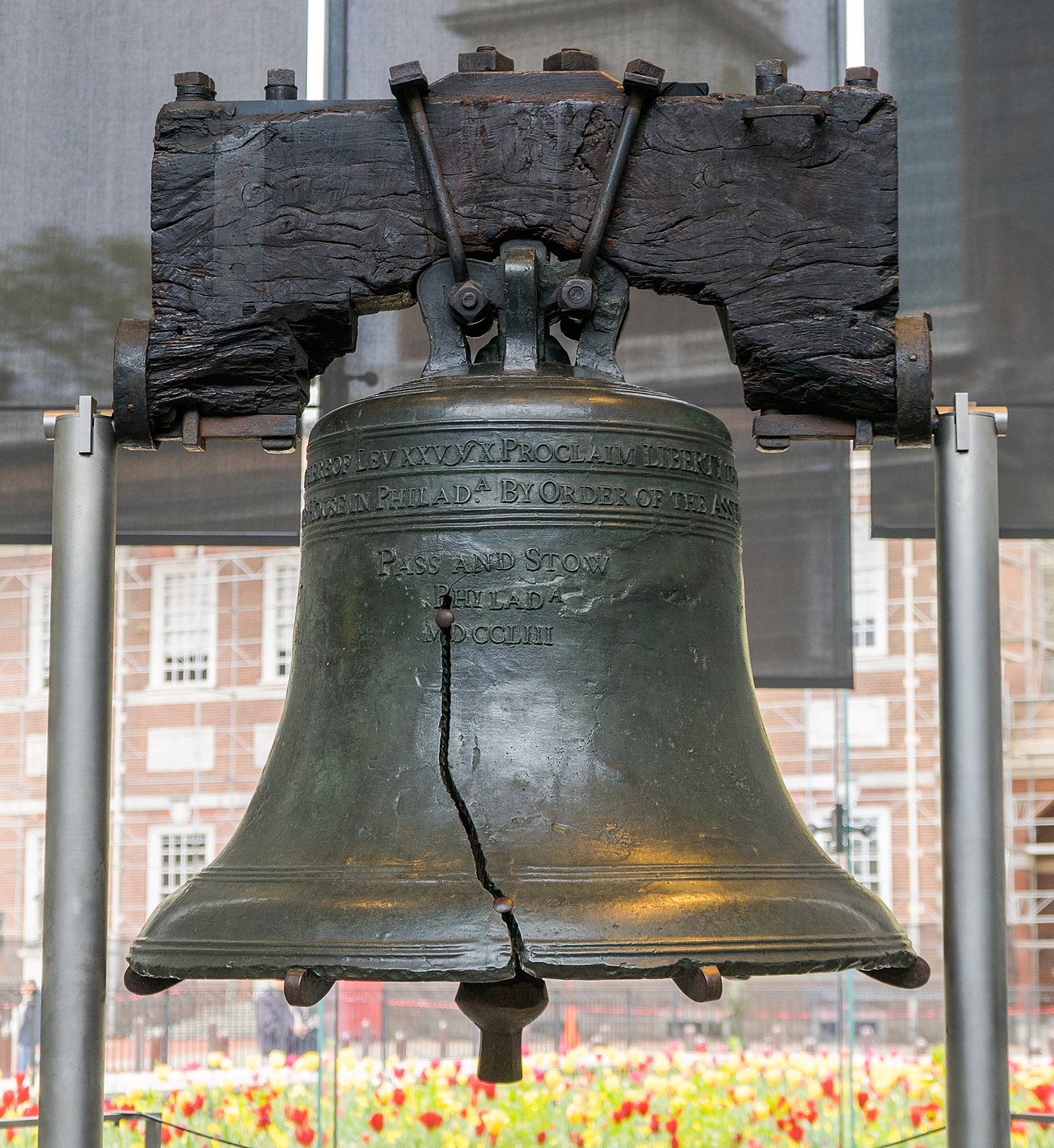


Composition, inscription and makers
The bell was cast in London in the early 1750s by the firm then identified as Lester and Pack, a business that later became known as the Whitechapel Bell Foundry. The raised-letter inscription across the bell reads in part: "Proclaim LIBERTY throughout all the land unto all the inhabitants thereof." That phrase is drawn from Leviticus and was chosen for its resonance with colonial-era rhetoric about rights and order. On first arrival in Philadelphia the bell reportedly cracked during testing; local craftsmen John Pass and John Stow recast and repaired the bell, leaving maker marks that record that local workmanship. For the foundry background, consult accounts of the London firm and the local Philadelphia casters.
Early uses in community life
In the colonial period the bell served practical civic functions. It called members of the colonial assembly to sessions, summoned residents to public meetings and marked important announcements. Bells throughout Philadelphia were part of a public network used to coordinate time and events; contemporary records describe bells ringing around the days when independence was announced and printed locally. While popular tradition sometimes claims that the bell itself tolled at a single, heroic moment, documentary evidence shows the timing and recipients of public readings and notifications could be complex and varied. The scriptural source of the inscription influenced how colonists understood the bell’s message.
Crack, repairs and later physical history
The familiar large fissure developed in the bell in the early 19th century. Reports differ about the precise cause; one story links the damaged rim to ringing following the death of Chief Justice John Marshall in 1835, though definitive proof is lacking. Additional handling, attempts to repair or re-profile the bell, and the stresses of repeated use all contributed to a fracture that eventually made the bell unringable for sustained musical use. As interest in the object grew, pieces were sometimes removed as souvenirs and the bell’s condition altered by travel and display. For information on repair history and maker tradition, see accounts of local workmanship and conservation records.
19th‑century fame and adoption by reformers
In the 19th century the bell’s public meaning broadened. Abolitionist groups and other reform movements adopted the bell and its inscription as a moral emblem in campaigns for emancipation and social change, and it became widely known by the popular name "Liberty Bell." A widely read short story published in 1847 promoted a dramatic narrative — an elderly bell‑ringer sounding the bell on the Fourth of July, 1776 — that helped fix a mythic origin in the public imagination even as historians later questioned the literal accuracy of that tale. The bell’s use by reformers and its circulation in printed accounts helped cement its status as a national touchstone; see discussions of public announcements and abolitionist adoption for context.
Tours, public display and conservation
From the late 19th century the City of Philadelphia began allowing the bell to travel to patriotic exhibitions and public rallies. These tours increased public familiarity but also accelerated wear: handling, movement and souvenir-taking removed small fragments and exacerbated the crack. After a series of early 20th‑century journeys (the last major trip occurred in 1915) authorities limited loans of the artifact and shifted attention to in‑place preservation. Modern conservation practice has focused on stabilizing the metal, preventing further fragmentation and presenting interpretive material to help visitors understand the bell’s complex story. The bell is today displayed as a preserved object within Philadelphia’s historic district; museum panels and programs situate it in the broader history of the nation and of reform movements. Related institutional histories are summarized in accounts of memorial associations and souvenir culture.
Notable facts and public meaning
- The bell’s inscription, its London casting and its Philadelphia repairs together tell a transatlantic material story about colonial America and artisan practices.
- The famous crack ended the bell’s use as a ringing instrument in the way it was originally intended; visitors now hear recordings or other bells rather than live ringing of the original object.
- Popular narratives about the bell mix documented events with later legendary elaboration; some familiar claims date from 19th‑century storytelling rather than contemporary records.
- Conservation and interpretation have aimed to balance preservation of the physical object with public access and education, so the bell remains a focal point for discussions of liberty, memory and social reform.
The Liberty Bell continues to be a prominent feature of American historical education and civic ritual, invoked in speeches, publications and commemorations as a widely recognizable shorthand for the ideal of liberty and for struggles to extend that ideal in practice.
Questions and answers
Q: What is the Liberty Bell?
A: The Liberty Bell is an important and famous symbol of American independence (freedom). It used to be in the Pennsylvania State House (now known as Independence Hall).
Q: Who made the Liberty Bell?
A: The bell was ordered from the London firm of Lester and Pack (which is known as the Whitechapel Bell Foundry today) in 1752.
Q: What words were inscribed on it?
A: The bell was inscribed with the words "Proclaim LIBERTY throughout all the land unto all the inhabitants thereof." These words are a part of Leviticus 25:10.
Q: How did it get its first crack?
A: The bell first cracked when it was first rung when it came to Philadelphia, and was made again twice by John Pass and John Stow, two workmen.
Q: When was it used for patriotic meetings?
A: From 1885, the City of Philadelphia, which owned the bell, allowed it to go to many different patriotic meetings. Many people came to see the bell, and it grew even more cracked. Pieces were broken off by souvenir hunters. The last such journey was in 1915. After that, the city refused any more requests of that kind.
Q: Was there a story about how it got its well-known crack?
A: Yes, one story claims that it was cracked while ringing after Chief Justice John Marshall's death in 1835.
Q: Is there any evidence that suggests that Liberty Bell rang on July 4th 1776?
A: No, there is no record that suggests this but many historians believe so due to a short story published in 1847 claiming an old bell-ringer rang it on July 4th 1776 after hearing Second Continental Congress's vote for independence which could not have been true since no announcement of Declaration had been made at that time
Related articles
Author
AlegsaOnline.com Liberty Bell Leandro Alegsa
URL: https://en.alegsaonline.com/art/57744
Sources
- measuringworth.com : Purchasing power of British Pounds from 1264 to present
- books.google.com : The Official Blackbook Price Guides to United States Coins 2010