
Leyden jar — early glass capacitor for storing static electricity
An 18th‑century device for storing static electricity. The Leyden jar was the first practical capacitor, widely used in early experiments to demonstrate charge storage, sparks and the principles of electrostatics.
Overview
The Leyden jar (also spelled Leiden jar) is an early device for storing static electricity. It consists of a glass container that separates two conductors: one inside and one outside. By maintaining a potential difference between those conductors the jar can retain an electrostatic charge and release it suddenly as a spark or shock. The Leyden jar is historically important as the first practical form of what later became known as the capacitor or condenser, and it played a central role in experimental studies of electricity in the 18th and early 19th centuries.
Image gallery
6 Images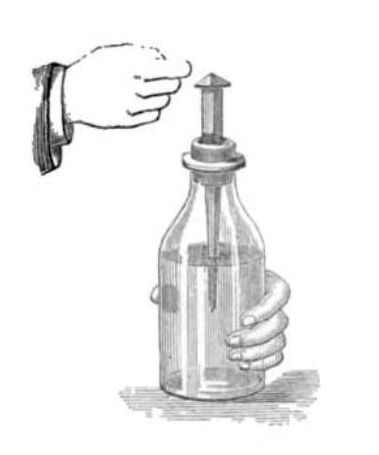
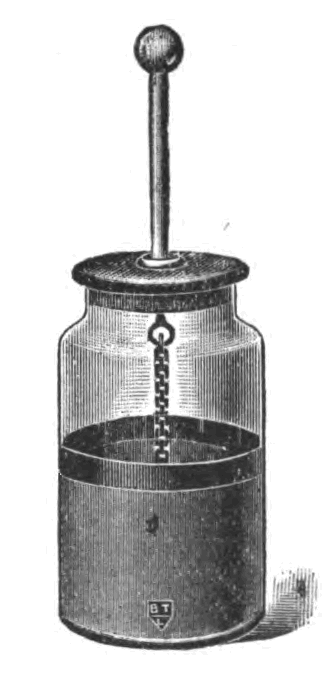


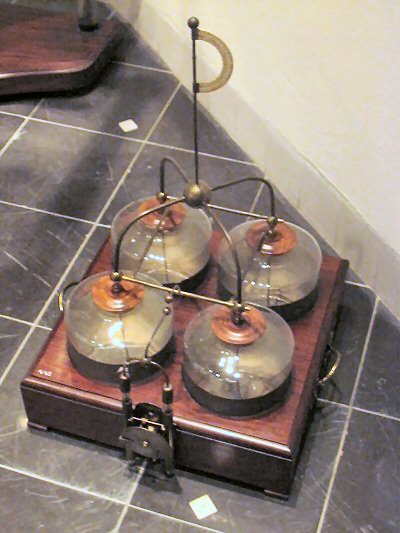

Construction and common variations
A typical Leyden jar uses a glass bottle or jar as the insulating dielectric. Conductive coatings or foils line the inner and outer surfaces. An inner conductor may be a metal rod, chain, or foil that reaches toward the interior, sometimes contacting a small amount of water used in early examples. The outer conductor commonly covers much of the external surface and is either grounded or held by the experimenter. A top terminal provides a convenient connection for charging and discharging.
Variations in size, shape and materials were explored historically: jars ranged from small medicine bottles to large, flaring vessels; conductors were leather, metal foil or plates; and insulators included different glass types. Experimenters also combined multiple jars in series or parallel to alter the overall storage capacity.
Physical principles
Functionally a Leyden jar is two conductors separated by an insulating layer. When charge is deposited on the inner conductor, an opposite charge is induced on the outer conductor. The glass prevents charge from equalizing directly, permitting a voltage difference to be maintained. The amount of charge stored for a given voltage depends on geometry and the insulating material; these dependencies are expressed in the modern concept of capacitance.
Although the glass itself has limited ability to store charge compared with modern dielectric materials, its presence increases the potential difference the device can sustain before breakdown. The phenomenon that allowed large amounts of charge to accumulate was not fully understood at first, but later experiments and analysis clarified that the conductors and the insulating layer together determine the stored energy and the discharge behavior.
Charging and discharge behavior
Charging is usually accomplished by bringing an externally generated electrostatic source into contact with the inner conductor while the outer conductor is connected to ground or held by a person. The jar can retain the separated charges until a conducting path connects inner and outer surfaces. When that path is made, the stored charge flows rapidly and a spark can be observed. The spark and accompanying shock provided dramatic evidence of stored electrical energy and were used in demonstrations and research.
In practice, jars could be combined to increase the total stored energy or to produce longer sparks. Experimenters learned to control discharge by using resistive paths or controlled gaps to reduce instantaneous current and make measurements more reproducible.
Historical development and key figures
The first device of this type was developed in the mid‑18th century. Ewald Georg von Kleist discovered that a charged glass vessel connected to a conductor could produce a powerful shock. Independently, Pieter van Musschenbroek at Leiden University investigated similar devices and publicized the results; the name "Leyden jar" reflects the role of Leiden in disseminating the invention. News of the jar spread quickly and many natural philosophers—then the term for scientists—used it to investigate electrostatic phenomena. Prominent experimenters of the period demonstrated charge storage, sparks, and interactions of charged bodies in studies that advanced the developing science of electricity.
Scientific and educational significance
The Leyden jar contributed to several advances: it made it possible to store and accumulate charge for experiments, it provided a means to study discharge and electrical conduction through various media, and it prompted theoretical work that led to the formal definition of capacitance and improved electrostatic theory. As a hands‑on apparatus it remains a valuable teaching device for illustrating how capacitors work, the role of dielectrics, and safe procedures for handling stored charge.
Differences from modern capacitors and practical considerations
Compared with modern capacitors, Leyden jars generally have lower capacitance for a given size, higher leakage, and less predictable breakdown behavior. Modern capacitor designs employ engineered dielectrics, compact geometries and controlled manufacturing to deliver specified capacitance, voltage ratings and reliability. Nevertheless, Leyden jars can reach relatively high voltages and were effective for producing visible sparks despite modest stored energy.
Constructing or using historical‑style jars for demonstration requires care. It is recommended to use insulating stands, to discharge jars through a resistor before handling, and to avoid direct contact with charged terminals. Safety practices help prevent accidental shocks and equipment damage during demonstrations.
Legacy and modern demonstrations
The Leyden jar is primarily of historical and pedagogical interest today. Museums and educational laboratories recreate jars or use modern capacitor substitutes to show the same principles. The device remains a clear illustration of how experimental apparatus can shape scientific discovery and public engagement with emerging technologies.
Further reading
- Introduction to the Leyden jar and electrostatics
- Technical description of charge storage
- How condensers and early capacitors evolved
- Modern capacitor concepts related to the Leyden jar
- Biographical note on Ewald Georg von Kleist
- Context about Pomerania and 18th‑century geography
- Correspondence and dissemination to European scientists
- Transition from electrostatic jars to batteries and generators
Questions and answers
Q: What is a Leyden jar?
A: A Leyden jar (or Leiden jar) is a device for storing static electricity. It is a large glass bottle, usually lined on both the inside and the outside with some type of metal foil. Some of the early ones had water inside, allowing experimenters to collect a large amount of charge. They are considered to be the first form of electrical storage.
Q: Who invented the first electrical storage jar?
A: The first electrical storage jar was created by Ewald Georg von Kleist on 11 October 1745. He was the dean of the cathedral of Cammin in Pomerania, on the north coast of Germany at that time.
Q: How did von Kleist create his invention?
A: Von Kleist used a small experimental friction generator and thought he might be able to capture and hold a small amount of static electricity in a bottle because he knew that electricity could not pass through glass. He underestimated how much electricity it could actually hold by thousands of times.
Q: What peculiarity allows electricity to continue flowing into the Leyden Jar?
A: A peculiarity of electricity allows it to continue flowing into the bottle provided that there is an electrically conductive surface connected to the earth which neutralises any pressure from charge trying to flow back out. In von Kleist's case, this electrically conductive surface was just his hand but it was enough for him to receive such an electric shock when he accidentally touched a nail driven through its cork that it threw him across the room.
Q: Who gave this invention its name "Leyden Jar"?
A: Pieter van Musschenbroek, who was then University of Leyden's main physics professor, worked out that its storage capacity was vastly improved only if held in one's hand and sent letters about this discovery to scientists in France which gave rise to its name "Leyden Jar".
Q: For how long did this invention remain as main tool for electrical storage?
A: The Leyden Jar remained as main tool for electrical storage until chemical batteries and modern day generators were invented many years later.
Related articles
Author
AlegsaOnline.com Leyden jar — early glass capacitor for storing static electricity Leandro Alegsa
URL: https://en.alegsaonline.com/art/57633
Sources
- web.archive.org : Biography, Pieter (Petrus) van Musschenbroek