
Letters patent: definition, history, and modern uses
Letters patent are public legal instruments that grant offices, rights, titles or monopolies; historically issued by sovereigns, they evolved into modern patents and remain used for honors, corporations and official appointments.
Overview
Letters patent are formal written instruments issued in the name of a sovereign or state to confer a right, title, office, privilege or status on a person or body. By design they are open documents intended for public inspection rather than private correspondence, so their contents are not sealed and are meant to give notice to all. Traditionally they were promulgated by a monarch or by a government authority and have been used across jurisdictions with roots in medieval and early modern governance.
Image gallery
3 Images

Form and principal features
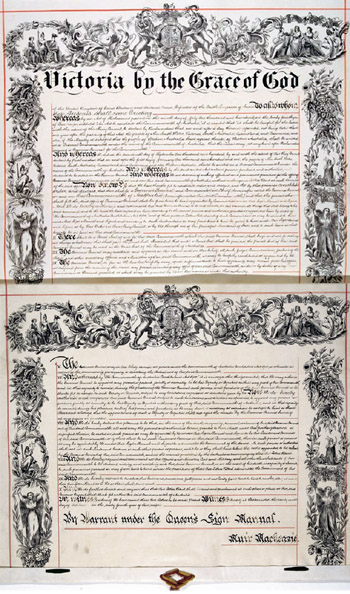
Typical letters patent include a heading identifying the issuing authority, a recital of facts or reasons, the grant or command itself, and concluding formalities such as date, signature and seal. They are drafted in a way that specifies the precise rights granted (for example a monopoly or a title), the persons who will take effect under the grant, and any conditions or limitations. Because they are public, letters patent serve both to create a legal entitlement and to give notice enabling others to know the legal landscape, for example to avoid infringing an exclusive right such as a monopoly.
Historical development
The practice emerged from the prerogatives of medieval rulers who issued open grants as a means of administering justice, rewarding service, creating corporations and regulating commerce. Over centuries the instrument diversified: city charters, grants of arms, patents for inventions and the creation of corporate entities all used this open form. The evolution of commercial and intellectual property systems transformed one branch of the instrument into the modern statutory patent, while other branches retained a more ceremonial or administrative role.
Common uses and examples
- Granting offices and commissions: appointing officials, diplomats or colonial administrators and naming representatives of the Crown, such as Governors or Governors-General in some constitutional systems.
- Creating and regulating corporations or bodies corporate, including charters that define corporate powers and privileges, often referenced in accounts of early commercial enterprises and guilds (corporation).
- Granting civic status and honours: conferring city status, peerages or coats of arms (coat of arms), titles still issued in certain monarchies and realms like the United Kingdom.
- Intellectual property: the historical form of letters patent gave rise to statutory inventions protection that grants exclusive rights over an invention to its patentee.
Legal distinctions and modern relevance
Letters patent are distinct from letters close, which are sealed and meant only for the addressee; the open character of letters patent is central to their legal effect. In many contemporary legal systems the instrument survives in specific functions—honours, land grants, commissions and the formal creation of some public offices—while statutory schemes now govern industrial patents and other regulated privileges. The continuing value of letters patent lies in their clarity, durability and role as public records.
Notable facts and practical considerations
Because letters patent create public rights, they can sometimes be challenged, interpreted by courts, or subject to statutory limitation or revocation. Their drafting traditionally uses formal language and precise boundaries to reduce ambiguity. The same open-record principle that justified early royal patents underpins modern patent law: disclosure in exchange for a time-limited exclusive right, allowing others to learn from the grant. Readers interested in governmental, historical or intellectual-property aspects may consult primary sources or specialised commentary for jurisdiction-specific rules.
Questions and answers
Q: What are letters patent?
A: Letters patent are a type of legal instrument in the form of a published written order issued by a monarch or government. They are generally used for granting an office, right, monopoly, title, or status to a person or corporation.
Q: What can letters patent be used for?
A: Letters patent can be used for the creation of corporations or government offices. They may also be used for the granting of city status or a coat of arms. Additionally, they can be issued for the appointment of representatives of the Crown such as Governors and Governors-General of Commonwealth realms and for creating peers of the realm in the United Kingdom.
Q: How do modern patents differ from letters patent?
A: Modern patents (referred to as utility patents or design patents in US law) grant exclusive rights to an invention (or design in case of design patents). In this case it is essential that the written grant should take form as a public document so other inventors can consult it to avoid infringement and understand how to "practice" the invention or put it into practical use.
Q: What is opposite to letters patent?
A: The opposite to letters patent are letters close which are personal in nature and sealed so that only the recipient can read their contents.
Q: Who is addressed when issuing letters patent?
A: Letters Patent are addressed to a wide audience.
Q: Are there any special requirements when using modern patents?
A: Yes, when using modern patents it is essential that the written grant should take form as a public document so other inventors can consult it to avoid infringement and understand how to "practice" the invention or put it into practical use.
Related articles
Author
AlegsaOnline.com Letters patent: definition, history, and modern uses Leandro Alegsa
URL: https://en.alegsaonline.com/art/57516
Sources
- oxforddictionaries.com : "letters patent"
- legal-dictionary.thefreedictionary.com : "Letters Patent"
- investopedia.com : "Letters Patent"