
Let's Make It Legal (1951 film)
A 1951 American romantic comedy directed by Richard Sale, based on Mortimer Braus's story, featuring Claudette Colbert and early appearances by Marilyn Monroe and Robert Wagner.
Let's Make It Legal is a 1951 American romantic comedy released by 20th Century Fox. Directed by Richard Sale and adapted from Mortimer Braus's story "My Mother-in-Law, Miriam," the picture belongs to the postwar tradition of light, star‑driven comedies that blend domestic misunderstandings with romantic reconciliation. It reflects studio-era production values and casting practices of the early 1950s, pairing an established leading lady with younger supporting players.
Image gallery
1 Image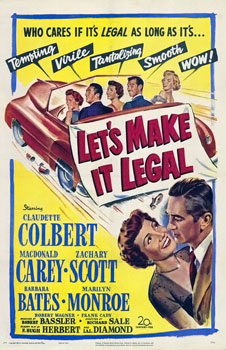
Overview
The film centers on marital tensions and the humorous complications that arise when former spouses, relatives and new romantic interests collide. Rather than high-concept satire, its appeal rests on performances, comic timing and situational set pieces typical of Hollywood's romantic comedies of the period. Richard Sale, known for his work as a writer as well as a director, guided the material toward a light, urbane tone.
Cast and performances
- Claudette Colbert – the established star whose screen persona anchors the film.
- Macdonald Carey – a leading man of the era who plays opposite Colbert.
- Zachary Scott – often cast in suave or conflicted roles, contributing a dramatic edge to the comedy.
- Barbara Bates – in a supporting role typical of studio ensembles at the time.
- Marilyn Monroe – appears in a small supporting part early in her career, before she became a major star.
- Robert Wagner – another young actor who went on to greater fame; his presence illustrates Fox's cultivation of new talent.
Production and background
The screenplay was adapted from Mortimer Braus's story, and the production reflects 20th Century Fox's midcentury approach to light comedy—tight shooting schedules, emphasis on star images, and polished art direction. Richard Sale brought experience as a novelist and screenwriter, shaping the dialogue and pacing to suit both Colbert's comic strengths and the ensemble cast.
Reception and legacy
At the time of release the film was received as a pleasant, if not groundbreaking, entry in the romantic comedy genre. Today it is often noted for its cast lineup: a veteran star working alongside performers who would later achieve greater prominence. Film historians sometimes cite it as an example of studio-era genre filmmaking and as an early screen credit for performers who became icons during the 1950s and beyond.
For viewers interested in classic Hollywood comedies, the film offers a window into postwar studio practice and the era's comic treatment of marriage, divorce and flirtation. More information can be found through studio catalogs and film reference works that document 20th Century Fox releases of the period.
Questions and answers
Q: Who directed the movie Let's Make It Legal?
A: Richard Sale directed the movie Let's Make It Legal.
Q: What is the genre of the movie Let's Make It Legal?
A: Let's Make It Legal is a romantic comedy movie.
Q: Who are the actors and actresses that starred in Let's Make It Legal?
A: Claudette Colbert, Macdonald Carey, Zachary Scott, Barbara Bates, Marilyn Monroe, and Robert Wagner starred in Let's Make It Legal.
Q: Which studio distributed Let's Make It Legal?
A: 20th Century Fox distributed Let's Make It Legal.
Q: What is the source material for Let's Make It Legal?
A: Let's Make It Legal is based on the story My Mother-in-Law, Miriam by Mortimer Braus.
Q: When was Let's Make It Legal released?
A: Let's Make It Legal was released in 1951.
Q: Which character did Marilyn Monroe play in Let's Make It Legal?
A: The specific character Marilyn Monroe played in Let's Make It Legal is not mentioned in the given text.
Related articles
Author
AlegsaOnline.com Let's Make It Legal (1951 film) Leandro Alegsa
URL: https://en.alegsaonline.com/art/57502