
Armistice and Preliminaries of Villafranca (11 July 1859)
Agreement signed at Villafranca di Verona on 11 July 1859 between France and Austria that ended the Austro–Franco–Sardinian War and shaped the next steps toward Italian unification.
Overview
The Armistice and Preliminaries of Villafranca were signed on 11 July 1859 in Villafranca di Verona. They brought a sudden halt to active hostilities between the French Empire and the Austrian Empire in northern Italy at the close of the Austro–Franco–Sardinian War, often called the Second Italian War of Independence. The agreement was negotiated between representatives of France and Austria and produced diplomatic outcomes that reshaped the map of northern Italy while leaving several political questions unresolved.
Image gallery
9 Images


Military and diplomatic context
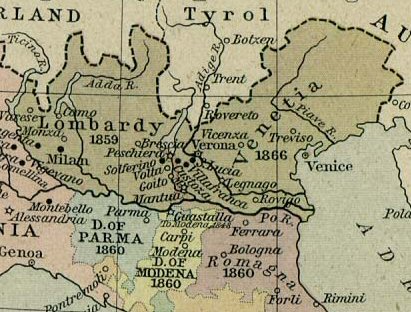
In the campaign of 1859 Franco‑Sardinian forces scored important victories at Magenta (4 June) and Solferino (24 June). The battle of Solferino in particular produced exceptionally heavy casualties on both sides and shocked public opinion in Europe. Faced with the human cost, the prospect of prolonged campaigning against fortified Austrian positions in the so‑called "quadrilateral," and rising domestic and international political pressures, Napoleon III opened negotiations for an armistice. A meeting between the French emperor and the Austrian emperor led to the preliminary agreement at Villafranca.
Principal terms
The armistice and its preliminaries set out several key arrangements. These can be summarized as follows:
- Austria agreed to transfer control of much of Lombardy to the French administration, which in turn would cede it to the Kingdom of Piedmont‑Sardinia. This transfer excluded certain fortresses such as Mantua and Peschiera.
- The creation of a proposed federal arrangement for the Italian states was envisaged, with a confederation nominally presided over by the Pope; the Veneto region, however, would remain under Austrian sovereignty.
- Several deposed Italian rulers — notably the dukes of Modena, Parma and Tuscany — were to be restored to their thrones, reversing revolutionary gains made earlier in 1859.
Political reactions and immediate aftermath
The way the armistice was negotiated provoked strong domestic reactions in Italy. Camillo di Cavour, the prime minister of Piedmont‑Sardinia, was not consulted about the ceasefire or its terms; he resigned in protest. King Victor Emmanuel II gave a qualified acceptance but insisted it was in a personal capacity, preserving room for later diplomatic action. The preliminaries signed at Villafranca were later formalized by the Treaty of Zurich on 11 November 1859.
Significance and legacy
Although the Villafranca arrangements ended active large‑scale combat and delivered Lombardy to Piedmont‑Sardinia, they did not complete Italian unification. Venice and the Veneto remained under Austrian control until 1866, and the status of the Papal States and Rome remained central unresolved issues. Nonetheless, the armistice accelerated the consolidation of northern Italy under Piedmontese leadership and set in motion a sequence of diplomatic and military events that culminated in the unification of Italy in the 1860s.
Related topics and further reading
For complementary information see resources on the armistice itself, the Lombardy question, the strategic importance of the Veneto, and the role of fortified places such as Mantua. Broader studies of mid‑19th century European diplomacy and military history place Villafranca in the context of Franco‑Austrian rivalry and the Italian movement for national unity.
Questions and answers
Q: What was the name of the treaty that put an end to the Austro-Franco-Sardinian War?
A: The armistice and preliminaries of Villafranca were signed on 11 July 1859 in Villafranca di Verona, in the Veneto.
Q: Who signed the armistice and preliminaries of Villafranca?
A: The armistice and preliminaries of Villafranca were signed by France and Austria.
Q: When did Napoleon III propose the armistice?
A: Napoleon III proposed the armistice on 8 July.
Q: How many people were killed or wounded at Solferino?
A: Nearly 40,000 people were killed or wounded at Solferino.
Q: Why was Napoleon III frightened by the hecatomb at Solferino?
A: Napoleon III was frightened by the hecatomb (nearly 40,000 killed or wounded at Solferino) and the idea of having to continue an autumn and winter campaign against the Austrians entrenched in the quadrilateral.
Q: What territories did Austria cede to France according to this agreement?
A: According to this agreement, Austria ceded Lombardy (except Mantua and Peschiera) to France which restored it to Piedmont-Sardinia.
Q: What other agreements were confirmed by this treaty?
A: This treaty also confirmed an Italian confederation under Pope Pius IX's presidency with Veneto under Austrian sovereignty being part of it as well as restoring thrones for dukes of Modena, Parma, and Tuscany who had been driven away by revolutions. These agreements were further confirmed by Treaty of Zurich on 11 November 1859.
Related articles
Author
AlegsaOnline.com Armistice and Preliminaries of Villafranca (11 July 1859) Leandro Alegsa
URL: https://en.alegsaonline.com/art/5737