
Lenz's Law: Electromagnetic induction and opposition to changing magnetic flux
Lenz's law states that an induced electromotive force produces a current whose magnetic field opposes the change in magnetic flux. It gives the negative sign in Faraday's law and enforces energy conservation.
Overview
Lenz's law is a qualitative rule used to determine the direction of an induced current when the magnetic flux through a closed loop changes. Named after the Russian physicist Emil Lenz, the rule explains why an induced electromotive force (emf) always acts to oppose the change in magnetic flux that created it. In practice this opposition ensures consistency with the conservation of energy and prevents self-amplifying effects that would otherwise lead to instability or free energy. For a concise statement see conservation of energy and historical notes at Emil Lenz.
Image gallery
2 Images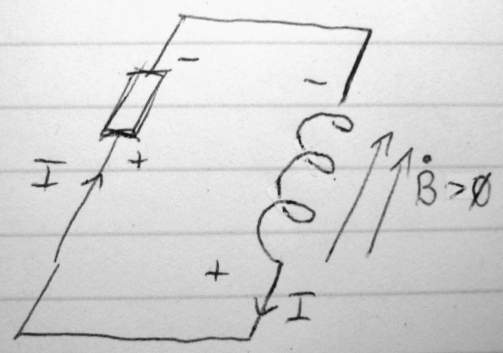

Mathematical form and interpretation
The rule is most commonly presented together with Faraday's law of induction. In integral form Faraday's law states that the induced emf around a closed loop equals the negative time rate of change of the magnetic flux through any surface bounded by that loop. The negative sign is Lenz's contribution: E = − dΦ_B/dt. That minus sign identifies the direction of the induced emf relative to the change in flux but does not give its magnitude, which follows from the full expression of Faraday's law and the circuit properties (resistance, inductance). For more formal treatments and derivations see standard electrodynamics texts or the entry at Faraday's law. The induced quantity itself is conventionally called the induced emf or induced voltage; references often label it as induced emf.
How it works physically
Lenz's law can be understood as the electromagnetic system producing a response that reduces the imposed change. If the external magnetic field through a loop increases in a particular direction, the induced current creates its own magnetic field that points in the opposite direction to reduce net flux. Conversely, if the external flux decreases, the induced field attempts to increase it. The direction of the induced magnetic field produced by a current may be determined using the right-hand rule; practical descriptions rely on such rules for orientation and on the Biot–Savart law for field calculations—see right-hand rule and general discussions of the magnetic field of a current.
Common examples and demonstrations
- Dropping a strong magnet through a conductive, non-magnetic tube (copper or aluminum) produces eddy currents in the tube walls that oppose the magnet's motion; the magnet falls more slowly than through air.
- Bringing a bar magnet toward a coil induces an emf and current whose polarity opposes the approaching pole; moving the magnet away reverses the induced current.
- When current is switched on in a coil connected to a battery, the coil's self-induced emf (back emf) opposes the increase; when the current is switched off, the induced emf tries to keep the current flowing, which can cause sparks at a switch.
- Eddy current braking and magnetic damping devices exploit the law to convert kinetic energy into heat in conductors for controlled deceleration.
Applications and practical importance
Lenz's law underlies operation and safety features of many electrical devices. Inductors and transformers rely on controlled flux changes and the predictable opposing emf for energy transfer and impedance. Engineering practices use the back emf in motor design to limit current and provide speed-dependent feedback. Eddy currents are both a useful effect (in braking, induction heating, metal detection) and a loss mechanism that designers reduce with laminations or slots in magnetic cores. In protection circuits, diodes and snubbers manage the large voltages produced when current through inductance is interrupted.
History, broader context and analogy
The behaviour summarized by Lenz's law was recognized in the 19th century during early experiments with electromagnetic induction and later formalized alongside Faraday's quantitative findings. Conceptually it connects with the general idea that physical systems resist changes in an established state; a somewhat looser analogy is found in Le Chatelier's principle for chemical equilibria, which states that a system in equilibrium will respond to counteract a disturbance—see equilibrium and Le Chatelier's principle. In classical electromagnetism Lenz's law emerges from Maxwell's equations together with energy conservation and is built into the negative sign of Faraday's law rather than standing as an independent law.
Limitations and related notes
Lenz's law determines only direction, not magnitude, of induced currents. In non-ideal materials and complex geometries the actual induced current distribution (eddy currents) can be intricate and requires numerical methods to predict accurately. The law applies within classical electromagnetic theory; in microscopic quantum descriptions of conductivity and magnetism the same opposition is manifested through the dynamics of charges and fields, but detailed mechanisms involve material-specific behaviour. Finally, while Lenz's law is a reliable rule of thumb for determining signs and directions, rigorous problems call for applying Faraday's law, the Lorentz force, and circuit analysis together.
Questions and answers
Q: What is Lenz's law?
A: Lenz's law states that an induced electromotive force (emf) always gives rise to a current whose magnetic field opposes the change in original magnetic flux.
Q: How is Lenz's law shown in Faraday's law of induction?
A: In Faraday's law of induction, Lenz's law is shown with the negative sign, indicating that the induced emf and the change in magnetic flux have opposite signs.
Q: What direction does the induced current flow when B' is directed out from the page and the area of the circuit is decreasing?
A: The induced current flows counterclockwise when B' is directed out from the page and the area of the circuit is decreasing.
Q: What does nature try to do through this induced field?
A: Nature tries to compensate for a reduction in flux due to an applied field by creating an outward-directed magnetic field within a circuit due to an induced current.
Q: What happens when a battery is suddenly connected to a coil of wire?
A: When a battery is suddenly connected to a coil of wire, it starts a current flowing clockwise as viewed by an observer. This will give rise to an induced emf which will be counterclockwise according to Lenz's Law, opposing any increase in current caused by connecting it.
Q: What effect does self-inductance have on circuits with changing currents?
A: Self-inductance causes an increase in current within a coil to result in an emf which opposes this increase, thus preventing unstable situations where energy conservation would be violated.
Q:What principle can be extended from Lenz’s Law?
A:Lenz’s Law can be extended into Le Chatelier’s Principle which states that when equilibrium in a system has been disturbed, equilibrium will be displaced so as undo any effects caused by this disturbance.
Related articles
Author
AlegsaOnline.com Lenz's Law: Electromagnetic induction and opposition to changing magnetic flux Leandro Alegsa
URL: https://en.alegsaonline.com/art/57174
Sources
- books.google.com : Electromagnetics explained