
Leaves of Grass
A revised and expanded overview of Walt Whitman’s landmark poetry collection, its composition, major themes, publication history, and lasting influence on American literature.
Overview
Leaves of Grass is a landmark collection of poetry by the American writer Walt Whitman (1819–1892). First self‑published in 1855, the book introduced a new, expansive voice in English verse and presented a democratic, sensual celebration of the individual and the body. Whitman continued to revise, enlarge, and reorder the work throughout his life, treating the volume more as a living manuscript than a static book.
Image gallery
6 Images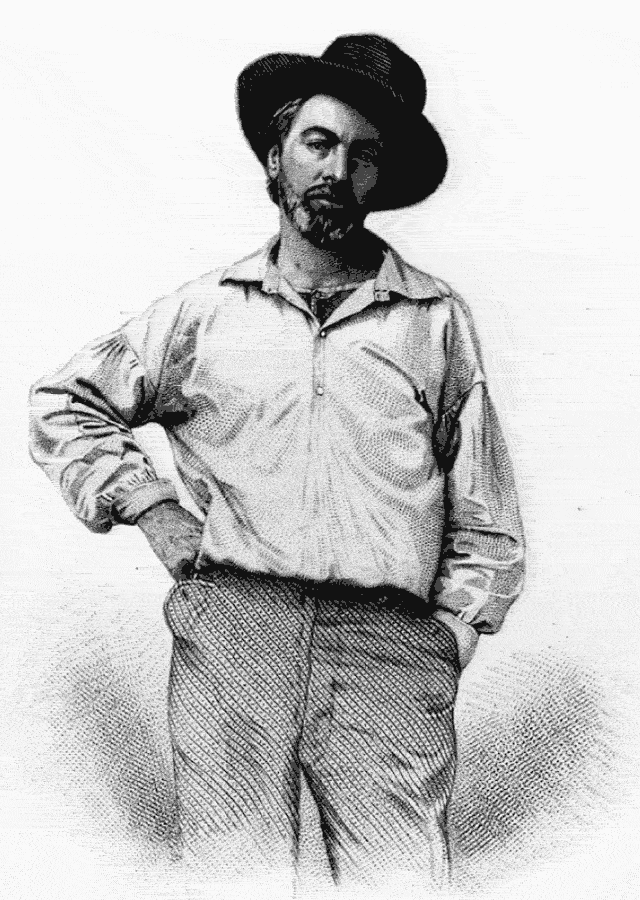


Composition and publication history
The initial edition appeared on July 4, 1855, printed in Brooklyn in a small run Whitman financed himself. That first book was brief by later standards, comprising around twelve poems across roughly ninety‑five pages. Over subsequent decades Whitman released a series of increasingly large editions, often retitling sections and adding substantial new material, culminating in a near‑final version compiled in the 1890s. The process of continual revision is one of the work's defining features.
Form and major themes
Leaves of Grass broke with many conventions of nineteenth‑century English poetry. Whitman favored a free, cadenced line rather than strict meter and rhyme, a practice now associated with modern free verse. The collection emphasizes themes such as democracy, the sanctity of the individual, the human body, nature, sexuality, death, and identity. It often links personal experience with broader social and national concerns, presenting intimacy and the public sphere as mutually reinforcing.
Notable poems and structure
Several long pieces within Leaves of Grass became especially influential and are frequently studied on their own. Among the best known are:
- Song of Myself
- I Sing the Body Electric
- Out of the Cradle Endlessly Rocking
- When Lilacs Last in the Dooryard Bloom'd
These and other sections range from intimate, meditative passages to public, rhetorical addresses. Whitman interspersed shorter lyrics and prose‑like lyrical sequences to vary tone and tempo throughout the collection.
Reception, controversy, and influence
At its first appearance the book sold slowly and provoked mixed reactions. Some critics and readers admired Whitman’s confidence and freshness, while others objected to frank treatments of the body and sexuality; the work at times faced moral censure. Despite early controversy, Leaves of Grass grew in stature and became a foundational text for American poetry, influencing generations of poets, modernist experiments in form, and discussions about national identity and literary freedom.
Legacy and distinctions
Leaves of Grass is notable both as a single work and as a continuing project across Whitman’s life. Its restless revisionary history, its revolutionary use of open verse, and its insistence on a poetry of inclusive, bodily experience distinguish it in the Western canon. For readers and scholars it remains a rich source for study of form, voice, and the interplay between private sentiment and public culture.
Questions and answers
Q: Who wrote Leaves of Grass?
A: American writer Walt Whitman (1819-1892) wrote Leaves of Grass.
Q: When was the collection first printed?
A: The collection was first printed on July 4, 1855 in Brooklyn at a Fulton Street printing shop.
Q: How many copies were printed for the first edition?
A: About 800 copies were printed for the first edition.
Q: How long was the book?
A: The book was 95 pages long and had 12 poems.
Q: Who paid for the first printing of Leaves of Grass?
A: Whitman paid for this first printing.
Q: What are some famous poems from Leaves of Grass?
A: Some famous poems from Leaves of Grass are "Song of Myself", "I Sing the Body Electric", "Out of the Cradle Endlessly Rocking", and "When Lilacs Last in the Dooryard Bloom'd".
Q: What themes did Whitman explore in his poetry collection?
A: In his poetry collection, Whitman praised the human body, material world, nature, and experience of senses at a time when poetry focused on religious experience and life of spirit.
Related articles
Author
AlegsaOnline.com Leaves of Grass Leandro Alegsa
URL: https://en.alegsaonline.com/art/56819
Sources
- wdl.org : "Leaves of Grass"