
Leaf insect (Phylliidae): true leaf mimics — appearance, life cycle, and distribution
Leaf insects (family Phylliidae) are remarkable leaf mimics found from South Asia through Southeast Asia to Australia. This article explains their form, behavior, ecology, and taxonomic issues.
Leaf insects are insects in the family Phylliidae often called true leaf insects or walking leaves. They are among the most convincing examples of morphological mimicry in animals: their bodies, legs and even venation-like patterns imitate leaves so closely that they can be overlooked by both predators and observers. For general background on mimicry and camouflage see leaf mimicry.
Image gallery
10 Images

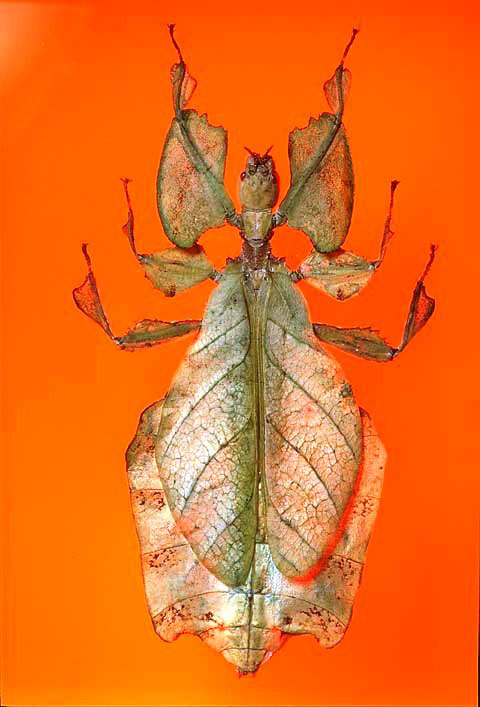


Appearance and distinguishing features
Phylliids have a flattened, broad body plan that resembles a foliage blade. Key features include lobed legs that continue the leaf outline, edges that may be serrated or undulated, and surface textures or color patterns that suggest veins, spots of decay, or bite marks. Sexual dimorphism is common: females tend to be larger, heavier-bodied and often have reduced or non-functional wings, whereas males are usually slimmer and more likely to have fully developed wings for flight. These morphological traits are adaptations to avoid detection rather than to mimic a single plant species.
Life cycle and behavior
Leaf insects undergo incomplete metamorphosis: eggs hatch into nymphs that resemble miniature adults and grow through successive molts. Nymphs often adopt swaying motions that mimic a leaf moved by a breeze. Most species are herbivorous, feeding at night on the leaves of broadleaf plants. In some groups, females or entire populations can reproduce without males (parthenogenesis), a trait that has been documented in captive and wild populations but varies by species and locality. Activity patterns, defense behaviors and host plant preferences are still subjects of study.
Distribution, systematics and history
True leaf insects occur from South Asia through Southeast Asia to Australia, occupying tropical and subtropical forests where leafy vegetation provides both food and concealment. The family Phylliidae is placed within the order Phasmatodea (stick and leaf insects), but its internal taxonomy has been revised repeatedly; different authors recognize varying numbers of genera and species and debate relationships among lineages. For discussions of taxonomic treatments and revisions see taxonomic treatments.
Ecology, human interactions and conservation
Ecologically, leaf insects are primary consumers that can influence plant foliage dynamics at a small scale and serve as prey for birds, reptiles and other predators when detected. They are also of interest to hobbyists and educators because of their striking appearance and relative ease of captive care; some species are commonly kept in insect collections. Threats include habitat loss, fragmentation and collecting pressure in parts of their range. Conservation attention varies by country and specific species; field surveys and habitat protection are important for poorly known taxa.
Notable distinctions and facts
- Although other insects such as certain katydids can resemble leaves, true leaf insects belong to Phasmatodea and are more specialized in body-wide leaf mimicry.
- Camouflage involves not only shape and color but also behavior: slow movement, swaying and posture enhance the illusion of a leaf in the wind.
- Because many species are cryptic and resemble each other, reliable identification often requires close morphological study or expert consultation; online and printed guides can help, including hobbyist resources and scientific keys (mimicry resources).
Questions and answers
Q: What family does the leaf insect belong to?
A: The leaf insect belongs to the family Phylliidae.
Q: What are the living true leaf insects also known as?
A: The living true leaf insects are also known as walking leaves.
Q: What is the leaf insect’s mimicry capability?
A: The leaf insect has remarkable leaf mimicry capability, which makes them some of the most remarkable leaf mimics in the entire animal kingdom.
Q: Where do leaf insects occur around the world?
A: Leaf insects occur from South Asia through Southeast Asia to Australia.
Q: What is the taxonomy of leaf insects?
A: There are different views about the taxonomy of leaf insects.
Q: What is the common misspelling of the Phylliidae family?
A: The common misspelling of the Phylliidae family is 'Phyllidae'.
Q: What is the significance of the Phylliidae family in the animal kingdom?
A: The Phylliidae family, which includes the leaf insect or walking leaf, is significant in the animal kingdom due to their remarkable leaf mimicry capability.
Related articles
Author
AlegsaOnline.com Leaf insect (Phylliidae): true leaf mimics — appearance, life cycle, and distribution Leandro Alegsa
URL: https://en.alegsaonline.com/art/56764
Sources
- biodiversitylibrary.org : "The taxonomic arrangement of the Phasmatodea with keys to the subfamilies and tribes"