
Leaf beetle (family Chrysomelidae): overview, identification, and importance
Leaf beetles (Chrysomelidae) are a large, diverse family of plant-feeding beetles. Many species are agricultural pests while others are used in biological control; they display varied forms and close ties to flowering plants.
Overview
Leaf beetles belong to the family Chrysomelidae, one of the largest beetle families. There are over 35,000 described species placed in more than 2,500 genera, with highest diversity in tropical regions but a worldwide distribution. Their evolutionary history is closely tied to flowering plants, and the family includes a wide range of forms adapted to feeding on leaves, stems, roots, flowers and seeds.
Image gallery
10 Images


Identification and morphology
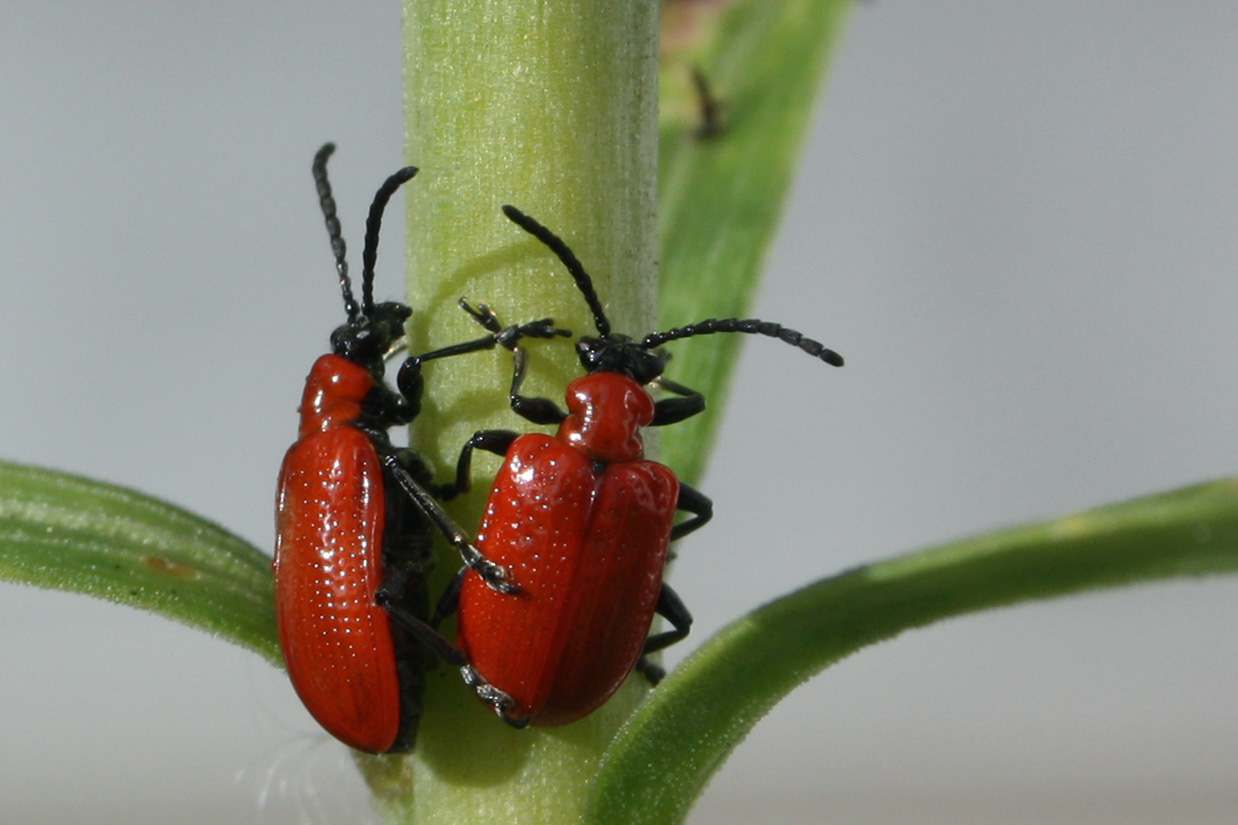
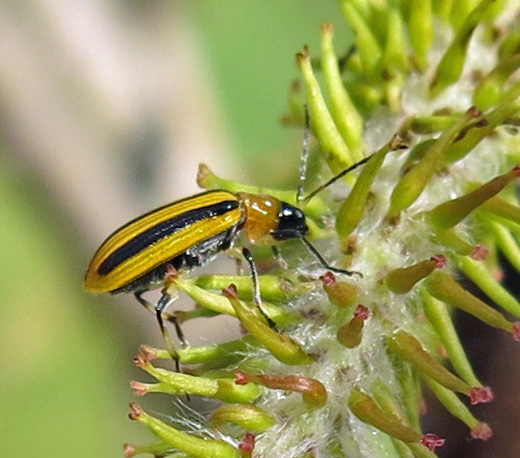
Adults are typically compact and often brightly coloured or metallic. A characteristic feature is the apparent tarsal formula of 4-4-4 (pseudotetramerous), which conceals a small fourth segment so the true formula is 5-5-5; this can be important in identification and is discussed in technical treatments of the tarsal formula. Some leaf beetles resemble long-horned beetles (Cerambycidae); one diagnostic difference is where the antennae arise on the head and the general antennal structure.
Life cycle and behaviour
Chrysomelids undergo complete metamorphosis: egg, larva, pupa and adult. Eggs are commonly laid on or near host plants, and larvae may feed externally on foliage, bore into stems or roots, or live in close association with particular plant parts. Many species have one or more generations per year, depending on climate and host availability. Behavioural adaptations include aggregation, defensive secretions and, in some taxa, cryptic or aposematic coloration linked to chemical defenses.
Feeding habits and host relationships
Both adult and larval leaf beetles are herbivorous and their host specificity ranges from highly specialized to broadly polyphagous. The family’s diversity has broadly tracked that of angiosperms, and many species feed on economically important crops and ornamentals. For notes on feeding stages and larval morphology see resources on larval descriptions and host records summarized in regional faunas and catalogs (beetle family accounts).
Economic importance
Many chrysomelids are significant agricultural pests. Notable pest species include the Colorado potato beetle, the asparagus beetle and the cereal leaf beetle, plus numerous flea beetles that damage seedlings and foliage. Some species act as vectors of plant pathogens, while others can cause severe defoliation or root damage. Integrated pest management for these beetles emphasizes monitoring, cultural controls, biological control agents and, where necessary, targeted chemical treatments.
Role in biological control and ecosystem services
While several species damage crops, others are valuable for biological control of invasive plants. Selected chrysomelids have been intentionally introduced or conserved as agents of weed suppression; successful use depends on host-specificity testing and post-release monitoring. Leaf beetles also contribute to food webs as prey for predators and parasitoids and participate in nutrient cycling through consumption of plant tissues.
Systematics, subfamilies and notable groups
Chrysomelidae comprises numerous subfamilies, including Chrysomelinae, Galerucinae (which contains many flea beetles), Cryptocephalinae (case-bearing leaf beetles), Cassidinae (tortoise beetles), Criocerinae and Donaciinae among others. Some groups show striking morphological specializations: tortoise beetles have expanded pronota and elytra that conceal the head and legs, while other taxa are elongate or laterally flattened. For genus- and species-level information consult specialist catalogs and regional keys (genus catalogs, species lists).
Fossils and evolution
The fossil record of chrysomelids extends into the Cenozoic and shows the family was already diverse by the time angiosperms were widespread. Molecular and morphological studies have refined relationships within the family, but taxonomic work is ongoing and new species are regularly described, especially from understudied tropical areas. See comparative studies and diversity analyses for more detail (diversity studies).
Practical notes for naturalists and researchers
- Collecting and curation: specimens are commonly collected by beating vegetation, sweep-netting and rearing from host plants; careful retention of host data improves ecological understanding. See regional collecting guides (Chrysomelidae resources).
- Identification resources: identification often requires examination of small structures and comparison with keys and illustrated guides; many museums and online databases maintain reference collections (anatomical guides, family accounts).
- Management: effective pest management uses life-history knowledge, host specificity information and integrated strategies; for pest profiles and extension advice consult agricultural sources (pest profiles, crop impacts).
- Conservation and study: habitat loss and changes in land use affect some native species; taxonomic and ecological research remains important to document diversity and inform conservation decisions (biocontrol case studies).
For further reading, researchers and enthusiasts should consult regional faunal treatments, taxonomic monographs and up-to-date extension literature. General overviews and species lists are useful starting points (tarsal morphology, larval descriptions, diversity analyses, agricultural impact summaries).
Questions and answers
Q: What are leaf beetles?
A: Leaf beetles are a family of beetles known as Chrysomelidae, and there are over 35,000 species in more than 2,500 genera.
Q: How common are leaf beetles?
A: Leaf beetles are one of the largest and most common of all beetle families.
Q: Do leaf beetles have any subfamilies?
A: Yes, there are many subfamilies within the family Chrysomelidae.
Q: What is the tarsal formula of leaf beetles?
A: Leaf beetles have a tarsal formula which appears to be 4-4-4, but is actually 5-5-5.
Q: What do adult and larval leaf beetles feed on?
A: Both adult and larval leaf beetles feed on all sorts of plant tissue.
Q: Are leaf beetles considered pests?
A: Yes, many leaf beetles are considered serious pests of cultivated plants, including the Colorado potato beetle, the asparagus beetle, the cereal leaf beetle, and various flea beetles.
Q: Are leaf beetles popular among insect collectors?
A: Yes, leaf beetles are highly popular among insect collectors, especially those species with glossy yellow to red or metallic blue-green hues and unique shapes such as Cassidinae.
Related articles
Author
AlegsaOnline.com Leaf beetle (family Chrysomelidae): overview, identification, and importance Leandro Alegsa
URL: https://en.alegsaonline.com/art/56761
Sources
- itis.gov : "Chrysomelidae"
- eny3005.ifas.ufl.edu : "Family identification – Chrysomeloidea"