
Laser printer: technology, components, history and uses
A laser printer uses focused light and toner to create images on paper. This article explains how laser printers work, their main parts, history, advantages and drawbacks, and common uses.
Overview
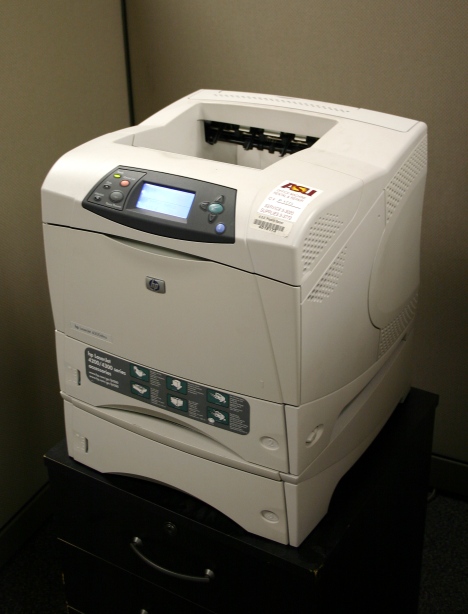
A laser printer is an electrostatic digital printing device used to reproduce text and images on paper with high speed and consistency. It receives data from a computer or network and transfers that information onto sheets of paper using a combination of light and powdered toner. For general context see printer types and the role of computers in modern printing. The light source can be a focused laser beam or arrays of light-emitting diodes; see laser technology for fundamentals.
Image gallery
9 Images



How it works
At a basic level a laser printer creates an electrostatic image on a photosensitive drum, applies toner particles to the charged areas, and then fuses the toner onto paper with heat and pressure. Some models substitute an LED bar for the scanning laser; compare LED printers for that variation. Toner is a fine plastic powder mixed with pigment; its composition and handling are described in summaries about toner. Consumables are supplied in cartridges and often include both toner and separate imaging drums; information about cartridges is available at cartridge resources.
Primary components
- Photoconductor drum — holds the latent electrostatic image.
- Laser or LED unit — writes the image onto the drum.
- Toner cartridge — delivers powdered pigment.
- Corona or charge roller — creates the initial charge on the drum.
- Fuser assembly — melts and bonds toner to paper.
History and development
Research that led to the laser printer began in the late 1960s. An important early phase of development took place at Xerox, and laboratory prototypes appeared before commercial machines. Later in the 1970s and early 1980s manufacturers introduced production models that brought the technology into offices and publishing environments. For corporate origins and milestones see historical notes.
Uses, advantages and limitations
Laser printers are widely used where high-volume, sharp text and rapid throughput are required: office documents, forms, invoices and many types of business printing. Typical advantages include lower cost per page for monochrome output, fast first-page and sustained print rates, and crisp monochrome text. Drawbacks include less-realistic photographic color compared with inkjet systems and potential damage if non-compatible media are used; for example, printing on glossy media intended for inkjet can harm the drum or fuser. Many buyers compare operating costs and output quality with ink cost estimates and direct comparisons to inkjet printers.
Maintenance and environmental notes
Routine care includes replacing toner cartridges, clearing paper jams and occasional cleaning of the drum and fuser. Recycling and remanufacturing programs reduce waste from spent cartridges, and manufacturers provide guidance on safe handling of toner dust. Modern multifunction laser printers also add scanning, copying and network services, making them central devices in many workplaces.
Questions and answers
Q: What is a laser printer?
A: A laser printer is a printer for computers that uses laser or LED-technology to get small particles of toner from a cartridge onto paper.
Q: How does the cost of using a laser printer compare to the cost of using an inkjet printer?
A: Very often, using a laser printer costs less than using the ink of inkjet printers.
Q: Does a laser printer print text or photos more neatly?
A: Laser printers often print text more neatly than inkjet printers.
Q: Can a laser printer print photos clearly?
A: No, laser printers don't print photos as clearly as inkjet printers.
Q: What paper should you avoid printing on with a laser printer?
A: Printing on photo paper or coated paper designed for inkjet printers can damage the laser printer's drum and fuser unit.
Q: Who invented the first laser printer?
A: The first laser printer was invented by a team at Xerox in 1969.
Q: What was the name of the first laser printer?
A: The first laser printer was called the Xerox 2000.
Related articles
Author
AlegsaOnline.com Laser printer: technology, components, history and uses Leandro Alegsa
URL: https://en.alegsaonline.com/art/56130