
Lake Eyre (Kati Thanda–Lake Eyre)
Lake Eyre (Kati Thanda–Lake Eyre) is Australia’s lowest natural point and an intermittent salt lake in northern South Australia that becomes the continent’s largest lake when it fills.
Overview
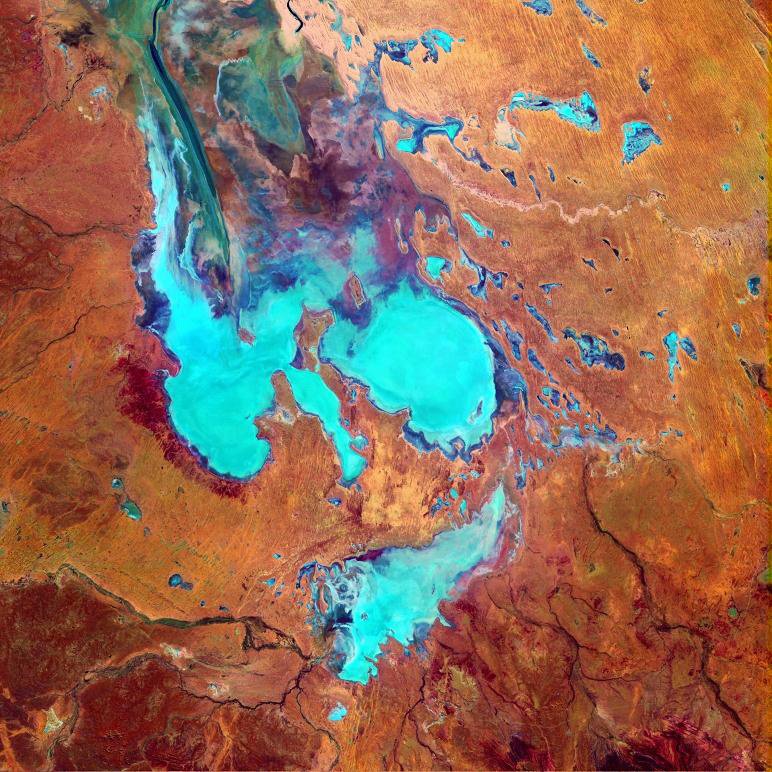
Lake Eyre, also officially known by its dual name Kati Thanda–Lake Eyre, sits at the lowest elevation in Australia and occupies part of the arid interior of northern South Australia. It normally exists as a wide salt pan but can transform into an immense shallow lake after rare heavy rains and floodwater inflows. When inundated it becomes the largest lake on the continent in area, stretching many tens of kilometres in both directions and visibly altering the landscape for months at a time. See the designation of the area as a lowest point here and its status as a largest lake here.
Image gallery
9 Images


Geography and hydrology
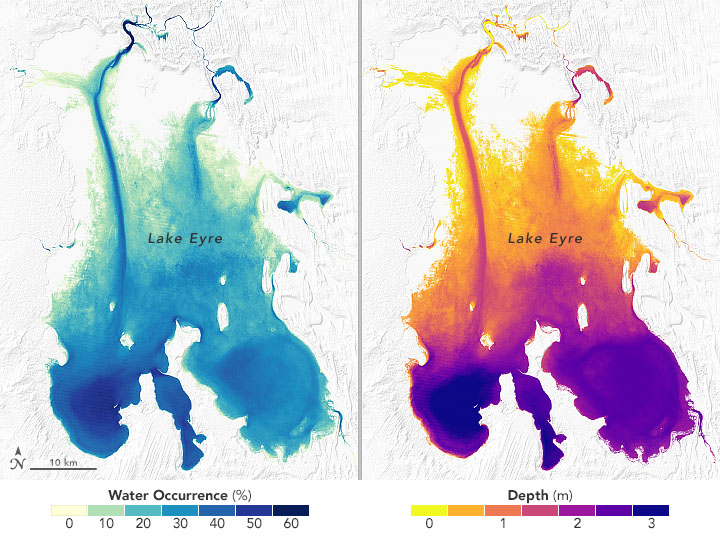
Lake Eyre comprises two main basins, commonly known as North and South Lake Eyre, separated by a narrow neck. The full extent can reach roughly 144 km in length and 77 km in width at high water, figures often quoted in descriptions of the lake dimensions. The region receives very little local rainfall — about 100 mm per year on average — but the lake occasionally fills from rivers that drain an enormous inland catchment far to the north. Annual rainfall reference: 100 mm (see also 4 in for imperial units).
Sources of water and climate
Floodwaters arrive via long, episodic flows down channels such as Cooper Creek and the Diamantina and Georgina systems; these rivers carry runoff from more humid parts of inland Australia into the lake basin. Because evaporation is intense in the arid climate, large fills are temporary and often leave a thick layer of salt and minerals on the playa. The lake lies in the north of South Australia, a long distance from major population centres — roughly 700 km by road from Adelaide Adelaide and within the state of South Australia.
History and cultural significance
The lake was first recorded by Europeans during the explorations of Edward John Eyre in 1840; his name was later given to the feature and surrounding landscape European discovery. Long before European contact, the area was and remains culturally important to Aboriginal peoples, including the Arabana, for whom the name Kati Thanda denotes the salt lake. Indigenous knowledge and place names play an important role in understanding the lake’s history and seasonal rhythms.
Ecology, uses and protection
When Lake Eyre fills it supports spectacular biological events: waterbirds, notably pelicans and migratory species, may breed in large numbers and fish populations expand temporarily. The surrounding landscape is otherwise sparsely vegetated and used for extensive pastoralism and tourism rather than intensive agriculture. Much of the area is protected within the Lake Eyre National Park and attracts scientific interest for studies of desert hydrology, salt crust formation and episodic wetland ecology.
Notable facts
- Length and width conversions are sometimes given with both kilometres and miles.
- The lake is a prominent salt pan most of the time but can become a shallow inland sea after major floods.
- Its dual name recognises both European exploration and Indigenous connection to the land.
Questions and answers
Q: What is Lake Eyre?
A: Lake Eyre is the lowest point in Australia, located in the north of South Australia. When it fills with water, it is the largest lake in Australia, being 144 km long and 77 km wide.
Q: How deep is Lake Eyre?
A: Lake Eyre is about 15 m below sea level.
Q: How much rain does Lake Eyre get each year?
A: Lake Eyre only gets about 100 mm (4 in) of rain each year.
Q: Who named Lake Eyre?
A: Lake Eyre was named after the explorer, Edward Eyre, who was the first European to see it in 1840.
Q: Where is Lake Eyre located?
A: Lake Eyre is located in the north of South Australia, about 700 km (435 mi) north of Adelaide.
Q: What is the Lake Eyre National Park?
A: The Lake Eyre National Park is a protected area that includes Lake Eyre as its center.
Q: How big is Lake Eyre?
A: When filled with water, Lake Eyre is the largest lake in Australia, covering about 144 km (89 mi) in length and 77 km (48 mi) in width.
Related articles
Author
AlegsaOnline.com Lake Eyre (Kati Thanda–Lake Eyre) Leandro Alegsa
URL: https://en.alegsaonline.com/art/55499
Sources
- southaustralia.com : "South Australia - Lake Eyre"
- australianexplorer.com : "Australian Facts"
- environment.sa.gov.au : "National Parks and Wildlife South Australia - lake eyre national park"
- abc.net.au : "Lake Eyre flooding attracts yachting club interest"
- theaustralian.news.com.au : "Lake Eyre's waters bring dead centre to life"