
Lady Penrhyn (First Fleet convict transport)
British merchant ship Lady Penrhyn (built 1786) was one of six convict transports in the First Fleet, carrying female prisoners to New South Wales and later sailing for the East India Company.
Lady Penrhyn was a British merchant vessel best known for her role in the First Fleet, the 1787–1788 convoy that carried convicts, marines and supplies to establish a penal settlement at Botany Bay and Port Jackson. The voyage marked a pivotal moment in the European colonisation of Australia and Lady Penrhyn’s passage is often cited in accounts of the fleet because she transported an exclusively female contingent of prisoners.
Image gallery
1 Image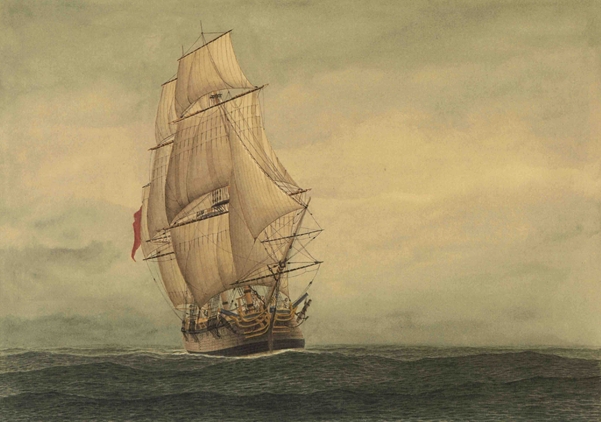
Design, ownership and specifications
The ship was built on the River Thames in 1786 and listed at roughly 338 tons burthen. Contemporary descriptions record a hull length of approximately 103 ft and a beam near 27 ft (commonly converted in sources to about 103 ft and 31 m or 8 m respectively in metric summaries). Commanded by Captain William Cropton Sever, she was owned in partnership by Sever and a supplier involved in victualling, often referred to in records as a baker or biscuit maker. The owners contracted with the British government under terms that required secure and humane carriage of prisoners; payment was made at a set rate per month, commonly recorded as 10 shillings per ton.
Voyage with the First Fleet
Lady Penrhyn was one of the convict transports in the First Fleet and sailed from England in May 1787 as part of the larger expedition. The fleet’s purpose was to transfer convict prisoners and an armed escort of soldiers to establish a penal colony in Australia. In company with the other vessels, the fleet reached the Australian coastline in January 1788, initiating sustained European settlement in the region.
Passengers and conditions aboard
Lady Penrhyn embarked about 101 female convicts for the voyage to New South Wales. Like other transports of the period, she was fitted to secure prisoners in transit: many contemporary accounts note the use of chains, handcuffs and locked confines. Officers and shipboard contractors were responsible under the contract to ensure prisoners were kept secure and reasonably healthy for the long sea passage, and the small complement of crew and marines managed the vessel’s routine and discipline.
After the convict voyage
After disembarking prisoners at Port Jackson, Lady Penrhyn undertook a commercial voyage under charter to the East India Company. She departed Sydney in early May 1788 bound for China to take on a cargo of tea and other trade goods for the return leg to Britain. Records indicate the ship later returned to England in August 1789, completing the extended circuit that combined penal transport with East India Company trade.
Historical significance and distinctions
Lady Penrhyn is remembered primarily for carrying female prisoners who formed part of the first European community that would develop into the colony of New South Wales. Her participation illustrates how commercial vessels, government contracts and imperial trade networks—formalised in agreements and contracts—were integral to colonial expansion. She exemplifies merchant shipping of the late 18th century: privately owned ships contracted to move people and goods, paid by the government at standard rates and later redirected to Company trade. Her story is part of broader narratives about transportation, maritime logistics and early colonial settlement in the Pacific.
- Convict transport: one of six transports in the First Fleet.
- First Fleet: departure May 1787, arrival January 1788.
- New South Wales: destination and site of disembarkation.
- Post-voyage commercial work for the East India Company.
Questions and answers
Q: What was the Lady Penrhyn?
A: The Lady Penrhyn was one of six convict transport ships in the First Fleet, which carried convicts and soldiers to Australia to start a penal colony.
Q: Who was the captain of the Lady Penrhyn?
A: The captain of the Lady Penrhyn was William Cropton Server.
Q: How big was the Lady Penrhyn?
A: The Lady Penrhyn was a ship of 338 tons, which was 103 ft long and 27 ft wide.
Q: Who were the owners of the Lady Penrhyn?
A: The owners of the Lady Penrhyn were the captain, William Server, and biscuit maker, William Curtis.
Q: How were the convict women kept secure during the voyage?
A: The convict women were kept secure with both handcuffs and chains.
Q: Where did the Lady Penrhyn go after the First Fleet trip?
A: After the First Fleet trip, the Lady Penrhyn was under contract to work for the East India Company. She left Sydney on May 5, 1788, to go to China to pick up a load of tea.
Q: When did the Lady Penrhyn get back to England?
A: The Lady Penrhyn got back to England in August 1789.
Related articles
Author
AlegsaOnline.com Lady Penrhyn (First Fleet convict transport) Leandro Alegsa
URL: https://en.alegsaonline.com/art/55335
Sources
- freepages.history.rootsweb.ancestry.com : "Lady Penryhn"