
Lacewings (Chrysopidae): biology, behavior, and role in pest control
Comprehensive overview of lacewings (family Chrysopidae): appearance, life cycle, behavior, predator–prey interactions, and their applications in biological pest control and integrated management.
Overview
Lacewings, commonly called green lacewings, belong to the family Chrysopidae within the order Neuroptera. This widespread family includes many genera and, depending on the source, roughly 1,300–2,000 described species worldwide. In temperate regions two genera, Chrysopa and Chrysoperla, are among the most commonly encountered. Lacewings occur across diverse habitats where vegetation supports the small arthropods that form their primary food supply.
Image gallery
10 Images




Morphology and distinguishing features
Adults are slender insects with large, reticulated wings held roof-like over the body when at rest. Many species are green, providing camouflage among leaves, though some are brown or yellowish. Distinctive traits include long, threadlike antennae and prominent compound eyes. Tiny hairs on the wing surface reduce adhesion to spider silk, and many species possess a specialised tympanal or auditory structure at the wing base that detects ultrasonic bat calls, enabling evasive responses.
Life cycle and feeding habits
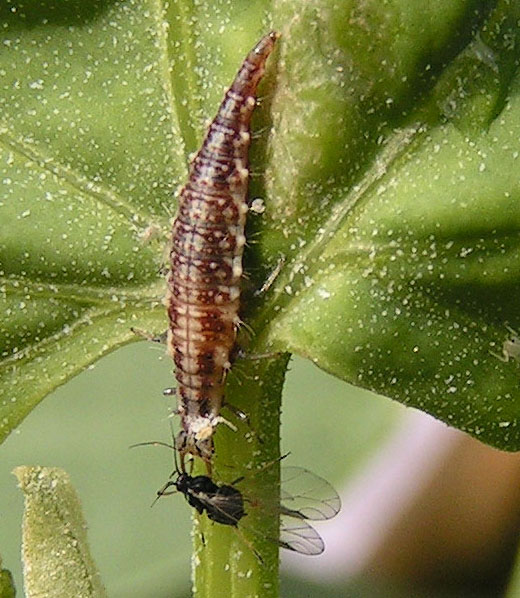
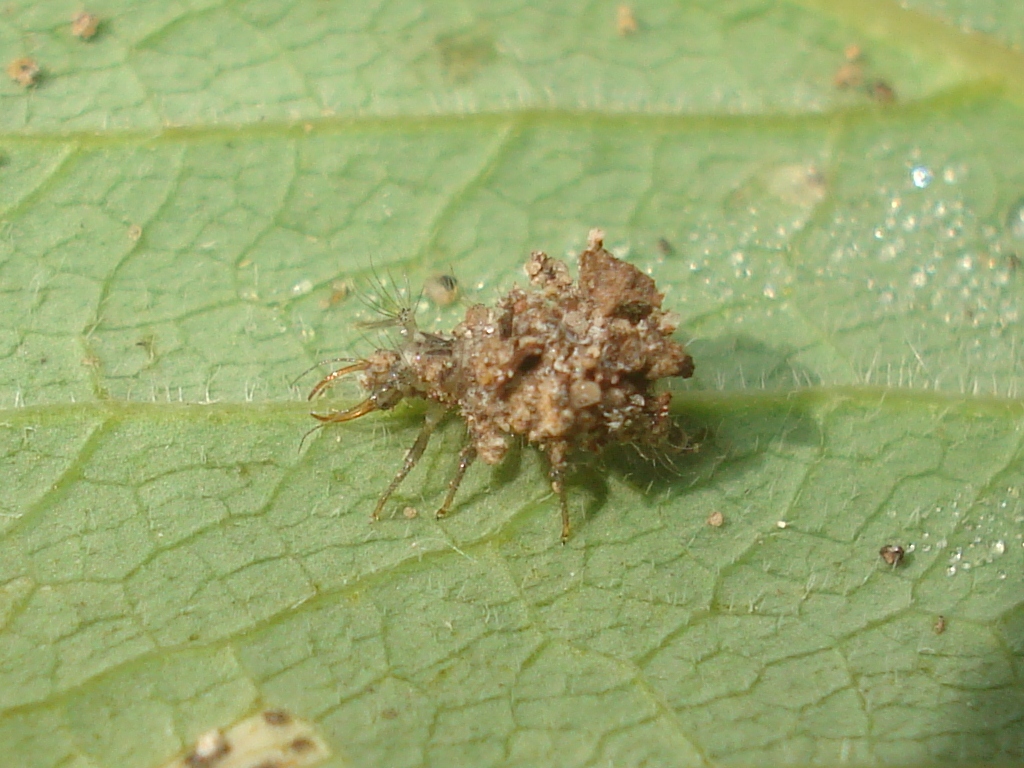
Lacewings undergo complete metamorphosis: egg, larva, pupa and adult. Females often lay eggs singly on short stalks to reduce predation and parasitism. Larvae are elongate, predatory and sometimes carry debris or shed skins as camouflage. Known colloquially as "aphid lions," larvae feed on soft-bodied arthropods such as aphids, whiteflies, small caterpillars and insect eggs. They capture prey with grasping front legs and inject digestive secretions through hollow maxillae, performing extra-oral digestion so that internal tissues are liquefied and consumed.
Behavior and defenses
Both adults and larvae show behavioural and chemical defenses. Some adult chrysopids can release unpleasant-smelling substances from thoracic glands to deter predators. When bats are detected by ultrasonic echolocation, many lacewings fold their wings and drop to escape. Their light body mass and wing microstructure also allow escape from spider webs: rather than thrashing, they may bite through silk threads and slip free with minimal vibration.
Ecological role
Lacewings are important natural enemies in many ecosystems, helping regulate populations of plant-feeding pests. Their presence in hedgerows, field margins and crop canopies contributes to biological control services that benefit agricultural and horticultural systems. Both larvae and some adults consume pests, although larvae typically account for most predation.
Use in biological control and integrated pest management
Because of their predatory habits, lacewings have been used in biological control programs in greenhouses, orchards and field crops. They are sold commercially as eggs, larvae or adults. Successful use depends on timing releases to match pest abundance, ensuring suitable habitat and alternative food (such as pollen) for adult survival, and reducing harmful pesticide exposure. Lacewings are one component of integrated pest management (IPM) rather than a standalone solution.
Taxonomy, communication and research
The family Chrysopidae is part of the ancient neuropteran lineage and is the subject of taxonomic and behavioural research. Some species of Chrysoperla use substrate-borne vibrational signals for mate recognition. Ongoing studies investigate species boundaries, life history variation, and interactions with other predators and parasitoids to improve conservation and biological control outcomes.
Practical considerations for growers and naturalists
To encourage lacewings, provide diverse flowering plants that supply pollen and nectar for adult nutrition, reduce broad-spectrum insecticide use, and maintain habitat complexity. Monitoring larvae and adults can inform whether augmentative releases are needed. When buying commercial lacewings, check supplier quality and release recommendations to match local pest pressures.
Further reading and resources
- Introduction to lacewings
- Family Chrysopidae overview
- Order Neuroptera information
- General neuropteran resources
- Species diversity and lists
- Biological control applications
- Chemical defenses in lacewings
- Predator–prey interactions: bats
- Echolocation and insect responses
- Escape strategies from spider webs
- Lacewing prey: aphids and other pests
- Interactions with caterpillars
- Larval mouthparts and feeding
- Digestive secretions and extra-oral digestion
- Physiology of larval predation
For identification, observe wing venation, body coloration and larval habitus; consult regional keys when precise species-level identification is required. The biology and usefulness of lacewings make them a familiar subject for entomologists, farmers and naturalists interested in sustainable pest management and biodiversity.
Questions and answers
Q: What is a lacewing?
A: A lacewing is an insect in the large family Chrysopidae of the order Neuroptera. There are about 85 genera and (differing between sources) 1,300–2,000 species in this widespread group. However, in America and Europe, the two genera Chrysopa and Chrysoperla are very common.
Q: How do adult lacewings defend themselves?
A: Many adults of Chrysopa can defend themselves by giving out a vile smell from glands at the front of their thorax. They have 'ears' at the base of their front wings which allow them to detect bat echolocation sounds so they can close their wings and drop down to avoid being eaten.
Q: How do lacewings escape spider webs?
A: Lacewings are able to escape spider webs because they are so light that they do not create much vibration to alert the spider. Instead of struggling like most insects, the lacewing bites through the strands holding its legs and antennae. When it is stuck only by its wings, it become completely immobile then slowly slides downwards out of the web due to tiny hairs on its wings preventing sticky spider silk from touching its surface.
Q: What does a larva lacewing eat?
A: The larvae of a lacewing are voracious predators attacking other insects of suitable size such as aphids, caterpillars and other insect larvae or eggs when they touch them with their maxillae which injects a digestive secretion into the prey that can dissolve organs within 90 seconds.
Q: Where can you find Lacewings?
A: Lacewings can be found all over world but especially in America and Europe where two genera Chrysopa and Chrysoperla are very common.
Q: Are there many species of Lacwings?
A: Yes there are about 85 genera with 1,300–2,000 species making up this widespread group worldwide.
Related articles
Author
AlegsaOnline.com Lacewings (Chrysopidae): biology, behavior, and role in pest control Leandro Alegsa
URL: https://en.alegsaonline.com/art/55254
Sources
- digitallibrary.amnh.org : PDF fulltext
- actazool.nhmus.hu : PDF fulltext