
Labyrinthodonts (Labyrinthodontia): an informal grade of early tetrapods
Labyrinthodonts is an informal name for a collection of early fossil tetrapods noted for maze-like tooth structure and heavy skull roofs; once a formal taxon, now treated as an evolutionary grade.
Overview
Labyrinthodont is a historical name used for a suite of early fossil tetrapods and amphibian-like vertebrates. The word combines labyrinth (a maze) and odont (tooth), referring to the characteristic pattern of infolding in their tooth enamel and dentine. Although the label Labyrinthodontia is no longer accepted as a formal, monophyletic taxon in modern systematics, it remains useful as an umbrella term for a set of related fossil forms and an evolutionary grade. Many introductory accounts therefore describe them generically as fossil amphibians, while specialist literature treats their members in more precise clades. The name has a long history in paleontology and reflects an early effort to group primitive tetrapods by shared anatomical traits rather than strict ancestry.
Time range and distribution
Forms traditionally called labyrinthodonts were especially prominent from the later parts of the Devonian into the Permian and into the Early Triassic, a span that covers the origin and early diversification of land-dwelling tetrapods. Fossil remains are known from many continents, showing considerable ecological diversity: some were largely aquatic, others adapted to shallow-water or near-shore habitats, and a few show traits linked to more terrestrial lifestyles. Their long-range presence across geological time makes them central to understanding early tetrapod evolution and the transition from fish to land vertebrates; the group is often discussed in the context of the Devonian and the recovery following the mass extinctions into the Lower Triassic.
Key anatomical features
Labyrinthodonts are most readily recognized by several distinctive skeletal traits. Their teeth typically show a complex, folded pattern of dentine and enamel when cut in cross section — the ‘‘labyrinthine’’ structure that gives the group its name. Many have broad, heavily ossified skull roofs with a mosaic of dermal bones, a condition that led older authors to use the synonym Stegocephalia for some members. Vertebral structure was often more complex than in earlier fish, and limb bones, shoulder and pelvic girdles reflect adaptations for weight-bearing and locomotion in shallow water or on land. Surface ornamentation and occasional dermal ossifications suggest that some species had strong cranial armour or body scutes; see also notes on skull anatomy and roofing bones in specialist treatments of the skull roof.
Classification and groups
Historic treatments grouped a wide array of early tetrapods together as Labyrinthodontia. With advances in cladistic analysis and new fossil discoveries, that grouping has been broken up: many taxa once called labyrinthodonts are now placed in distinct clades such as temnospondyls and other early tetrapod lineages. In older literature, labyrinthodonts were sometimes equated with or dominated by the large amphibian-like radiation called the Temnospondyls. Modern authors recognize that Labyrinthodontia is not monophyletic; it functions better as a descriptive grade than as a scientific clade and has been largely superseded in current classifications.
Evolutionary importance and paleobiology
Labyrinthodont-grade animals document critical stages in tetrapod evolution: the development of robust limbs, changes in feeding mechanics reflected in skull and tooth morphology, and the variety of respiratory and sensory adaptations needed for life in shallow-water or terrestrial settings. Their fossils help reconstruct early ecosystems and the sequence of anatomical innovations that led to modern tetrapod groups. Paleobiological studies combine skull anatomy, limb proportions and sedimentary context to infer lifestyles ranging from ambush-predatory aquatic forms to more mobile semi-terrestrial species.
Image gallery
10 Images


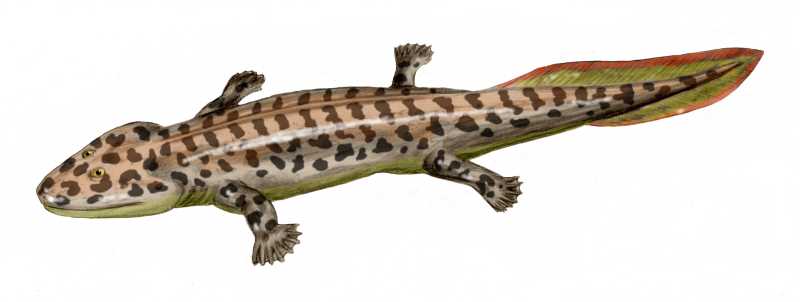
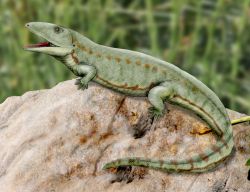


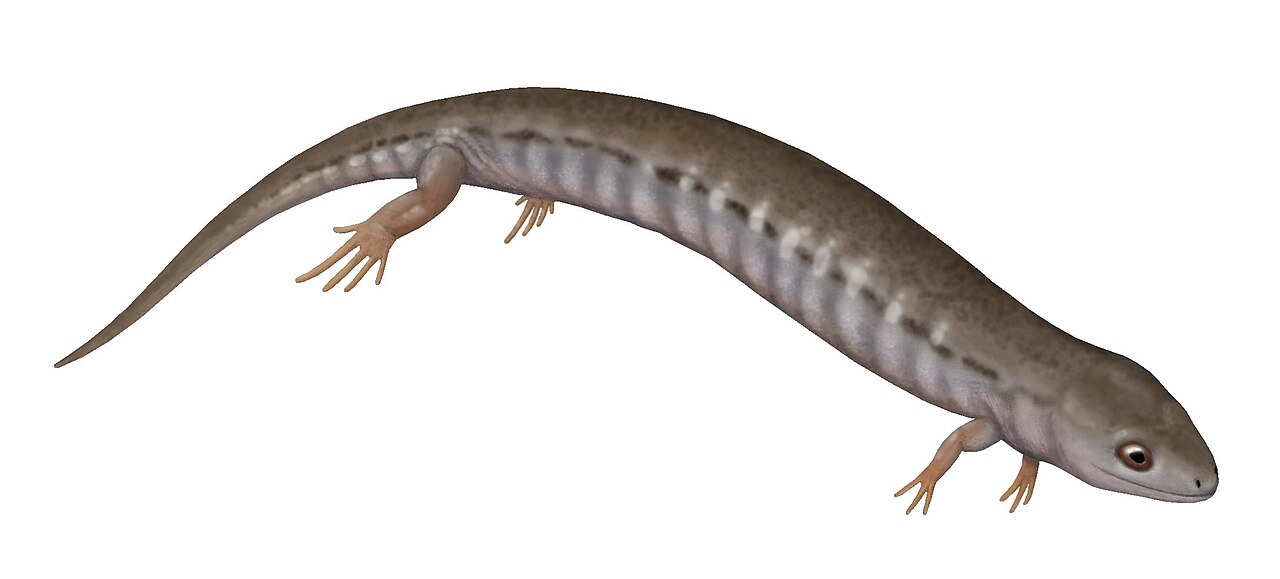


Notable facts and distinctions
- Terminology: the term is largely historical and descriptive; see debates about taxonomic usage and the modern preference for clade-based names.
- Conceptual role: used as an evolutionary grade to group similar morphologies rather than implying direct common ancestry.
- Historic replacements: many classic 'labyrinthodont' taxa are now assigned to named, monophyletic groups in revised classifications (modern classification summaries provide context).
- Representative lineages: the large amphibian-like temnospondyls are among the best-known members of the traditional assemblage (Temnospondyls).
For further reading and fossil records consult specialist surveys and regional field guides; many museum exhibits and paleontology texts still use the term informally while clarifying its limits in evolutionary and taxonomic discussions. General introductions to early tetrapods and the fish-to-tetrapod transition also place the labyrinthodont-grade forms at the heart of that evolutionary story.
Questions and answers
Q: What does the term "Labyrinthodont" mean?
A: The term "Labyrinthodont" is a combination of two words, "labyrinth" meaning maze and "dont" meaning tooth. It was used to describe fossil amphibia.
Q: Are Labyrinthodonts still considered a formal taxonomic term?
A: No, Labyrinthodonts are no longer considered a formal taxonomic term and have been replaced by more accurate terms in classification.
Q: When did Labyrinthodonts exist?
A: Labyrinthodonts existed from the Devonian period to the Lower Triassic period, about 390 to 210 million years ago.
Q: What makes Labyrinthodonts unique?
A: Labyrinthodonts are unique due to their pattern of infolding of dentine and enamel of teeth which often fossilise, heavily armoured skull roof, and complex vertebrae.
Q: Is the group Labyrinthodontia monophyletic?
A: No, the group Labyrinthodonia is not monophyletic and has been replaced in classification by more correct terms.
Q: How are Labyrithondons classified today?
A: Today, Labyrithondons are classified as an evolutionary grade or polyphyletic/paraphyletic group of species which look rather similar.
Related articles
Author
AlegsaOnline.com Labyrinthodonts (Labyrinthodontia): an informal grade of early tetrapods Leandro Alegsa
URL: https://en.alegsaonline.com/art/55245
Sources
- icb.oxfordjournals.org : PDF