
Kumquat: small citrus fruit and ornamental tree
Kumquat (Fortunella or Citrus subgenus) is a small, hardy citrus tree with edible, sweet-peel fruit eaten whole, used in preserves, candied fruit, and as an ornamental; native to China and cultivated worldwide.
Overview
The kumquat is a small fruit-bearing tree and the name of its edible fruit. Often treated separately as Fortunella or as a subgroup of the genus Citrus, kumquats are distinctive for their small, orange fruits whose skin is sweet and eaten together with the tart pulp. They are valued both for culinary uses—preserves, marmalades, candied fruit and liqueurs—and as attractive container or garden plants that bear glossy leaves and fragrant white blossoms. For general plant information see plant description and for culinary uses see food and recipes.
Image gallery
10 Images


Appearance and botanical characteristics
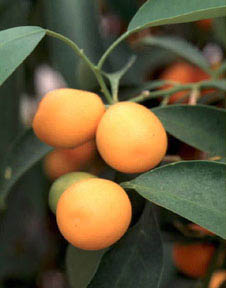
Kumquats are slow-growing evergreen shrubs or small trees, typically forming dense, compact crowns. Mature plants often reach a few metres in height and may have small thorns on the branches. Leaves are dark, glossy green and the fragrant, white flowers resemble those of other citrus species. The fruit is notably smaller than an orange—ranging from round to oval—whose thin peel is sweet and aromatic while the interior segments are tangy. See detailed foliage and flower notes at leaf and flower traits, and a description of the foliage at leaf description and blossoms at flower description.
Varieties and taxonomy
Taxonomically kumquats have been treated in different ways: historically placed in the genus Fortunella, more recent classifications often include them within Citrus as a distinct subgroup. Several cultivars are widely grown; some of the best known include the oval 'Nagami' and round 'Meiwa', as well as 'Marumi' and 'Fukushu'. Cultural and botanical histories link the group closely to East Asia; see origins and early records at origins and historical mentions at early literature and regional cultivation.
History and geographic spread
Kumquats are native to parts of China and have been grown there and in neighboring regions for centuries. They appear in historical literature from medieval periods and were later introduced to Japan, where they became part of local horticulture. Western awareness increased in the 19th century: a well-known introduction to Europe came in the mid-1800s, and shortly after kumquats reached North America. For more on introductions and collectors see European introduction, the mid-19th century account at 1846 introduction, and later movement to the Americas at transatlantic spread.
Cultivation, hardiness and uses
Compared with many citrus species, kumquats are relatively hardy and tolerate cooler climates. Some cultivars, notably 'Nagami', perform best with a warm summer but can survive light to moderate frost. Reported tolerance allows survival through occasional subzero temperatures in protected sites; general cultivation guidance is available at cold tolerance and care. Kumquats are popular in small gardens and on patios because they adapt well to containers and respond well to pruning.
Uses and notable facts
Kumquat fruit are commonly eaten whole—skin and pulp together—offering a balance of sweet peel and sour flesh that suits preserves, marmalades, candied specialties and flavoring for spirits. Beyond the kitchen they serve ornamental roles: the combination of glossy foliage, white flowers and bright fruit makes them attractive for decorative planting and bonsai. Regional culinary traditions differ, but the fruit’s versatility and relative cold tolerance explain its broad appeal across temperate and subtropical gardens.
- Ornamental cultivation and bonsai: care
- Culinary uses—jams, candied, fresh eating: recipes
- Botanical resources and identification: botanical notes, leaf, flower
- Historical and geographic background: origins, early mentions, regional history
- Introduction to Europe and beyond: European records, 1846, North America
- Hardiness and practical growing advice: cold tolerance
Questions and answers
Q: What are kumquats?
A: Kumquats are a type of small fruit-bearing tree whose edible fruit is similar to other citrus fruits but smaller in size.
Q: What do kumquat trees look like?
A: Kumquat trees are slow-growing evergreen shrubs or small trees, ranging from 2.5-4.5 meters tall, with dense branches. They may have small thorns, and their leaves are dark glossy green.
Q: Where did kumquats originate from?
A: Kumquats originally came from China and have been cultivated there and in Japan for a long time. They were first introduced to Europe in 1846 by Robert Fortune, a collector for the London Horticultural Society.
Q: How hardy are kumquat trees compared to other citrus plants?
A: Kumquat trees are much hardier than other citrus plants, such as oranges.
Q: What is the ideal temperature range for 'Nagami' kumquat trees to grow?
A: The 'Nagami' kumquat needs a hot summer, ranging from 25°C(77°F) to 38°C(100.4°F), but can withstand frost down to about -10°C(14°F).
Q: Where do 'Nagami' kumquat trees grow well?
A: 'Nagami' kumquat trees grow well in the tea regions of China, where the climate is too cold for other citrus fruits, even the Mikan (also known as the Satsuma) orange.
Q: When were kumquats first mentioned in literature?
A: Kumquats were first mentioned in literature in the 12th century.
Related articles
Author
AlegsaOnline.com Kumquat: small citrus fruit and ornamental tree Leandro Alegsa
URL: https://en.alegsaonline.com/art/54594
Sources
- en.wiktionary.org : kumquat
- hort.purdue.edu : Fruits of warm climates
- rbgsyd.nsw.gov.au : online