
Krebs cycle (citric acid cycle) — central metabolic pathway
The Krebs cycle, also called the citric acid or TCA cycle, oxidizes acetyl-CoA in aerobic organisms to produce reduced cofactors for ATP generation and supplies intermediates for biosynthesis.
Overview
The Krebs cycle, named for Hans Krebs (Krebs), is a core component of cellular respiration. Also known as the citric acid cycle or the tricarboxylic acid (TCA) cycle, it is a cyclic sequence of enzyme-catalyzed reactions that oxidize acetyl groups to carbon dioxide while conserving energy in the form of reduced cofactors. The cycle operates in most aerobic organisms and underpins many cellular processes.
Image gallery
3 Images
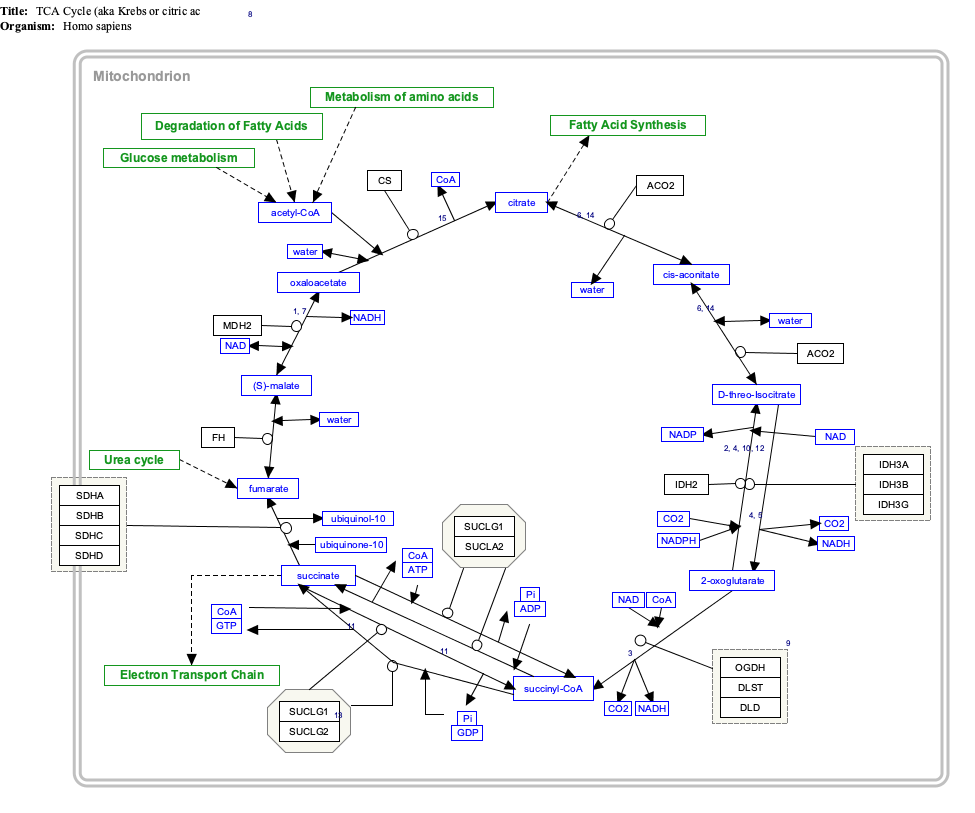

Key reactions and products
One turn of the cycle begins when a two-carbon acetyl unit (acetyl-CoA) condenses with a four-carbon acceptor to form citrate. Through a series of steps the molecule is rearranged and decarboxylated back to the four-carbon acceptor. The pathway produces reduced electron carriers (notably NADH and FADH2) and a high-energy phosphorylated nucleotide (GTP or ATP), which feed the electron transport chain and oxidative phosphorylation. It also releases carbon dioxide and regenerates the acceptor for additional turns.
Cellular context and connections
The cycle follows the pyruvate dehydrogenase or "link reaction" that converts pyruvate into acetyl-CoA. In eukaryotes the Krebs cycle takes place in the mitochondrial matrix (mitochondria), while in many bacteria homologous reactions occur in the cytosol. The reduced cofactors produced are the primary source of electrons for the respiratory chain and ATP synthesis.
Biological importance and history
Beyond energy production, the cycle provides carbon skeletons for amino acids, nucleotide bases and other biosynthetic pathways. Its centrality and conservation across life forms have led researchers to propose an early evolutionary origin for parts of the pathway (biochemical pathways; evolutionary significance), making it a focus of studies on the emergence of metabolism.
Notable facts and applications
- Integration: The cycle connects carbohydrate, lipid and protein metabolism.
- Clinical relevance: Defects in cycle enzymes can cause metabolic disease and are studied in medicine and biotechnology.
- Research: The pathway is a model system in biochemistry and bioenergetics.
Questions and answers
Q: What is the Krebs cycle?
A: The Krebs cycle is a series of chemical reactions used by all aerobic organisms in their energy conversion processes.
Q: Who is Hans Krebs?
A: Hans Krebs is the person for whom the Krebs cycle is named after.
Q: What are some other names for the Krebs cycle?
A: Some other names for the Krebs cycle are the citric acid cycle and the tricarboxylic acid cycle.
Q: Why is the Krebs cycle important?
A: The Krebs cycle is important to many biochemical pathways, and it suggests that it was one of the earliest parts of cellular metabolism to evolve.
Q: What comes before the Krebs cycle?
A: The link reaction comes before the Krebs cycle.
Q: What does the Krebs cycle provide for the electron transport chain?
A: The Krebs cycle provides the hydrogen and electrons needed for the electron transport chain.
Q: Where does the Krebs cycle take place?
A: The Krebs cycle takes place inside mitochondria.
Related articles
Author
AlegsaOnline.com Krebs cycle (citric acid cycle) — central metabolic pathway Leandro Alegsa
URL: https://en.alegsaonline.com/art/54429