
Arezzo — historic city and provincial capital in Tuscany, Italy
Arezzo is a historic city in central Italy, capital of its province in Tuscany, known for Etruscan and Roman roots, medieval architecture, Renaissance art, a lively antiques market and traditional festivals.
Overview
Arezzo is an ancient city in central Italy and serves as the administrative centre of the Province of Arezzo. It lies within the greater area identified as Tuscany and is commonly described as one of the region's important cultural and commercial centres (Tuscany being the larger region). Located roughly 80 km (50 mi) south‑east of Florence, Arezzo occupies a plateau above the valley of the Arno river; its elevation is about 296 m above sea level. Historical census figures recorded a population of around 91,600 in 2001, and the city has since experienced modest demographic change.
Image gallery
10 Images




History and development
Archaeological and documentary evidence shows continuous settlement since Etruscan times. The town became a Roman municipium and retained importance through late antiquity and the Middle Ages. During the medieval period Arezzo grew as a fortified and commercially active centre; it later came under the influence of regional powers such as Florence and the Grand Duchy of Tuscany. The Renaissance left a strong imprint: local religious and civic buildings were decorated by artists whose work survives as major attractions.
Principal sights
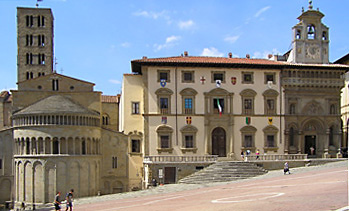
The city centre preserves a compact urban fabric of piazzas, churches and palaces. Key attractions include:
- Piazza Grande — the irregular medieval square that hosts markets and the famous joust.
- Basilica of San Francesco — home to the celebrated fresco cycle by Piero della Francesca.
- Arezzo Cathedral (Cattedrale di San Donato) — a Gothic cathedral with notable stained glass and artworks.
- Roman remains and medieval towers that reveal the city's deep past.
Culture, events and notable figures
Arezzo has a lively cultural calendar. The Giostra del Saracino is a historic medieval-style jousting festival revived in modern times; monthly antiques fairs draw collectors from across Italy and abroad. The city is associated with important historical figures: the medieval music theorist Guido of Arezzo, the poet Francesco Petrarca (Petrarch) was born nearby, and the painter Giorgio Vasari came from the city. Artists such as Piero della Francesca executed some of their most admired work in Arezzo's churches.
Economy and transport
Traditionally a market and artisan town, Arezzo developed modern industries in manufacturing and jewellery; the area around the city is known for goldsmithing and small-scale workshops. It is connected by road and rail to Florence, Rome and other Tuscan centres, making it both a local commercial hub and an accessible destination for visitors exploring the region.
Distinctive features
What distinguishes Arezzo is the layering of ancient, medieval and Renaissance elements in a relatively compact centre, plus a continuing tradition of craftsmanship and public festivals. Visitors often combine the city's artistic heritage with its lively outdoor markets and seasonal events, encountering a town that remains both historic and actively lived-in. For further information and visitor guidance, consult local cultural resources or official tourism pages Arezzo and regional guides (central Italy, province details).
Additional references and specialized studies — for archaeology, art history and municipal records — can be found through academic libraries and curated online portals (regional archives, Tuscany cultural sites, and municipal resources: transport distances, conversion details, nearby Florence, demographic statistics: topography, elevation data, and historical population records: population 2001).
Questions and answers
Q: Where is Arezzo located?
A: Arezzo is located in central Italy.
Q: What is the capital of the Province of Arezzo?
A: Arezzo is the capital of the Province of Arezzo.
Q: In which region of Italy is Arezzo located?
A: Arezzo is located in the region of Tuscany.
Q: How far is Florence from Arezzo?
A: Florence is about 80 km (50 mi) south-east of Arezzo.
Q: How high above sea level is Arezzo?
A: Arezzo is at an elevation of 296 m above sea level.
Q: What was the population of Arezzo in 2001?
A: The population of Arezzo in 2001 was about 91,600 people.
Q: Is Arezzo a new or old city?
A: Arezzo is an old city.
Related articles
Author
AlegsaOnline.com Arezzo — historic city and provincial capital in Tuscany, Italy Leandro Alegsa
URL: https://en.alegsaonline.com/art/5440
Sources
- istat.it : "Superficie di Comuni Province e Regioni italiane al 9 ottobre 2011"
- demo.istat.it : "Popolazione Residente al 1° Gennaio 2018"
- demo.istat.it : "GeoDemo"