
Arecibo Message (1974)
A radio transmission sent from the Arecibo telescope in 1974 that encoded basic information about humanity and Earth; intended as a technological demonstration and symbolic message to the stars.
Overview
The Arecibo message was a brief, deliberately structured radio transmission broadcast in November 1974 from the Arecibo Observatory in Puerto Rico. Composed as part of a public ceremony to mark an upgrade to the telescope, the message was beamed toward the globular cluster M13, a dense grouping of stars located roughly 25,000 light years away from Earth. The message was created under the leadership of astronomer Frank Drake, then at Cornell University, with contributions from Carl Sagan and others associated with studies such as the Drake equation that consider the likelihood of communicative civilizations.
Image gallery
10 Images






Contents and structure
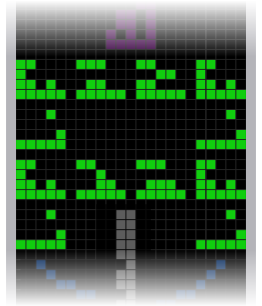
The transmission consisted of 1679 binary digits presented as a single sequence; the choice of 1679 reflected deliberate mathematical considerations rather than an arbitrary length. When the bits are placed into a grid of 73 rows by 23 columns, they arrange into a visual pattern containing seven conceptual blocks. The encoded material includes:
- Basic numerals (one through ten) and a number system
- The atomic numbers of key elements—hydrogen, carbon, nitrogen, oxygen, and phosphorus—that form the backbone of DNA
- Simple chemical information such as the formulas for constituent sugars and bases in the nucleotides of DNA
- An indication of the number of nucleotides and a schematic of the double helix
- A stylized human figure, a representation of an average height and the human population
- A simple map of the Solar System showing Earth and the sending antenna
- A graphic depiction of the Arecibo dish and its diameter
Technical details
Technically the message was small—about 210 bytes worth of information in binary form—and broadcast in a tightly controlled carrier. It was transmitted at a radio frequency of 2380 MHz using frequency-shift keying (a kind of modulation) in which 'ones' and 'zeros' were represented by a 10 Hz difference and sent at roughly 10 bits per second. The transmitter operated at about 1,000 kilowatts of power, and the entire broadcast lasted under three minutes.
Choice of target, travel time, and intent
M13 was selected largely because the cluster was visible in the sky during the ceremony and because its compact size made aim and demonstration practical. In astronomical terms the selection was symbolic: at ~25,000 light years the message will require about that many years to arrive, and any reply would take an equal span to return, so a round trip would span tens of thousands of years. For this reason—and because the stars in M13 will have moved from their present positions by the time the signal arrives—the project is widely interpreted as a demonstration of human capability rather than a realistic immediate attempt to communicate with extraterrestrial life.
Legacy, interpretation and cultural echoes
The Arecibo transmission has become a touchstone in discussions about active attempts to reach other intelligence (sometimes called METI) and about how to encode meaningful information in simple signals. The choice of the message length as a semiprime (the cardinality 1679) and the way the bits form an image when arranged correctly are often cited as instructive examples of designing messages that an unknown recipient might decipher. The broadcast was explicitly described by Cornell University decades later as a publicity and technical demonstration; nevertheless it continues to inspire artists and scientists alike. For example, the electronic musician Boxcutter named an album after the transmission (Arecibo Message), while debates about the risks and benefits of sending messages beyond Earth remain active topics.
Decoding and notable points
Anyone attempting to recreate the message from its binary form must choose the correct grid orientation—the sequence forms a coherent picture in one rectangular arrangement but not in the transposed alternative. That deliberate ambiguity was intended to make a correct reconstruction more likely if an intelligent recipient recognized the mathematical clue. The Arecibo message therefore serves both as a historical milestone in radio astronomy and as an educational example of how scientists translate numbers and chemistry into abstract, compact forms suitable for interstellar transmission.
For further reading about the observatory, the message authors, and discussions surrounding interstellar messaging, see detailed sources and outreach materials from technical and historical archives, or follow introductory summaries available from institutional pages such as Cornell University and project histories linked from astronomy outreach portals (Arecibo, Frank Drake, Carl Sagan).
Questions and answers
Q: What is the Arecibo Message?
A: The Arecibo message was a short radio message sent into space to celebrate the remodeling of the Arecibo radio telescope in Puerto Rico in 1974. It was aimed at the globular star cluster M13, about 25,000 light years from Earth.
Q: Who wrote the message?
A: Dr. Frank Drake, then at Cornell University and creator of the famous Drake equation, wrote the message, with help from Carl Sagan, among others.
Q: What did it contain?
A: The message was in seven parts which show numbers one (1) to ten (10), atomic numbers of elements hydrogen, carbon, nitrogen, oxygen and phosphorus which make up deoxyribonucleic acid (DNA), formulas for sugars and bases in nucleotides of DNA, number of nucleotides in DNA and a graphic of double helix structure of DNA; figure of a human size average man; human population on Earth; Solar System; Arecibo Observatory and diameter of transmitting antenna dish.
Q: How long will it take for any reply to be received?
A: It will take 25,000 years for the message to reach its destination and at least another 25,000 years to get any reply.
Q: Why was it sent?
A: The real purpose behind sending this message was not to make contact but rather as a show of human technological achievement.
Q: What does 1679 signify?
A: 1679 is semiprime number which can be arranged as 73 rows by 23 columns or 23 rows by 73 columns but only one arrangement produces meaningful result when translated into graphics characters and spaces.
Q: What album is named after this event?
A: In 2009 band Boxcutter made an album called 'The Arecibo Message', which has many short songs related to this event.
Tags
Related articles
Author
AlegsaOnline.com Arecibo Message (1974) Leandro Alegsa
URL: https://en.alegsaonline.com/art/5413
Sources
- news.cornell.edu : "Cornell News: It's the 25th anniversary of Earth's first (and only) attempt to phone E.T., FOR RELEASE: Nov. 12, 1999" · web.archive.org
- zwire.com : "Larry Klaes. Ithaca Times - Making Contact (11/30/2005)"
- physics.utah.edu : "The Arecibo Message"
- williams.edu : "Chapter 20: Life in the Universe"
- williams.edu : Astronomy: From the Earth to the Universe, Updates by Chapter, 5th Ed.
- planet.mu : "Planet Mu Records"