
Koh-i-Noor (Mountain of Light) — historic diamond
The Koh-i-Noor is a famed colourless diamond from the Indian subcontinent, notable for its size, 19th‑century recutting, royal use in British crowns, and ongoing repatriation claims.
Koh-i-Noor is a large, colourless diamond whose name means "Mountain of Light" in Persian. It has long been celebrated for its size and brilliance and is one of the most famous gemstones in the world. Historically associated with rulers across the Indian subcontinent, the gem entered British possession in the 19th century and today forms part of the United Kingdom's Crown Jewels on display at the Tower of London. Koh-i-Noor remains a subject of fascination, royal pageantry and international debate.
Image gallery
10 Images



Physical characteristics
The stone is naturally colourless and, before extensive cutting, ancient accounts describe a very large rough of roughly 793 carats. By the time it entered European hands in the 19th century it had been reduced to about 186 carats; in 1852 it was recut to improve its brilliance and symmetry and emerged as an oval brilliant of about 105.6 carats, measuring a few centimetres across. The loss of weight during recutting reflects a common trade‑off: removing internal flaws and poor proportions to create more optical fire and sparkle.
Origins and early history
Traditional accounts place the diamond's origin in the mines of central and southern India, with one commonly cited findspot near Guntur in the modern Indian state of Andhra Pradesh. Guntur and the surrounding regions were sources of large diamonds in earlier centuries. Early ownership is associated with regional dynasties and medieval rulers of South Asia; over several centuries the stone passed through the hands of various sultans, emperors and conquerors, reflecting the region's turbulent political history.
Acquisition by the British and later treatment
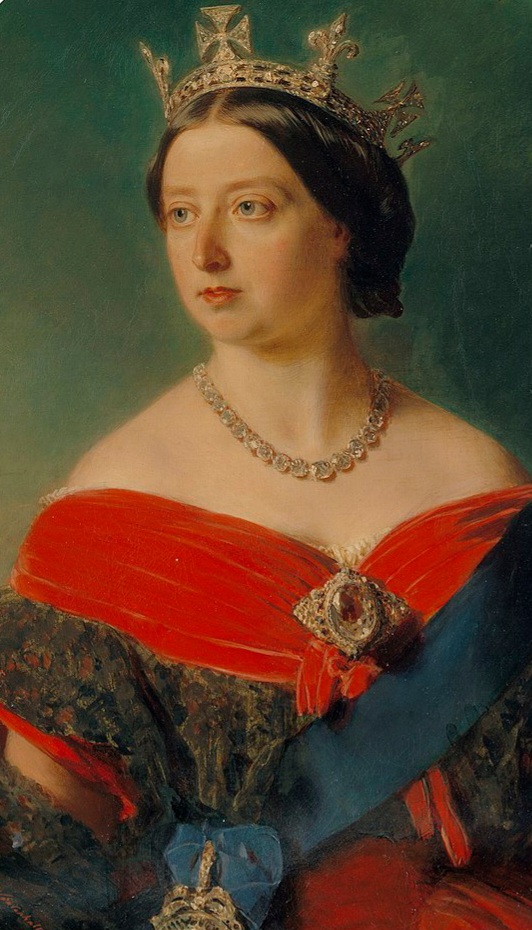
After the British military annexation of the Punjab in 1849 the diamond came into British hands and was presented to Queen Victoria. It became closely associated with the British monarchy after being displayed and mounted for formal use. Queen Victoria wore it at times but it was not generally used by male monarchs. The transfer followed the east‑west conflicts of the period and is often described in the context of the British conquest of the region; relevant events include the annexation following the conclusion of the Second Anglo‑Sikh War and formal treaties surrounding the Punjab.
Royal settings and public display
After its arrival in Britain the stone was recut at the request of Prince Albert to enhance its brilliance. It later appeared in a series of female crowns: set in the crown of Queen Alexandra, then mounted for Queen Mary, and most recently placed in the crown of the Queen Mother. The Koh-i-Noor has been displayed as part of the British Crown Jewels within the Royal Collection, and millions visit the Tower where it is exhibited. On occasion it has been used in state ceremonies and was notably placed atop the coffin at the 2002 funeral of the Queen Mother.
Significance and controversy
The diamond is important as a symbol of imperial history and artistic craft, but it is also the focus of enduring repatriation claims. Governments and groups from countries of origin, including India and others in the region, have at times requested its return, arguing historical ownership and cultural patrimony. The British government and custodial museum institutions have maintained their own legal and curatorial positions. Discussions around the gem touch on wider issues of colonial legacy, heritage law and the ethics of cultural property.
Timeline and notable facts
- Traditionally found in India in medieval times; name means "Mountain of Light".
- Ancient rough accounts cite a very large initial weight; later reduced before the 19th century.
- Entered British possession after 1849 and was presented to Queen Victoria.
- Recut in 1852 at the request of Prince Albert, producing the current ~105.6 carat brilliant.
- Mounted in the crowns of Queen Alexandra, Queen Mary, and the Queen Mother.
- Displayed with the Crown Jewels in the Tower of London, part of the Royal Collection. See also historical context of the Punjab transfer and later public debates.
The Koh-i-Noor's combination of exceptional size, a history that spans multiple empires, and its role in modern political and cultural debates make it more than a gemstone: it is an object through which many narratives of power, craftsmanship and memory continue to be discussed. For further curated historical material and official descriptions consult institutional resources and catalogue entries maintained by relevant museums and archives. Edward VII is among the monarchs associated with crowns that have borne the stone during official ceremonies.
Questions and answers
Q: What is the Koh-i-Noor?
A: The Koh-i-Noor is a large, colourless diamond that was found near Guntur in Andhra Pradesh, India, possibly in the 13th century. The name means Mountain of Light in the Persian language.
Q: How much did it weigh before it was cut for jewellery?
A: Before it was cut for jewellery, it weighed 793 carats (158.6 g).
Q: Who were its first owners?
A: Its first owners were the Kakatiya dynasty.
Q: How did the British acquire possession of the stone?
A: The British acquired possession of the stone after their conquest of Punjab in 1849.
Q: What happened to its appearance when Prince Albert ordered it cut down?
A: When Prince Albert ordered it cut down from 186 carats (37.2 g), it emerged 42 per cent lighter as a dazzling oval-cut brilliant weighing 105.6 carats (21.12 g) and measuring 3.6 cm x 3.2 cm x 1.3 cm.
Q: Who has worn the Koh-i-Noor since arriving in U.K.?
A: Since arriving in U.K., the Koh-i-Noor has only ever been worn by female members of royalty, starting with Queen Victoria and including Queen Alexandra, Queen Mary and Queen Mother Elizabeth II at her coronation in 1902 and state funeral in 2002 respectively .
Q: Where can visitors see this diamond today ?
A: Today , visitors can see this diamond as part of The Crown Jewels of United Kingdom which are held at Tower Of London and seen by millions each year .
Related articles
Author
AlegsaOnline.com Koh-i-Noor (Mountain of Light) — historic diamond Leandro Alegsa
URL: https://en.alegsaonline.com/art/54100
Sources
- books.google.com : The Tower of London: 900 Years of English History
- royalcollection.org.uk : "FAQ: Does the Queen own the Royal Collection?"
- books.google.com : Diamonds: In the Heart of the Earth, in the Heart of Stars, at the Heart of Power
- books.google.com : The Crown Jewels
- amazon.com : B000HHY1ZQ
- royalcollection.org.uk : royalcollection.org.uk/collection/31704/queen-marys-crown
- royalcollection.org.uk : royalcollection.org.uk/collection/31703/queen-elizabeth-the-queen-mothers-crown
- news.bbc.co.uk : "Priceless gem in Queen Mother's crown"