
Knights of the Round Table
Legendary company of King Arthur’s foremost knights, centered on a Round Table symbolizing equality; central to medieval romance, chivalric ideals, Grail quests, and later adaptations.
Overview
The Knights of the Round Table are a band of legendary warriors associated with the Arthurian legends who served King Arthur. In medieval and later stories they are portrayed as the kingdom's finest knights and principal companions of the king. The Round Table itself, traditionally located in Arthur's court or Camelot, is a symbolic object: its circular form implies that no one seat is superior and that those who gather there are equal in honor.
Image gallery
10 Images


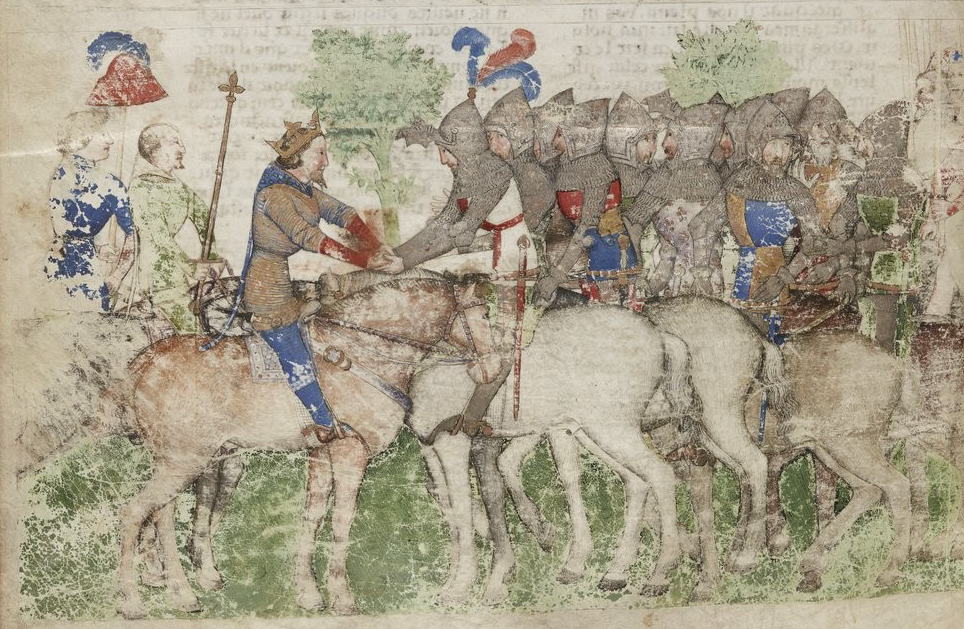
Composition and symbolism
Membership and number of the knights vary widely among sources. Authors used the Round Table as a literary device to assemble heroes, dramatize rivalries, and stage quests. The table expresses the ideals of chivalry—courage, loyalty, courtesy, and service—yet the stories often explore how human weakness, love, and ambition undermine those ideals. Certain seats have special significance in romances; for example, one seat is sometimes described as reserved for the one who will achieve a sacred mission.
Origins and literary development
The figure of Arthur and his court evolved across centuries. Early medieval sources introduced Arthur in a partly historical and partly legendary context. Later medieval writers on the continent and in Britain—among them poets and romancers—expanded the cast of characters, adding episodes of courtly love, tournaments, and spiritual quests. Notable contributors to the Arthurian corpus include writers whose works assembled or reshaped tales for different audiences and purposes. English prose cycles and later compilations further codified many of the familiar tales.
Notable members and major stories
- Sir Lancelot — often depicted as the most skilled knight, whose affair with Queen Guinevere introduces tragic conflict.
- Sir Gawain — portrayed in varied ways, sometimes a paragon of courtesy, sometimes flawed by vengeance or loyalty dilemmas.
- Sir Galahad — a later addition closely linked to the Grail quest and ideals of purity.
- Sir Percival and other questing knights
Many narratives concentrate on the quest for the Holy Grail, martial contests, and moral trials. Internal strife—romantic scandal, rivalries, or political treachery—frequently precipitates the decline of Arthur's realm, culminating in rebellion and the king's fall in several versions of the legend.
Historical sources and named traditions
Medieval texts and later retellings present divergent lists and episodes. Some chronicles and romances name dozens of knights; other treatments focus on a core group. The Round Table appears in material culture as well as in literature: painted medieval round tables and later artistic depictions reflect how the motif entered civic and popular imagination. Scholarly study traces how continental romance, Celtic material, and English tradition intermingled to produce the familiar corpus.
Legacy and cultural influence
The Knights of the Round Table have shaped Western notions of chivalry and heroism and have been adapted in drama, opera, painting, and film. They serve as archetypes in narratives about moral testing, leadership, and fellowship. Modern retellings and scholarly interpretations continue to revisit the knights to highlight different themes—religious, social, or psychological—and to situate the legends within changing cultural contexts.
Further reading
For general background on the tradition see introductions to the Arthurian legends, accounts of King Arthur, studies listing prominent knights and episodes at the Round Table (knight rosters), and treatments of Arthur's court and settings such as the king's castle and Camelot. These sources illustrate both the literary variety and the enduring appeal of the Round Table motif.
Questions and answers
Q: Who were the Knights of the Round Table?
A: The Knights of the Round Table were characters in the legends about King Arthur. They were the best knights in King Arthur's kingdom.
Q: Where did they live?
A: The Knights of the Round Table lived in King Arthur's castle, Camelot.
Q: What was special about their table?
A: The table that was in Camelot was round instead of rectangular, which meant that everyone who sat around it was seen as trustworthy and equal.
Q: Why were they called the Knights of the Round Table?
A: They were called the Knights of the Round Table because of a special table that was in Camelot, which was round instead of rectangular.
Q: What did having a round table signify?
A: Having a round table signified that everyone who sat around it was seen as trustworthy and equal.
Q: How did this affect their relationships with each other?
A: This meant that all members at the table had an equal standing and could be trusted by one another, creating strong relationships between them.
Q: What is Camelot known for? A: Camelot is known for being King Arthur's castle where he kept his best knights, known as The Knights of The Round Table.
Related articles
Author
AlegsaOnline.com Knights of the Round Table Leandro Alegsa
URL: https://en.alegsaonline.com/art/53986