
Ardèche (river)
The Ardèche is a 125 km river in south-central France, a right-bank tributary of the Rhône, known for its limestone gorges, the Pont d'Arc natural arch and the nearby Chauvet cave with Paleolithic art.
The Ardèche is a 125-kilometre river in south-central France. It is a right-bank tributary of the Rhône and gives its name to the French department of Ardèche. The name appears in Occitan as Ardecha. Basic reference coordinates for part of the river are indicated here: map coordinates. The stream and its valley combine natural, historical and recreational value and attract visitors from across Europe.
Image gallery
10 Images


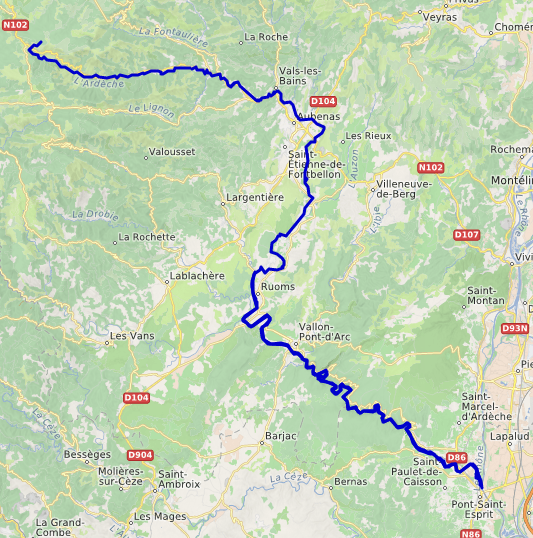


Course and physical characteristics
The Ardèche rises in elevated terrain of the Massif Central region and flows generally eastward to join the Rhône. Along its course it crosses varied landscapes: upland plateaux, wooded valleys and limestone country that is vulnerable to karst erosion. The river is relatively short but energetic, with seasonal variations in flow that reflect Mediterranean and continental influences.
Gorges, geology and notable landmarks
One of the river's best-known features is the Gorges de l'Ardèche, a dramatic limestone canyon carved over millennia. Within the gorge area stands the Pont d'Arc, a large natural arch that spans the river and has become an iconic symbol of the region. Nearby is the Chauvet-Pont-d'Arc cave, famed for its well-preserved Paleolithic paintings and archaeological significance; the cave site has reinforced the cultural prominence of the Ardèche valley.
Human uses and environment
The Ardèche supports local communities through irrigation, small-scale hydropower and tourism. Recreational canoeing and kayaking through the gorges are major seasonal activities, drawing many visitors for day trips and multi-day excursions. The valley also hosts vineyards, pasture and small towns. Conservation efforts focus on protecting riverine habitats, karst systems and archaeological sites while managing visitor impact.
Quick facts and distinctions
- Length: about 125 km; a tributary of the Rhône.
- Striking landmarks: the Pont d'Arc natural bridge and the Gorges de l'Ardèche.
- Cultural importance: proximity to the Chauvet cave with Paleolithic art.
- The river gives its name to the department of Ardèche and is known in Occitan as Ardecha.
- General references and mapping: see coordinates and regional geographic sources for detailed maps and access points.
- For general information about rivers and their classification see related river resources.
The Ardèche combines striking natural scenery, important prehistoric heritage and active outdoor recreation. Its compact length belies a diverse set of landscapes and cultural sites that make the river an important feature of the Rhône basin region.
Questions and answers
Q: What are the coordinates of the Ardèche river?
A: The coordinates of the Ardèche river are 44°15′52″N 4°38′52″E / 44.26444°N 4.64778°E / 44.26444; 4.64778.
Q: Where is the Ardèche river located?
A: The Ardèche river is located in south-central France.
Q: What is the length of the Ardèche river?
A: The Ardèche river is 125-kilometre (78 mi) long.
Q: What is the Ardèche river's relation to the River Rhône?
A: The Ardèche river is a right-bank tributary of the River Rhône.
Q: What does the Ardèche river give its name to?
A: The Ardèche river gives its name to the French department of Ardèche.
Q: How is Ardèche pronounced in the Occitan language?
A: Ardèche is pronounced as Ardecha in the Occitan language.
Q: What is the Occitan language?
A: Occitan is a Romance language spoken in southern France, Monaco, and parts of Italy and Spain.
Related articles
Author
AlegsaOnline.com Ardèche (river) Leandro Alegsa
URL: https://en.alegsaonline.com/art/5367
Sources
- services.sandre.eaufrance.fr : "L'Ardèche (V50-0400)"
- hydro.eaufrance.fr : "L'Ardèche à Saint-Martin-d'Ardèche [Sauze-Saint-Martin]"
- geoportail.gouv.fr : "Source de l'Ardèche"
- geoportail.gouv.fr : "Confluence de l'Ardèche"