
Ardashir I — Founder of the Sasanian Empire
Ardashir I (late 2nd–3rd century) founded the Sasanian dynasty, overthrowing the Parthians and restoring a centralized Persian monarchy; his reign shaped late antique Iran's institutions and art.
Overview
Ardashir I (Persian Ardašīr), often called Ardashīr-i Pāpagān, was the founder of the Sasanian dynasty that ruled Persia for roughly four centuries. Born in the region of Istakhr in what is today Fars province, he rose from local power to proclaim himself king of kings and established a new imperial order that replaced the Parthian aristocracy. His life marks the end of Parthian dominance and the beginning of a renewed Persian monarchy.
Image gallery
10 Images


Origins and rise to power
Ardashir's family background linked him to local nobility in Istakhr; traditional accounts name his father as Pāpak. He began his career as ruler of Istakhr and expanded his authority in Fars. Contemporary and later sources variously Latinized his name as Artaxares or compared it to the older royal name Artaxerxes (Artaxerxes). At the time his province was formally a vassal to the Parthian overlords (Parthia), but central control under the Arsacid kings had grown weak and regional dynasts contested power.
Conflict with the Parthians and accession
As Ardashir expanded, he came into open conflict with the Parthian king Artabanus IV (Artabanus IV) and with neighboring vassals. The climactic confrontation between the two rulers is commonly dated to the early 220s CE, when Ardashir's forces routed the Parthian army and Artabanus was killed. After this victory Ardashir assumed the traditional title of "king of kings" (Šāhān šāh) and consolidated control over much of Iran; some sources give his formal coronation as occurring a few years after the battlefield victory. He is often associated with the city and seat of power at Istakhr and with the wider province of Fars.
Administration, religion, and cultural policies
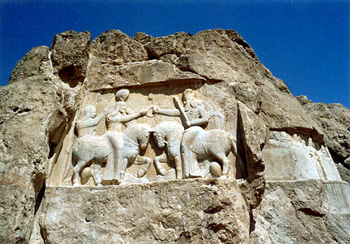
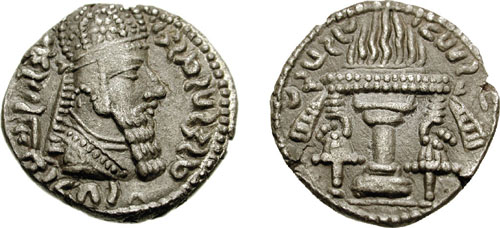
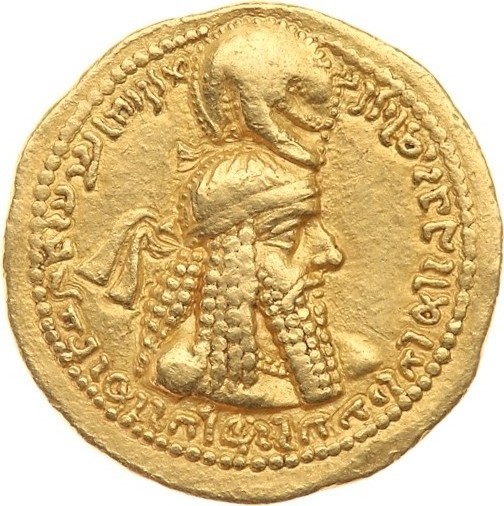
Ardashir sought to restore a centralized monarchy with stronger royal institutions than those of the late Arsacid state. He promoted a reorganization of administration and law, patronized Zoroastrian clergy, and encouraged the revival of Persian court ritual and symbolism. Royal coinage and statuary from his reign signal a deliberate use of iconography to assert legitimacy. He also commissioned reliefs and inscriptions carved into rock faces and palaces to record royal achievements and to present his image as a legitimate successor to ancient Persian kings.
Key features and achievements
- Founded the Sasanian dynasty, a major Iranian imperial house that claimed succession from earlier Persian kings.
- Ended effective Parthian rule in Iran and reasserted central authority under a Shahanshah.
- Promoted Zoroastrian institutions and court ceremonial, influencing later Sasanian governance and culture.
- Left a visible artistic and epigraphic legacy in royal reliefs and coin types used by successors.
Legacy and historical significance
Ardashir's foundation of the Sasanian state reshaped the political map of late antiquity. The dynasty he established became the principal rival to Rome (and later Byzantium) in the Near East and persisted until the mid-7th century, when Sasanian rule finally collapsed under the Arab Muslim expansions led by the early Islamic caliphate (Rashidun Caliphate). His consolidation of royal power, court structures, and Zoroastrian patronage set patterns followed by later Sasanian rulers and influenced Persian culture for centuries.
Although later Sasanian kings—most notably his son and successor—extended and modified many of his policies, Ardashir I is remembered chiefly as the military and political architect who replaced the fragmented Arsacid world with a revived Persian monarchy that claimed ancient imperial legitimacy. For further local context and archaeological remains associated with his early domain, see material related to Istakhr and the province of Fars.
Notes: his name appears in several forms in classical and later sources (including the Latinized Artaxares), and his struggle with the last effective Parthian king (Artabanus IV) is the pivotal military episode of his rise. The Sasanian state's eventual fall to the Rashidun Caliphate centuries later marks the end of the imperial line he began.
Questions and answers
Q: Who was Ardashir I?
A: Ardashir I was the founder of the Sassanid dynasty and the king of Persia from 226 until his death.
Q: What territories did Ardashir rule before becoming the King of Kings of Persia?
A: Ardashir first ruled over Istakhr, then an important part of Persia, before being crowned as the King of Kings of Persia in 226.
Q: How long did the Sassanid dynasty rule?
A: The Sassanid dynasty ruled for four centuries until it was overthrown by the Rashidun Caliphate in 651.
Q: Where was Ardashir born?
A: Ardashir was born in Istakhr, which is present-day Fars in Iran.
Q: What was the Parthian Empire?
A: The Parthian Empire was an ancient Iranian empire that existed from 247 BC to 224 AD.
Q: How did Ardashir become the King of Kings of Persia?
A: Ardashir defeated the Parthian ruler Artabanus IV in battle and was crowned as the King of Kings of Persia in 226.
Q: How did the Sassanid rule differ from the Parthian Empire?
A: The Sassanid rule was characterized by a centralized government, a flourishing economy, and a strong military, which differed from the more decentralized government of the Parthian Empire.
Related articles
Author
AlegsaOnline.com Ardashir I — Founder of the Sasanian Empire Leandro Alegsa
URL: https://en.alegsaonline.com/art/5363