
Kingdom of Castile
Medieval Iberian kingdom that grew from a ninth‑century frontier county into the dominant Castilian realm whose institutions and language shaped later Spain and its overseas empire.
Overview
The Kingdom of Castile was a medieval Christian state on the Iberian Peninsula that emerged from frontier settlements and expanded to become a principal power in medieval Spain. Originating as a border society organized to resist and recover territory from Muslim polities, Castile evolved into a kingdom with growing political, military and cultural influence. Over several centuries it played a leading role in the Reconquista and the formation of the Spanish monarchy.
Image gallery
2 Images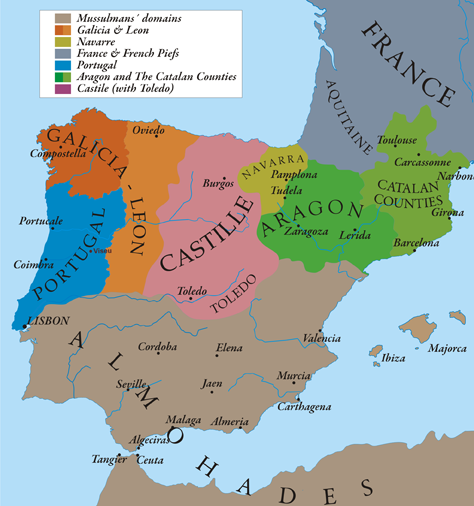

Origins and development
Castile began in the 9th century as the County of Castile, a largely autonomous frontier district established to defend northern Christian realms. For a time it was held as a vassalage of the neighboring Kingdom of León, but local counts and later kings increased their autonomy and territory. By the High Middle Ages the county had been elevated to a kingdom; through conquest, settlement and dynastic unions it absorbed neighboring lands and became the core of the later Crown of Castile.
Institutions, society and culture
Castilian governance combined royal authority, summoned courts and municipal councils; local customary law and privileges (fueros) shaped urban and rural life. Military orders and lordships were important in newly reconquered districts. Castile was also the principal incubator of the Castilian language, which developed into the standard Spanish tongue and carried administrative, legal and literary culture across the peninsula.
Economy and examples of expansion
The kingdom's economy rested on agriculture, livestock (notably sheep and wool), commerce and the growth of towns. Repopulation programs settled Christians in reconquered areas, creating new municipal centers. Castile’s armies and colonizing initiatives expanded its influence; its later political formation, the Crown of Castile, became the principal component of the unified Spanish monarchy and the institution that directed overseas expansion.
Legacy and notable distinctions
Castile left enduring marks on Iberian geography, language, law and identity. Modern administrative regions in Spain preserve the Castile name, and the legal-administrative traditions developed there influenced the institutions of early modern Spain. Distinctions often made in history include the early county phase versus the later royal kingdom, and the difference between the medieval Kingdom of Castile and the broader Crown of Castile that emerged through union and conquest.
- Key themes: frontier origins, Reconquista, linguistic and legal legacy.
- Administrative legacy: municipal fueros, royal cortes and provincial identities.
- Cultural legacy: spread of Castilian language and institutions to the Americas under the Crown of Castile.
For further reading on related topics, see entries on the geography of medieval Iberia, feudal structures and the history of León and Castile in specialist histories and reference works.
Questions and answers
Q: What is the Kingdom of Castile?
A: The Kingdom of Castile was one of the medieval kingdoms of the Iberian Peninsula.
Q: When did the Kingdom of Castile begin?
A: The Kingdom of Castile began in the 9th century.
Q: What was the Kingdom of Castile called when it began?
A: The Kingdom of Castile was called County of Castile when it began.
Q: Which kingdom was the County of Castile a vassalage depending on?
A: The County of Castile was a vassalage depending on the Kingdom of León.
Q: Was the Kingdom of Castile one of the kingdoms that existed before the Kingdom of Spain?
A: Yes, the Kingdom of Castile was one of the kingdoms that existed before the Kingdom of Spain.
Q: Is the Kingdom of Castile still existent today?
A: No, the Kingdom of Castile is not existent today.
Q: How many medieval kingdoms were there in the Iberian Peninsula?
A: The text does not provide information on the number of medieval kingdoms in the Iberian Peninsula.
Related articles
Author
AlegsaOnline.com Kingdom of Castile Leandro Alegsa
URL: https://en.alegsaonline.com/art/53588