
Kingda Ka — strata coaster at Six Flags Great Adventure
Kingda Ka is a launched steel strata coaster at Six Flags Great Adventure in New Jersey, notable for its 456 ft tower and 128 mph launch. Opened in 2005, it remains an icon of extreme coaster engineering.
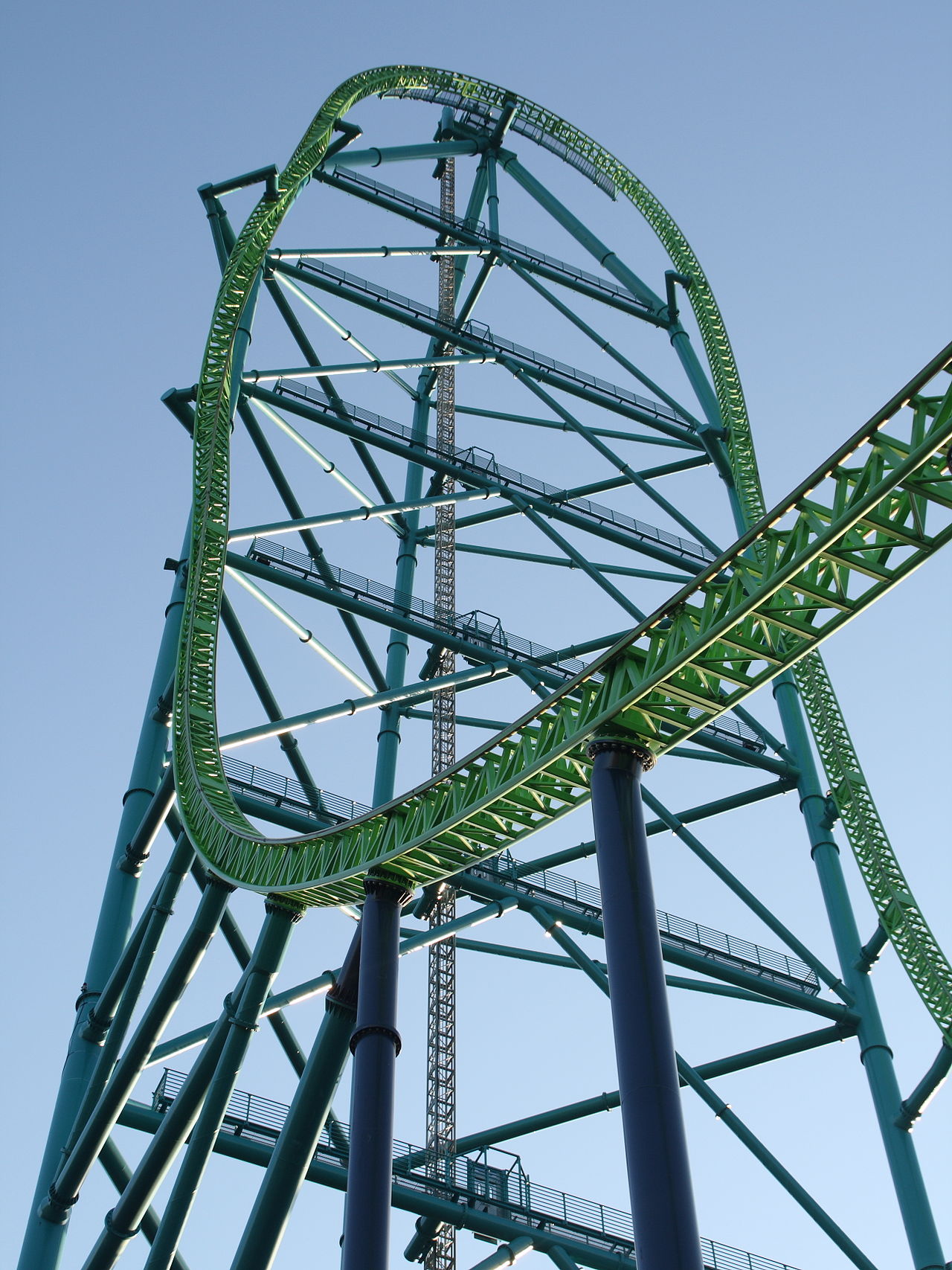
Kingda Ka is a steel launched roller coaster located at Six Flags Great Adventure in Jackson, New Jersey, United States. Opened in May 2005, it was designed to push the practical limits of height and acceleration for a commercially operated amusement ride. Classified as a "strata coaster" because its peak exceeds 400 feet, Kingda Ka became notable for combining an exceptionally tall vertical element with a very short, intense ride cycle.
Image gallery
6 Images


Design and construction
The attraction was developed for the park by the Swiss company Intamin, with assembly and on-site construction handled in part by subcontractors. Its most visible feature is a single, towering top-hat element: a long horizontal launch accelerates a train to top speed and propels it nearly vertically up the tower, where it crests and returns along the same path. The structure and track are heavy-gauge steel engineered to resist high dynamic loads produced during the rapid acceleration and abrupt change of direction. The launch system uses a high-powered mechanism to accelerate the train on a short launch track instead of a conventional chain lift.
Ride experience
Riders experience a very brief but intense sequence: a high-tension launch to roughly 128 miles per hour, a near-vertical ascent up the 456-foot tower, a brief moment at or near the apex, and a return descent followed by a small airtime hill and final braking. The interval from launch to final brakes is short compared with many modern coaster layouts; the most memorable sensations are the extreme acceleration and the height-induced view from the top of the tower. The launch is completed in only a few seconds, and the entire high-speed portion of the ride is measured in tens of seconds rather than minutes.
Statistics and operation
- Height: approximately 456 feet (about 139 m)
- Top speed: approximately 128 miles per hour (about 206 km/h)
- Launch interval: accelerated to top speed in roughly 3–4 seconds
- Typical active ride time: the primary launch and tower cycle is under a minute; the core thrill portion is under half a minute
Records, comparisons and operation limits
At opening Kingda Ka was promoted as both the tallest and fastest coaster in commercial operation. It remains one of only two roller coasters commonly described as "strata" coasters; the other early example is a similar high-speed, very tall launch coaster that aimed for comparable records. Its top-speed record was later exceeded by Formula Rossa, installed at a park in Abu Dhabi. Because of its extreme profile, Kingda Ka is sensitive to weather conditions: high winds, lightning, or other adverse conditions routinely require temporary closures. The ride is equipped with systems and procedures to handle events such as a launch that does not clear the tower (a "rollback"); these are anticipated in design and training so the train can be brought to rest and returned to the station safely.
Safety, maintenance and legacy
Rides of this size require rigorous inspection and maintenance programs. Daily checks, non-destructive testing of critical components, and redundant braking and control systems are typical. Because the attraction emphasizes a short, extreme experience rather than a long sequence of elements, operational reliability and launch-system maintenance are major concerns for the park. Over the years Kingda Ka has attracted attention for both its headline-making statistics and the practical challenges of running a very tall, high-speed launch coaster reliably and safely.
Cultural and engineering significance
Kingda Ka exemplifies a specific approach to coaster design that prioritizes records and spectacle: a single dramatic element that produces instant publicity and draws visitors seeking an extreme one-off experience. Its influence is visible in how some parks allocate capital to headline attractions intended to draw crowds and press coverage, while other designers have continued to focus on longer, more varied layouts that emphasize sustained ride storytelling and elements. As an engineering accomplishment, Kingda Ka remains a reference point in discussions of launch-system technology, structural design at great height, and the operational trade-offs inherent to peak-seeking attractions.
Questions and answers
Q: Where is Kingda Ka located?
A: Kingda Ka is located at Six Flags Great Adventure in Jackson, New Jersey, USA.
Q: Who built Kingda Ka?
A: Kingda Ka was built by Stakotra, a subcontractor to Intamin.
Q: What was Kingda Ka built to be?
A: Kingda Ka was built to be the world's tallest and fastest roller coaster.
Q: How fast can Kingda Ka go?
A: Kingda Ka can go 128 miles per hour (206 km/h).
Q: What other records did Kingda Ka hold?
A: Kingda Ka held the record for the world's fastest roller coaster until the completion of Formula Rossa at Ferrari World in Abu Dhabi, United Arab Emirates.
Q: How is the train launched to get up 456 feet?
A: The train is launched by a machine that can launch it to 128 miles per hour in 3 seconds.
Q: How long does the ride on Kingda Ka last from the time it is launched?
A: The ride on Kingda Ka lasts 28 seconds from the time it is launched.
Related articles
Author
AlegsaOnline.com Kingda Ka — strata coaster at Six Flags Great Adventure Leandro Alegsa
URL: https://en.alegsaonline.com/art/53579
Sources
- stakotra.sk : stakotra.sk