
King eider (Somateria spectabilis): description, range, behaviour and ecology
A large Arctic sea duck, the king eider breeds on coastal tundra and winters in subarctic seas. Distinctive male plumage, diving diet of benthic invertebrates, and periodic large flocks characterize the species.
Overview
The king eider (Somateria spectabilis) is a large marine duck found across the high northern latitudes. A member of the sea ducks, it spends most of the year in coastal waters and moves to Arctic coasts and tundra in summer to nest. The species is notable for the male's striking, multicoloured head and for winter congregations that may number in the tens of thousands.
Image gallery
8 Images



Identification and appearance
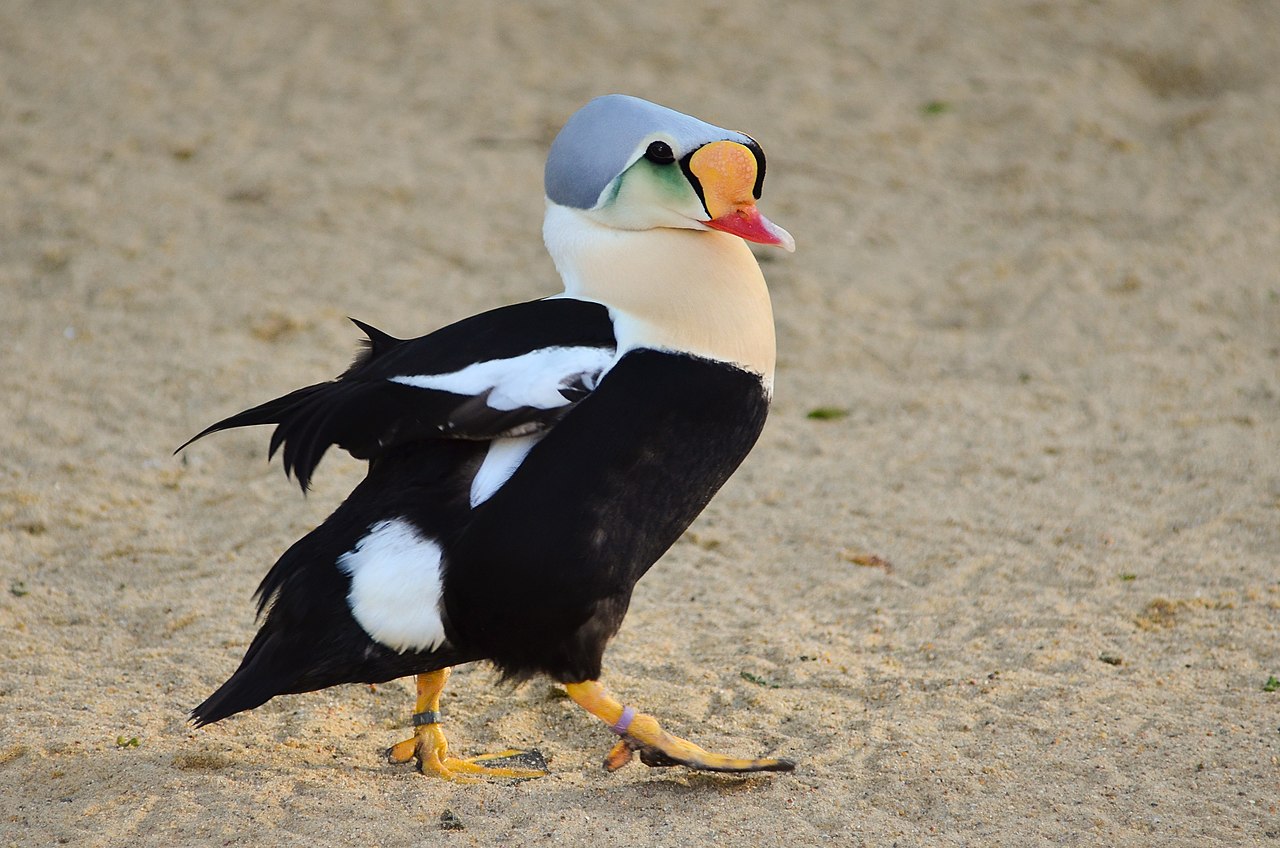
Adult males show a bold contrast of black body and white breast with a colorful, bulbous head. The drake's bill becomes more brightly coloured in winter and the voice is a low coo. Females are cryptically coloured brown, which helps conceal nests and incubating birds. Females can generally be distinguished from smaller ducks by size and structure, although they are more similar to other eider species than to most waterfowl; the king eider is smaller than the common eider. Juvenile males in first winters often show an intermediate appearance with a dark body, pale breast, and a patch of yellow on the bill.
Range, migration and habitat
King eiders breed along the Arctic coasts of northeast Europe, North America and Asia. During spring and summer they migrate inland only a short distance to nest on coastal and low-lying tundra; many populations return to the Arctic tundra to breed. Important breeding locations include the bird-rich coasts and river deltas of the north coast of Alaska. In winter the species occupies subarctic and Arctic marine waters: key wintering areas include the eastern Canada coast, the northern Norway coast and the productive waters of the Bering Sea. Non-breeding vagrants or seasonal visitors may appear off the northeastern United States, Scotland and Kamchatka.
Feeding and behaviour
King eiders are diving ducks that forage on or near the seabed for benthic invertebrates. Their diet is composed mainly of crustaceans, polychaete worms and various molluscs; mussels are a commonly reported prey item where available. Foraging often occurs in relatively shallow coastal waters and around islands and leads in pack ice. In winter, birds form large flocks on sheltered coasts and sea surfaces; these concentrations can be important for feeding efficiency and predator avoidance.
Breeding and life cycle
On arrival to tundra breeding grounds in early summer, females select a scrape or shallow depression near shelter and line it with grasses and down plucked from their own breasts. Clutch size is typically four to seven eggs, and the precocial ducklings leave the nest soon after hatching to follow their mother to nearby water. Like other eiders, the species invests heavily in insulating down, which is valuable both for the young and, historically, for human use.
Population notes, human interactions and conservation
Numbers of king eiders fluctuate naturally and locally in response to food availability, ice conditions and predation. Large winter flocks — sometimes reported in very high numbers — underline the species' reliance on productive coastal marine habitats. King eiders have been hunted by Indigenous peoples for food and occasionally for down, and they can be vulnerable to oil pollution, habitat changes and disturbances to coastal feeding grounds. Their conservation depends on maintaining healthy marine ecosystems and monitoring population trends.
Quick facts
- Scientific name: Somateria spectabilis.
- Family: sea ducks (sea duck group).
- Typical nest: ground scrape lined with grass and down.
- Diet: crustaceans, polychaetes, molluscs including mussels.
- Range highlights: northeast Europe, North America, Asia, wintering in eastern Canada, the Bering Sea and northern Norway.
- Occasional sightings: northeastern United States, Scotland, Kamchatka.
For more detailed regional information and monitoring reports, consult specialist sources and conservation groups focused on Arctic waterbirds and marine habitats.
Distinctive comparisons: female king eiders are plain compared with males but are still larger than most ducks (all ducks), and differ from the other eider species by head shape and bill feathering.
Questions and answers
Q: What is the king eider?
A: The king eider (Somateria spectabilis) is a large sea duck.
Q: Where does the king eider breed?
A: The king eider breeds along Northern Hemisphere Arctic coasts of northeast Europe, North America and Asia.
Q: When do they migrate to the Arctic tundra to breed?
A: They migrate to the Arctic tundra to breed in June and July.
Q: How many eggs do they lay?
A: They lay four to seven eggs in a scrape on the ground lined with grass and down.
Q: Where do they winter?
A: The king eider winters in arctic and subarctic marine areas, most notably in the Bering Sea, the west coast of Greenland, eastern Canada and northern Norway. It also happens yearly off the northeastern United States, Scotland and Kamchatka. Breeding areas include the Arctic coastal tundra of the north coast of Alaska.
Q: What type of food do they eat?
A: This species dives for benthic invertebrates, such as crustaceans, polychaete worms, and molluscs, with mussels being a favoured food.
Q: How big can flocks get?
A Wintering birds can form large flocks on suitable coastal waters, with some flocks bigger than 100,000 birds.
Related articles
Author
AlegsaOnline.com King eider (Somateria spectabilis): description, range, behaviour and ecology Leandro Alegsa
URL: https://en.alegsaonline.com/art/53536
Sources
- iucnredlist.org : Somateria spectabilis
- commons.wikimedia.org : Somateria spectabilis