
Archostemata: the primitive, basal suborder of beetles
Archostemata is a small, ancient suborder of beetles with fewer than fifty living species. They retain primitive traits, have a rich fossil history, and include unusual life cycles such as paedogenesis.
Overview
Archostemata is a small and ancient suborder of Coleoptera (beetles) that includes fewer than fifty known living species. These insects are often described as "primitive" because they preserve a suite of ancestral anatomical features not seen in most modern beetles. Extant members are geographically scattered and comparatively rare, but the group has a long fossil record that shows it was once far more diverse and widespread. For general context on beetle classification and diversity see beetle suborders and classification.
Image gallery
1 Image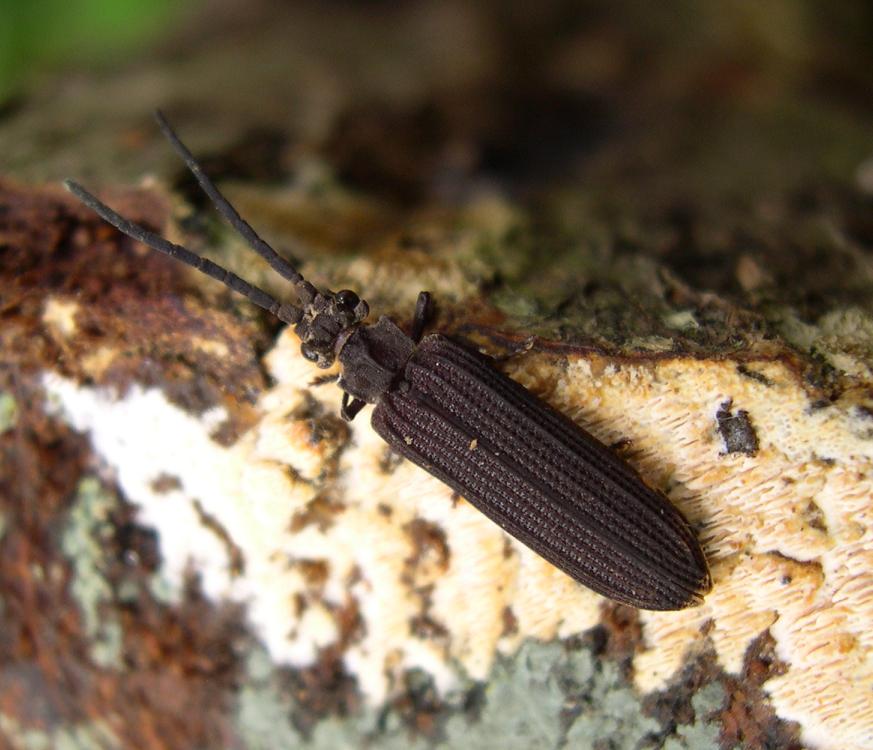
Key characteristics
Archostematan beetles are defined by a combination of morphological traits that specialists recognize as plesiomorphic (ancestral). Typical features include distinctive patterns on the elytra, comparatively complete wing venation, and mouthparts and abdominal structures that differ from those of more derived beetle groups. These traits are useful for identifying fossils as well as living specimens.
- Notable living families: Cupedidae (reticulated beetles), Ommatidae, Micromalthidae, and Jurodidae.
- Distinctive features: reticulate elytral sculpture, conservative wing venation, and other ancestral anatomical characters.
- Special life-history note: the species Micromalthus debilis shows paedogenesis (reproduction by larval stages), an unusual strategy among beetles.
Fossil record and evolutionary significance
Archostemata have one of the deepest fossil records among beetles. Fossils from Permian and Triassic deposits indicate that members of this lineage were abundant and globally distributed in the Paleozoic and early Mesozoic eras. The continuity of certain anatomical features from those fossils to living forms has led many researchers to treat Archostemata as the basal or earliest-diverging suborder of true beetles. For more on fossil evidence and cladistic studies consult fossil and phylogenetic research.
Ecology, life cycles, and rarity
Living archostematans occupy a range of mostly cryptic habitats. Many are associated with decaying wood, fungal substrates, or other hidden microhabitats where they feed and develop. Their populations are typically sparse, and several species are known from only a few localities. The rarity of extant Archostemata stands in contrast to their fossil abundance, suggesting a major reduction in diversity over geological time. For ecological summaries and species lists see species databases and morphological trait references.
Taxonomic notes and notable facts
Taxonomically, Archostemata is treated as one of the principal suborders of Coleoptera. Its composition and internal relationships have been refined through both fossil discoveries and modern phylogenetic methods. A widely cited curiosity within the group is the paedogenic reproductive behavior of Micromalthus debilis, which is the only beetle known to routinely reproduce through larval forms; this feature has been the subject of ecological and developmental studies. For introductions to family-level treatments and conservation status consult family accounts, paleontological summaries, and additional resources.
Archostemata therefore occupy an important place in beetle evolution: they offer a living window into ancestral morphologies and life histories while their fossil record helps reconstruct the early diversification of Coleoptera. Ongoing fieldwork, taxonomic revision, and paleontological discoveries continue to refine our understanding of this small but scientifically significant group.
Questions and answers
Q: What is Archostemata?
A: Archostemata is the smallest suborder of beetles with less than fifty known species.
Q: How old is the lineage of Archostemata?
A: Archostemata is an ancient lineage that is similar to the first beetles that appear in the fossil record about 250 million years ago.
Q: What makes Archostemata different from other beetle suborders?
A: Archostemata contains the only paedogenic beetles known as Micromalthus debilis and has a number of primitive characteristics.
Q: Are Micromalthus debilis beetles common or rare?
A: Micromalthus debilis beetles are rare.
Q: Was Archostemata once more common in the past?
A: Yes, fossil deposits from the Permian suggest that Archostemata were once much more common and were widespread over the globe.
Q: What is the significance of Abundant cladistic and fossil evidence?
A: Abundant cladistic and fossil evidence shows that the Archostematans are the basal suborder of true beetles.
Q: How many species of Archostemata are currently known?
A: There are less than fifty known species of Archostemata.
Related articles
Author
AlegsaOnline.com Archostemata: the primitive, basal suborder of beetles Leandro Alegsa
URL: https://en.alegsaonline.com/art/5327