
Archimedes' screw
A helical pump attributed to Archimedes, used to lift water and, in reverse, to generate low-head hydropower; valued for simplicity, durability and tolerance of debris.
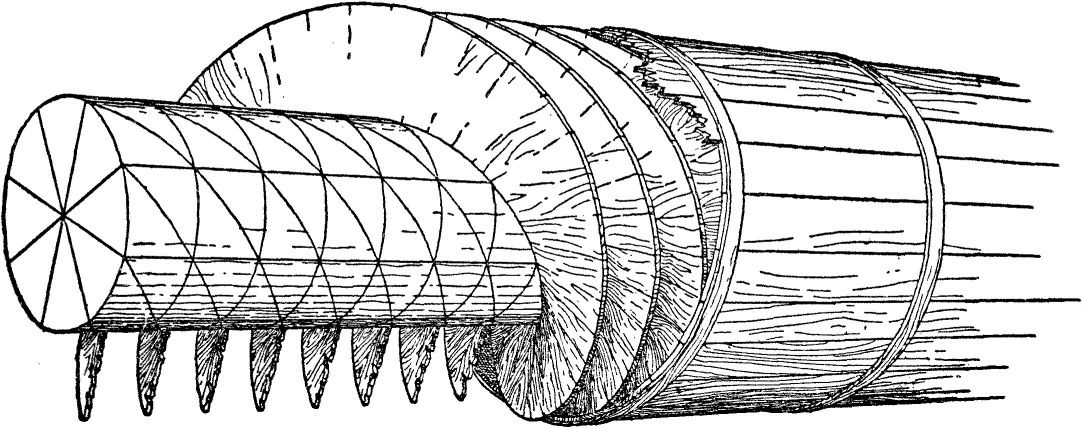
The Archimedes' screw is a helical device used to move water and other fluids up a slope. It consists of a spiral blade, or flight, wrapped around a central shaft and housed within a close-fitting trough or cylinder. With the lower end placed in the source water, rotation of the shaft traps successive volumes of liquid in pockets between the flights and carries them upward, discharging at the top. The mechanism is simple to build and operate, tolerates suspended solids and grit, and has been employed in irrigation, drainage and industrial applications for millennia.
Image gallery
9 Images


Design and operating principle
The basic geometry of an Archimedes' screw includes the overall diameter, the diameter of the central shaft, the pitch (axial distance between successive turns), the number of flights, and the inclination angle relative to horizontal. These dimensions determine volumetric capacity, the maximum head the screw can overcome, and hydraulic efficiency. Clearance between the flights and the enclosing trough affects leakage and wear. Rotation may be supplied by hand, animal power, wind, motors, or other prime movers; see the device described as a machine or used specifically as a pump.
Historical context and attribution
The screw is traditionally associated with the mathematician and engineer Archimedes of Syracuse, who lived in the 3rd century BCE and wrote about similar devices while in Alexandria. Direct evidence about its earliest invention is limited, so attribution to Archimedes is conventional rather than definitively proven. Variants of the screw appear in historical records around the Mediterranean, and it was widely adopted for moving irrigation water into fields and draining marshes.
Variations and construction
Materials and construction have evolved: ancient screws were often made from wood and metal bands, while modern units use stainless steel, coated metals or composite plastics for corrosion resistance and longevity. Screws may be enclosed in a close-fitting cylinder or operate in an open trough. Pitch, number of starts, and support bearings are adjusted to suit flow rates, head and the nature of the liquid handled.
Common applications
- Irrigation and drainage: moving water from canals or rivers into agricultural ditches and fields.
- Municipal and industrial pumping: handling wastewater, stormwater and slurries where solids and debris are present.
- Marine uses: compact screws have been used for bilge pumping and other shipboard dewatering tasks.
- Hydropower generation: operated in reverse, flowing water can turn the screw to produce electricity in small low-head installations.
Reverse operation as a turbine
When water is delivered to the top of the screw and allowed to flow downward, the passing fluid induces rotation of the shaft. Coupled to a generator via suitable gearing or a direct drive, the rotating shaft produces electrical power. Such screw turbines are particularly attractive at sites with modest drops where conventional turbines are less effective: they are tolerant of variable flow, can pass debris with less clogging, and are considered fish-friendly because of their gentle rotational speeds.
Advantages and limitations
Advantages include mechanical simplicity, robustness in dirty or debris-laden waters, low maintenance requirements, and scalability from portable hand-operated units to large installations several metres in diameter. Limitations include relatively low maximum head compared with high-pressure pumps and typically lower specific speed than some turbine types. Proper installation requires a stable support structure to maintain inclination and prevent misalignment.
Operation, efficiency and maintenance
Efficiency depends on design details, installation, and operating conditions; modern seals, bearings and variable-speed drives improve performance. Routine maintenance focuses on removing trapped debris, inspecting bearings and supports, and monitoring clearances to limit leakage. In pump mode the device is forgiving of suspended solids; in turbine mode, screening and trash racks upstream may still be used to protect ancillary equipment.
Environmental and engineering considerations
Screw installations often have low environmental impact relative to some other options: they can allow safe fish passage, have modest noise levels, and fit well into river restoration or irrigation modernization projects. Engineers evaluate site head, flow variability, sediment load and accessibility when selecting a screw for pumping or power generation. For practical design and installation guidance consult specialist engineering texts and manufacturer manuals.
Further reading and resources
General introductions treat the screw as a historical and mechanical device; for specific topics see materials on the device as a windmill-driven or mechanically powered mechanism, its use with modern engines, and accounts of Archimedes and his era in classical sources and studies of Alexandria and Egypt. For practical installations consult guidance on the enclosing cylinder, irrigation systems, and contemporary small hydro references (regional histories and technical summaries). See also introductory overviews of pumps and machines at general resource hubs and technical collections (machine, pump).
Questions and answers
Q: What is Archimedes' screw?
A: Archimedes' screw is a machine used for raising water up, consisting of a screw inside a fairly tight-fitting cylinder.
Q: How does Archimedes' screw work?
A: With the bottom end in water, the screw lifts water up to the top, where it pours out of a spout. The screw can be turned by hand, or by a windmill or engine.
Q: What is the purpose of Archimedes' screw?
A: Archimedes' screw is often used for filling irrigation ditches.
Q: Who is believed to have invented Archimedes' screw?
A: Although it is not known for certain, Archimedes is always attributed to have invented the screw.
Q: Where did Archimedes write about the screw?
A: Archimedes wrote about the screw when he was in Alexandria, Egypt.
Q: What is the reverse Archimedes' screw?
A: The reverse Archimedes' screw is a kind of screw that turns when water is poured in on top. The turning drives an electric generator, which creates electricity.
Q: What are the benefits of using the reverse Archimedes' screw?
A: The reverse screw can handle very dirty water and widely varying rates of flow, with high efficiency, making it good for rivers with modest water drops ('low heads').
Tags
Related articles
Author
AlegsaOnline.com Archimedes' screw Leandro Alegsa
URL: https://en.alegsaonline.com/art/5315
Sources
- mwbdvjh.muse.jhu.edu : mwbdvjh.muse.jhu.edu