
Archaeothyris: an early synapsid from the Late Carboniferous
Archaeothyris is one of the earliest definite synapsids, known from Late Carboniferous fossils in Nova Scotia. It illustrates early mammal-line adaptations and the split from sauropsids.
Overview
Archaeothyris is a genus of early synapsid known from Late Carboniferous rocks. It is often cited as one of the earliest definite synapsids, the lineage that eventually led to mammals. Its fossils come from exposed coal-bearing strata dated to the Pennsylvanian subperiod of the Carboniferous, roughly three hundred million years ago. The remains were recovered in coastal deposits of Nova Scotia, a region famous for well-preserved early terrestrial vertebrates.
Image gallery
9 Images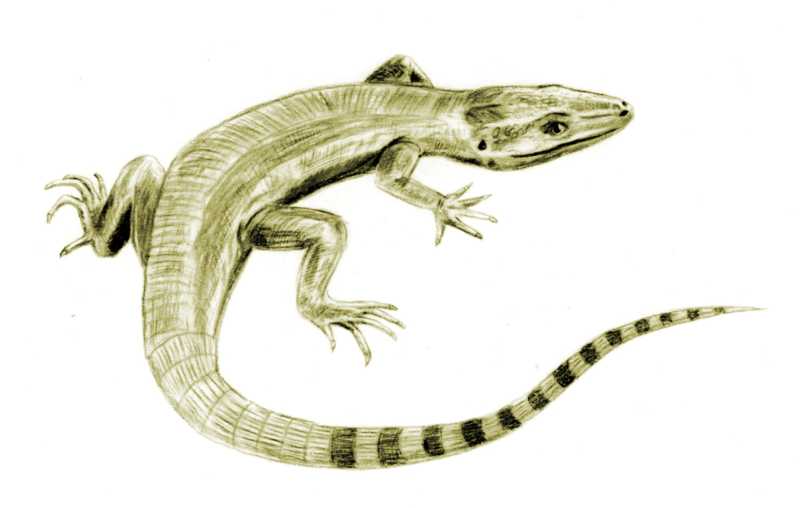


Anatomy and adaptations
Archaeothyris had a compact, lizard-like body and a skull showing the key synapsid feature: a single temporal opening behind each eye that provided attachment area for jaw muscles. Its jaws bore differentiated teeth, including enlarged canine-like teeth, indicating a carnivorous or insectivorous diet. Known elements suggest a terrestrial lifestyle, with limb proportions suited to walking rather than climbing or swimming.
Discovery and geological context
Specimens of Archaeothyris were collected from fossil-rich layers that also preserve a diverse assemblage of early amniotes. At the same locality paleontologists have found early reptiles such as Hylonomus and the more lizard-like Petrolacosaurus. Those animals are usually interpreted as part of the sauropsid branch (sauropsids) that gave rise to modern reptiles and birds, illustrating an early split between the two great amniote lineages.
Significance and relationships
Archaeothyris helps document the early stages of synapsid evolution: it shows the skull and dental specializations that distinguish the mammal line from its reptile relatives. Some slightly older fragmentary fossils, for example Protoclepsydrops, may also belong to early synapsids, but their incomplete preservation makes Archaeothyris one of the clearest early examples. Its presence alongside primitive sauropsids offers a snapshot of the ecological diversity in Late Carboniferous terrestrial ecosystems.
Notable facts
- Represents an early stage in the mammal lineage before more familiar synapsid groups evolved.
- Important for understanding the functional origin of stronger jaw musculature and tooth differentiation.
- Found in the same fossil beds as some of the oldest known reptiles, highlighting the early amniote radiation.
Together, the anatomy and context of Archaeothyris make it a cornerstone fossil for interpreting how the mammal lineage diverged from other amniotes and adapted to a fully terrestrial lifestyle during the Carboniferous.
Questions and answers
Q: What is Archaeothyris?
A: Archaeothyris is the earliest definite synapsid.
Q: When did Archaeothyris live?
A: Archaeothyris lived in the late Carboniferous period, 306 million years ago.
Q: Where was Archaeothyris found?
A: Archaeothyris was found in Nova Scotia.
Q: What other animals were found at the same locality as Archaeothyris?
A: Hylonomus and Petrolacosaurus were found at the same locality as Archaeothyris.
Q: Are Hylonomus and Petrolacosaurus similar to Archaeothyris?
A: Yes, Hylonomus and Petrolacosaurus are similar to Archaeothyris.
Q: What is Protoclepsydrops?
A: Protoclepsydrops is an animal slightly older than Archaeothyris.
Q: Is the status of Protoclepsydrops as a synapsid clear?
A: No, the status of Protoclepsydrops as a synapsid is unclear as the remains are more fragmentary.
Related articles
Author
AlegsaOnline.com Archaeothyris: an early synapsid from the Late Carboniferous Leandro Alegsa
URL: https://en.alegsaonline.com/art/5282
Sources
- findarticles.com : article