
Keith Haring
American artist and activist (1958–1990) known for bold graphic imagery, public murals, subway drawings and work addressing social issues; founder of the Keith Haring Foundation.
Overview
Keith Haring (May 4, 1958 – February 16, 1990) was an American artist whose energetic, graphic imagery became a defining visual language of 1980s New York. He rose to public attention with quick, chalk drawings in subway stations and expanded into large public murals, gallery exhibitions and commercial collaborations. Haring's work combined elements of street culture, pop art and graphic design to produce simple, instantly recognizable symbols that carried social messages.
Early life and training shaped Haring's interest in public communication and cartoons; he studied at the School of Visual Arts in New York and immersed himself in the downtown art scene where he associated with contemporaries such as Jean-Michel Basquiat and Andy Warhol. He was openly gay and his identity informed several subjects in his art.
Image gallery
10 Images


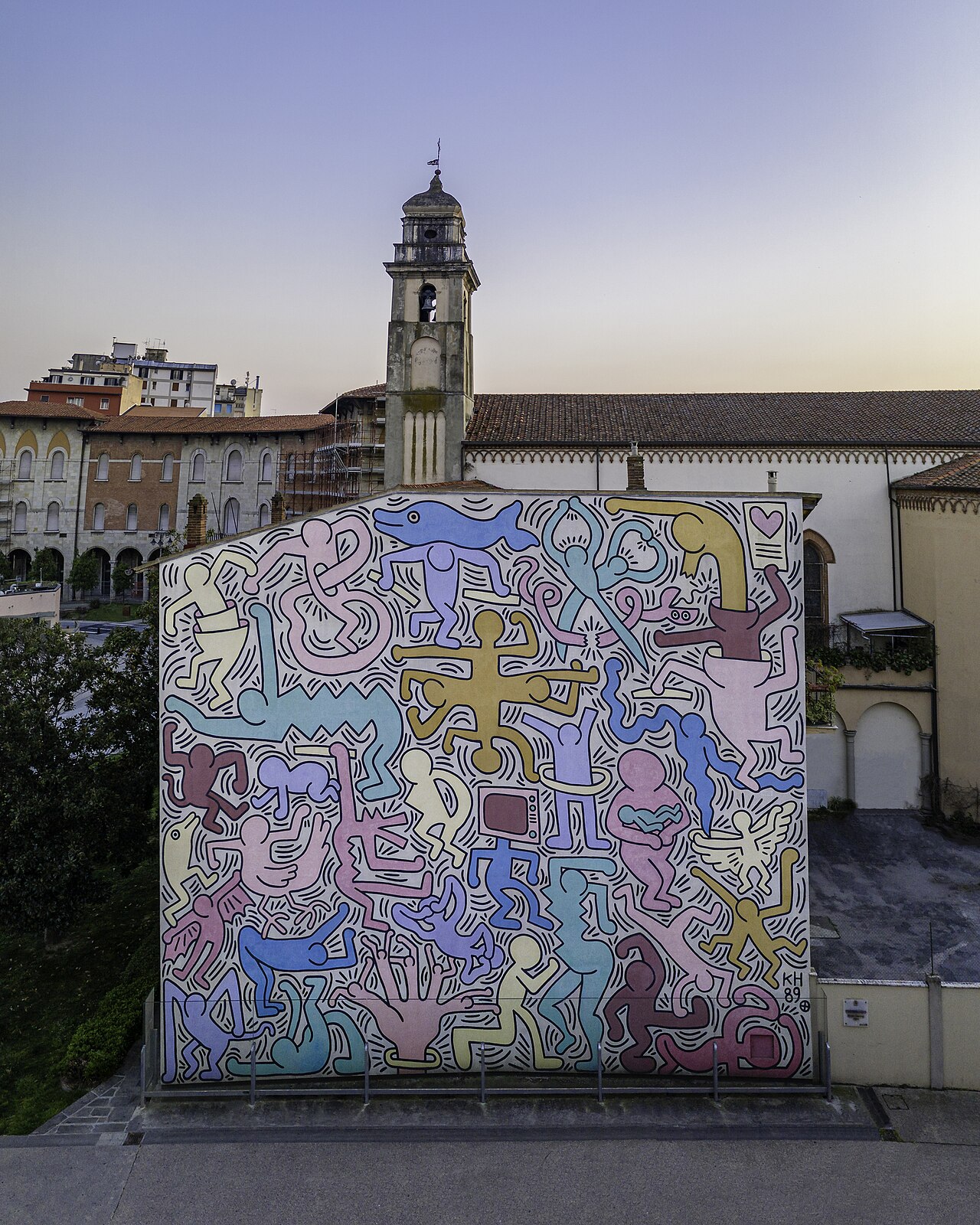
Visual style and motifs
Haring favored bold outlines, flat fields of color and recurring pictograms — dancing figures, radiant babies, barking dogs and angular human forms — which function like a personal iconography. His imagery drew from graffiti's immediacy and pop art's readability: simple lines conveyed movement and emotion while remaining adaptable across media from posters to painted murals. For many viewers these motifs became shorthand for themes such as birth, death, love, and social struggle.
Career and public art
After gaining attention with subway drawings, Haring moved fluidly between street projects and institutional contexts, creating site-specific murals and collaborating with museums and commercial brands. One of his most famous public commissions is the mural "Crack Is Wack"; he also executed community murals that aimed to make art accessible outside conventional galleries. His work circulated widely through prints, T-shirts and posters, which helped spread his imagery internationally.
Social engagement and legacy
Haring used his visibility to address social issues including AIDS awareness, safe-sex education and support for children and marginalized communities. After his HIV-positive diagnosis he became more vocal about AIDS-related suffering and prevention, and he offered his art and funds to benefit organizations in need. He donated time and money to causes and created works intended to educate as well as to beautify public spaces.
Foundation and ongoing influence
In 1989 he established the Keith Haring Foundation to preserve his work and to distribute funds to charities and arts programs for youth and people living with AIDS. The foundation continues to support exhibitions, educational initiatives and licensing that keeps his imagery in circulation. For more on Haring's exhibitions, rights and the foundation's programs see exhibitions, collections and educational resources.
Haring remains a touchstone for artists who combine public art, activism and a graphic vernacular. His legacy is visible in contemporary street art practices, museum retrospectives and cultural references worldwide. Further reading and archival material can be found via institutional entries and specialist catalogues: biography, catalogue raisonné, educational guides and foundation records.
Questions and answers
Q: Who is Keith Haring?
A: Keith Haring was an American artist who gained fame in the 1980s for his mixture of graffiti and pop art that used bright colors and simplistic images, as well as social and homoerotic themes.
Q: What was Keith Haring famous for?
A: Keith Haring was famous for his art that was a mixture of graffiti and pop art and used bright colors and simplistic images, as well as social and homoerotic themes.
Q: What did Keith Haring donate money to?
A: Keith Haring donated money to children's causes and organizations.
Q: Was Keith Haring openly gay?
A: Yes, Keith Haring was openly gay.
Q: How did Keith Haring die?
A: Keith Haring died of an AIDS-related illness in 1990.
Q: What is the Keith Haring Foundation?
A: The Keith Haring Foundation, set up in 1989, continues his legacy of promoting art and helping children.
Q: Did Keith Haring's artwork become well known around the world?
A: Yes, Keith Haring's artwork became well-known around the world.
Related articles
Author
AlegsaOnline.com Keith Haring Leandro Alegsa
URL: https://en.alegsaonline.com/art/52740