
Keel-billed Toucan (Ramphastos sulfuratus)
A colorful tropical bird of the toucan family found from southern Mexico to northern South America; known for its large multicolored bill, social behavior, and role in forest ecology.
The keel-billed toucan (Ramphastos sulfuratus), sometimes called the rainbow-billed or sulfur-breasted toucan, is a striking member of the tropical bird fauna of Central and northern South America. It belongs to the toucan family Ramphastidae and is widely recognized by its oversized, vividly marked bill. The species also holds national symbolism in some places and is the national bird of Belize.
Image gallery
10 Images


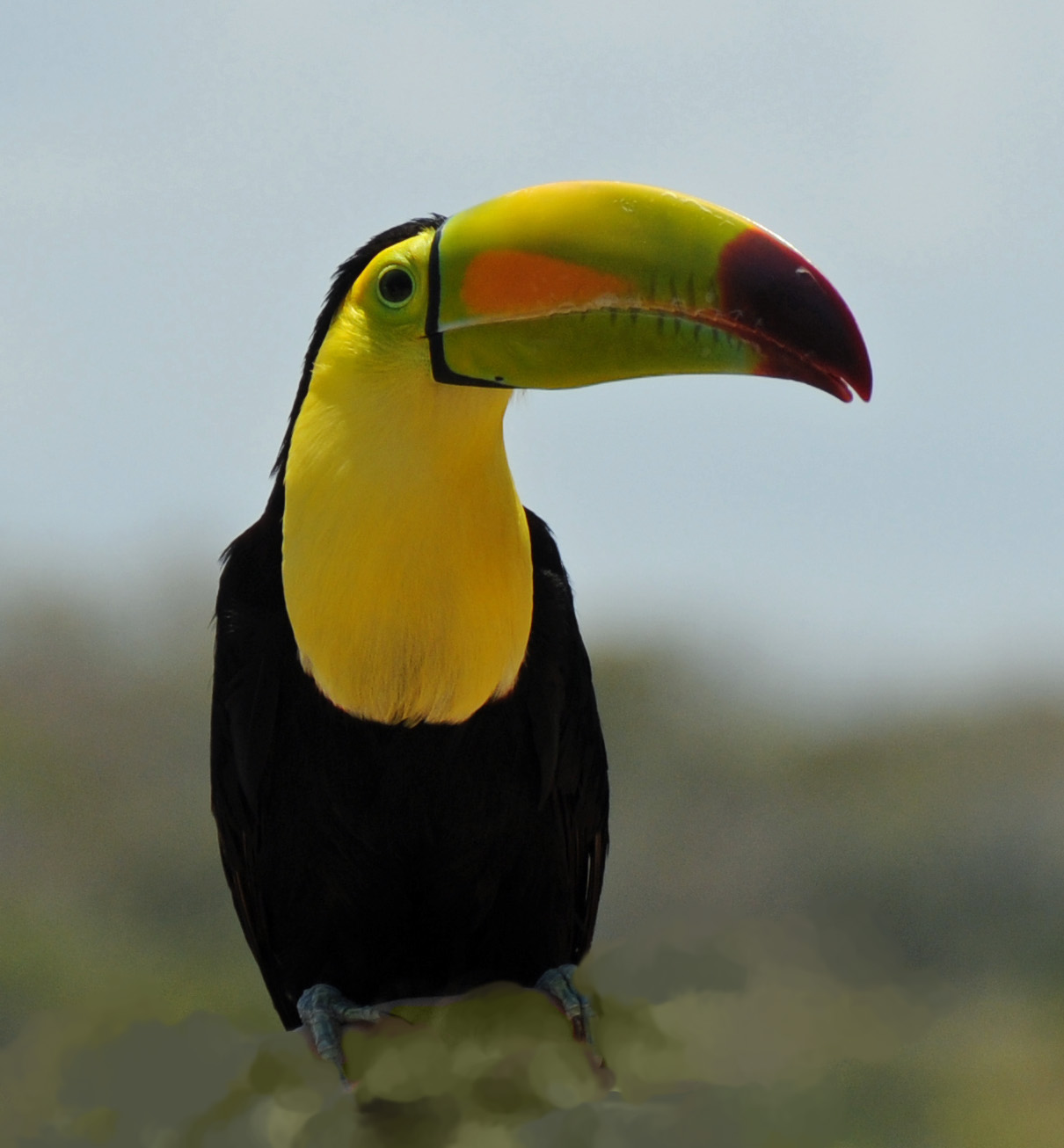

Identification and physical traits
Keel-billed toucans are medium-to-large arboreal birds with a compact body, short wings, and a long, laterally flattened bill. The bill displays several bright colors, often including green, orange and red tones, creating the species' common name. Plumage is primarily black with a pale throat or breast that can appear yellowish; the tail and face show contrasting patches. Sexes are similar in appearance, and juveniles have duller bills and softer coloring.
Range and habitat
Its native range extends from southern Mexico through parts of Central America and into northern South America, including regions of Venezuela and Colombia. The keel-billed toucan favors humid lowland forests, forest edges and secondary growth, where tall trees with cavities provide nesting opportunities. Lowland rainforest and adjacent wooded areas are typical habitats cited by field guides and studies; see resources on tropical forests for more context here.
Behavior, diet and ecology
These toucans are highly social birds and are commonly observed in small groups or flocks of several individuals, often moving together through the canopy (social flocks). They are not strong long-distance fliers and usually travel by hopping between branches. The keel-billed toucan has an omnivorous diet dominated by fruit, but it also eats insects, small reptiles, eggs and nestlings on occasion. By consuming and dispersing seeds, it contributes to forest regeneration and plant diversity.
Reproduction and lifespan
Keel-billed toucans nest in tree cavities, either natural holes or abandoned woodpecker nests. Both parents typically share duties such as incubating eggs and feeding chicks. Young are altricial — born relatively helpless — and remain in the nest until they are able to clamber out and feed. In captivity and protected settings toucans may live many years; in the wild their lifespan is shorter and influenced by predation and habitat quality.
Conservation and human connections
While the keel-billed toucan is not currently considered highly threatened across its whole range, local populations can decline because of habitat destruction, fragmentation and capture for the pet trade. Conservation efforts focus on protecting continuous tracts of tropical forest and preserving nesting trees. Beyond conservation concerns, the species is an important cultural and ecological symbol in its range and appears frequently in ecotourism literature and natural history outreach.
- Key features: bright multicolored bill, black body, pale throat.
- Habitat: lowland tropical forests and forest edges (rainforest habitats).
- Sociality: moves in small groups or flocks, often vocal and conspicuous in the canopy.
For region-specific information, species accounts and conservation status, consult regional bird guides and databases that cover the range from Mexico to northern South America, including Venezuela and Colombia. Additional resources and outreach materials are available through organizations and educational pages linked here and here.
Questions and answers
Q: What is the keel-billed toucan?
A: The keel-billed toucan is a colorful Latin American member of the toucan family.
Q: What are some other names for the keel-billed toucan?
A: Some other names for the keel-billed toucan are sulfur-breasted toucan or rainbow-billed toucan.
Q: Where can the keel-billed toucan be found?
A: The keel-billed toucan can be found from Southern Mexico to Venezuela and Colombia.
Q: What is the national bird of Belize?
A: The keel-billed toucan is the national bird of Belize.
Q: Is the keel-billed toucan a social bird?
A: Yes, the keel-billed toucan is a very social bird, rarely seen alone.
Q: How do keel-billed toucans move through trees?
A: Keel-billed toucans move mostly by hopping through trees.
Q: Is the keel-billed toucan a good flyer?
A: No, the keel-billed toucan is a poor flyer.
Related articles
Author
AlegsaOnline.com Keel-billed Toucan (Ramphastos sulfuratus) Leandro Alegsa
URL: https://en.alegsaonline.com/art/52687
Sources
- iucnredlist.org : "Ramphastos sulfuratus"
- belize.gov.bz : About Belize - National Symbols
- anywhere.com : "Keel-Billed Toucan, Costa Rica"
- saczoo.com : saczoo.com
- commons.wikimedia.org : Ramphastos sulfuratus