
Katana: The traditional Japanese curved samurai sword
The katana is a curved, single-edged Japanese sword long associated with the samurai. This article explains its form, history, making, uses in martial arts and cultural significance.
The katana is a Japanese curved, single-edged sword traditionally carried by samurai as part of a paired set. It is often described as the long component of the daishō, the matched pair of swords worn by samurai; the shorter counterparts are the wakizashi and the tanto. In modern descriptions a katana denotes a blade with a gentle curve, a single cutting edge, and a sharply pointed tip, designed for cutting as well as thrusting. For basic context see a general introduction to swords here.
Image gallery
10 Images

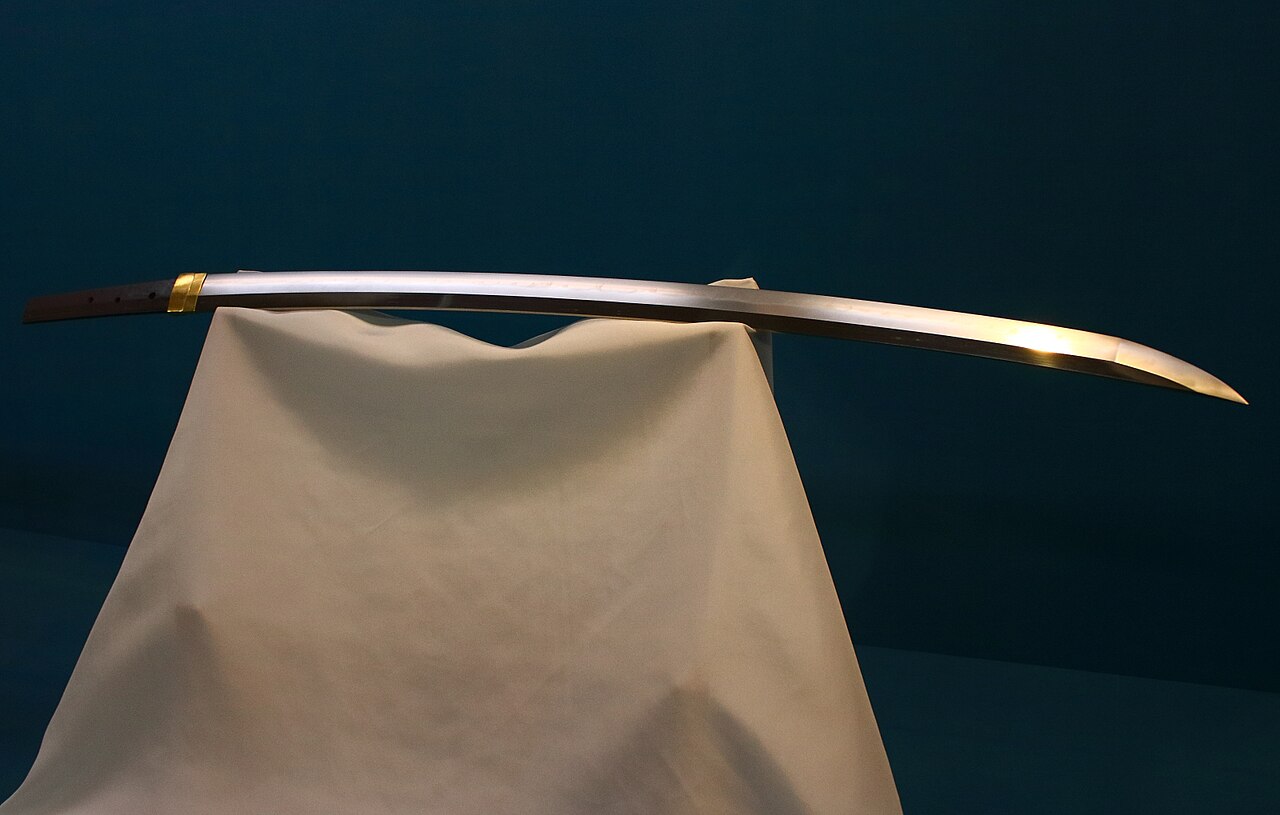


Characteristics and parts
A typical katana combines a long blade, a hilt wrapped for grip, and a scabbard. Key parts include:
- Ha (edge) — the sharpened cutting surface.
- Kissaki — the tip of the blade.
- Tsuba — the handguard, often decorative.
- Tsuka — the hilt, wrapped and fitted with pins.
- Saya — the wooden scabbard that protects the blade.
The blade often shows a visible temper line (hamon) and may display patterns from traditional forging and folding techniques. Read more about construction and metallurgy here.
History and development
The katana evolved in Japan over several centuries, adapting to changes in armor, battlefield tactics and swordmaking. It became particularly associated with samurai culture from the medieval period onward. During the 19th century, political and social reforms reduced the samurai class’s public role and, by the late 1800s, restrictions limited civilian carriage of swords. For broader historical context see further reading.
Craftsmanship and styles
Traditional swordsmithing combines folded-steel forging, differential hardening and careful polishing. Regional schools and individual smiths produced distinctive shapes, temper patterns and fittings. While premodern smithing methods are iconic, modern makers may use contemporary steel and tools while following classical techniques.
Uses and cultural significance
Beyond battlefield use, the katana is central to martial arts such as iaido and kenjutsu, where drawing and cutting techniques are practiced. It holds symbolic value as a cultural artifact, ceremonial object and collectible. Legal status, collecting rules and museum care vary by country and are governed by modern laws and conservation standards.
Notable distinctions
Although often called simply "samurai swords" in popular use, the katana differs from other blades by its curvature, edge geometry and typical length. Its reputation for craftsmanship has made it an enduring symbol of Japan’s martial and artistic traditions.
Questions and answers
Q: What is a katana?
A: A katana is a Japanese long sword used by samurai warriors.
Q: What are the three swords worn by samurai?
A: The three swords worn by samurai are the katana, wakizashi, and tanto.
Q: When was the katana popular?
A: The katana was popular from 1400 A.D. until 1876, when the samurai were abolished as a social class.
Q: What does "katana" mean in Japanese?
A: "Katana" means a long sword in Japanese.
Q: How is the blade of a katana represented?
A: The blade of a katana is represented by a little curved single edge with a very sharp point.
Q: Who used the katana?
A: Samurai warriors used the katana.
Q: Which of the three swords worn by Samurai is the most important?
A: The katana is the most important sword of the three swords worn by samurai.
Related articles
Author
AlegsaOnline.com Katana: The traditional Japanese curved samurai sword Leandro Alegsa
URL: https://en.alegsaonline.com/art/52476
Sources
- hanamiweb.com : hanamiweb.com/katana.html