
Kata: Japanese 'form' and prearranged movement in martial arts and theatre
Kata (型) are codified forms—prearranged sequences of movement—used in Japanese martial arts and traditional theatre to teach technique, timing, conditioning, and stylistic expression.
Overview
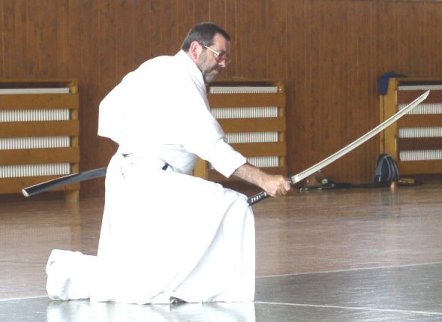
Kata (型, literally "form") is a Japanese term for a fixed pattern of movements widely used in martial arts and in traditional performing arts such as kabuki. In martial contexts kata are practiced as a solo or group exercise that preserves technique, develops body mechanics, and encodes tactical responses to imagined attacks. The word itself is often introduced as the Japanese term 'kata' for a repeatable form or model.
Image gallery
5 Images


Characteristics and structure
At its core a kata is a sequence of strikes, blocks, stances and footwork performed in a defined order. Each motion typically has an intended purpose and one or more possible applications. Practitioners pay careful attention to posture, breathing, rhythm, distance and timing so that movements can be delivered with power and accuracy. In describing kata it is useful to distinguish between the visible choreography and the underlying combat interpretation—sometimes called bunkai in karate.
Training methods and related practices
Kata are learned after or alongside basic drills; many schools emphasize kihon—fundamental techniques—before or while teaching kata. Practice formats include slow repetition for precision, faster execution for timing, and partner drills to test applications. In instructional vocabulary kata function as a kind of simulation of combat: though performed without an active opponent, each attack and defence is executed as if facing real resistance. This simulated aspect trains muscle memory and decision-making under stress.
History and development
The use of formalized movement sequences has long roots across East Asia; in Japan kata became especially associated with schools of karate, judo, kendo and aikido as ways to transmit technique reliably from teacher to student. Over generations kata have been adapted, codified and named; different styles preserve different sets of kata and interpret them in distinctive ways. For example, many karate systems divide kata into beginner, intermediate and advanced sets, each intended to build on prior lessons.
Uses, examples and importance
Kata serve multiple purposes: they act as repositories of technique, tools for physical conditioning, exercises in concentration and balance, and criteria for grading and competition. Famous examples in karate include Heian/Pinan series and Sanchin—forms that emphasize different ranges and principles. Beyond martial training, kata-like forms appear in theatrical disciplines where stylized gestures and poses communicate character and emotion.
Distinctions and notable facts
- Kata encode both movement and intent; careful study reveals applications beyond the obvious.
- Different schools or styles will interpret the same kata differently, producing varied timing, stance length and emphasis.
- Besides kinesthetic benefits, practice develops cognitive and psychological qualities such as focus, situational awareness and calm under pressure.
For further reading see introductory glossaries and style-specific guides; many instructors supplement kata study with partnered bunkai, sparring, and isolated technique drills to make the lessons practical and applicable. See also discussions of how kata relate to basic drills and tradition in systems like karate, and how the term appears in performance arts like kabuki. Additional resources and comparative notes are available through general martial-arts primers and language references: definition, training uses, and pedagogical outlines of sequence design.
Questions and answers
Q: What is the meaning of the word "kata"?
A: The word "kata" means "the form" in Japanese and is used in some martial arts and theatre.
Q: How is the word "kata" used in karate?
A: In karate, "kata" refers to a simulation of combat - a sequence of movements that is practiced and trained individually or in a group.
Q: What must a martial artist do before learning "kata"?
A: Before learning "kata", a martial artist must train in basic techniques called "kihon".
Q: What does the simulation of combat in "kata" represent?
A: The simulation of combat in "kata" represents a sequence of movements, attacks, and defenses in an imagined combat scenario.
Q: How should a karateka perform each movement in "kata"?
A: A karateka should perform each movement as if facing an opponent, with attacks and defenses executed as if they were in a real situation of danger.
Q: What is the goal of practicing "kata" in karate?
A: The goal of practicing "kata" is to develop the psychological and physical abilities necessary for real combat.
Q: What is the importance of timing and ability in "kata"?
A: In "kata", timing and ability are important as the karateka must show consideration for them in order to execute each movement correctly and effectively.
Related articles
Author
AlegsaOnline.com Kata: Japanese 'form' and prearranged movement in martial arts and theatre Leandro Alegsa
URL: https://en.alegsaonline.com/art/52467