
Karnak Temple Complex
Karnak is the largest ancient religious site, a vast complex of temples and monuments near Luxor on the Nile, developed over centuries as the principal cult centre of Amun in ancient Thebes.
The Karnak Temple Complex is a vast ensemble of temples, chapels, pylons, obelisks, and courtyards clustered near Luxor on the Nile in Egypt. Regarded as the largest ancient religious site in the world, Karnak grew over many centuries into a monumental record of pharaonic religion, art and architecture. It lies to the south of Cairo and formed the principal cult centre of Amun in the city known to the Greeks as Thebes.
Image gallery
10 Images




Layout and principal structures
The complex is made up of several precincts, the largest being the Precinct of Amun-Re, which contains the principal temples and the famous Great Hypostyle Hall. Other important areas include the precincts dedicated to the goddesses and gods Mut and Montu, a sacred lake used in ritual purification, storerooms, and administrative buildings. The core of the cult activity is focused around the Great Temple of Amun, but numerous pylons, obelisks, colossal statues and an avenue once lined with sphinxes contribute to the site's layered appearance.
- Main precincts: Amun-Re, Mut and Montu.
- Key monuments: Hypostyle Hall, temple pylons, obelisks and processional avenues.
- Ritual features: The sacred lake and festival routes that linked Karnak to nearby temples.
Chronology and construction
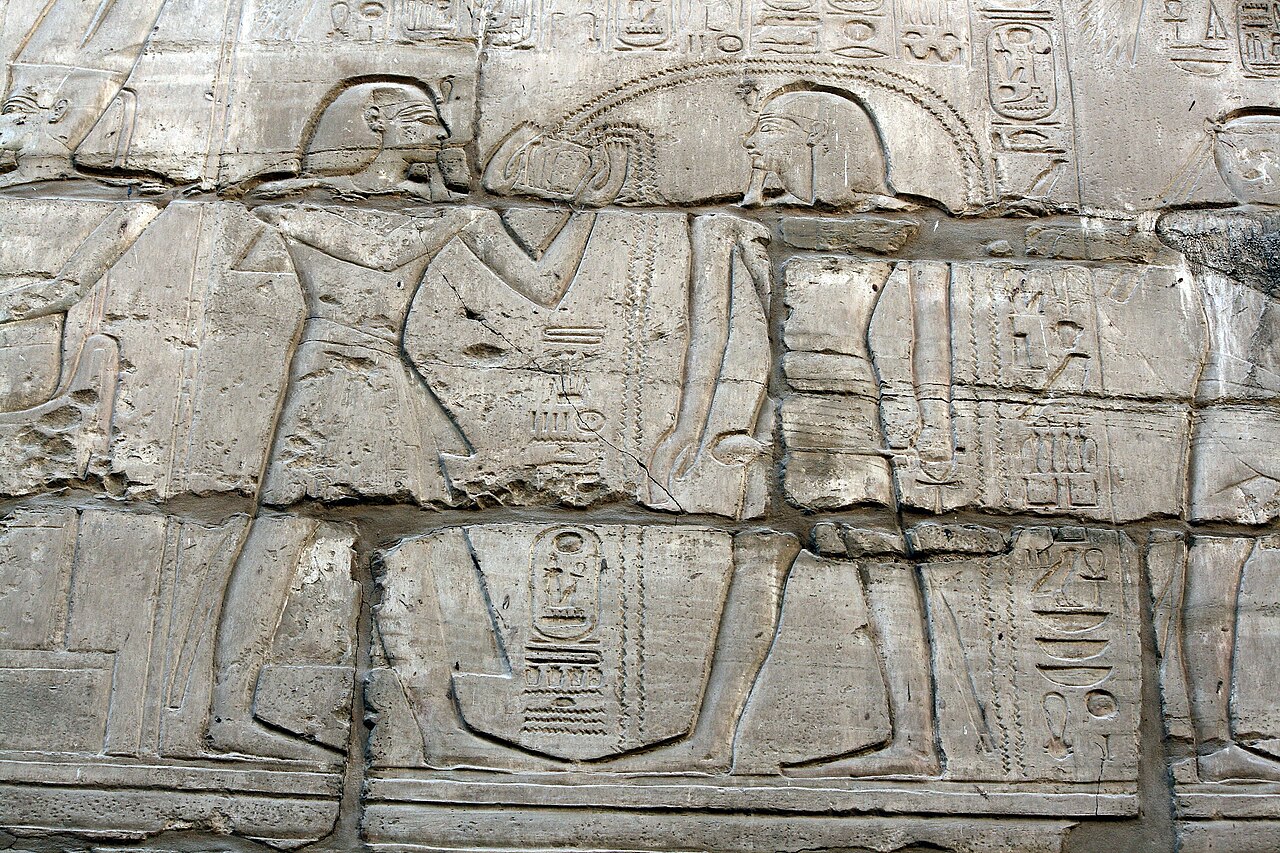
Karnak was not constructed in a single period but accreted in stages from the Middle Kingdom and especially during the New Kingdom (roughly the second millennium BC). Over time approximately thirty pharaohs and many generations of priests and artisans added buildings, sculptures and inscriptions. Successive rulers often built beside, over or from the stone of earlier structures, so walls and reliefs at Karnak preserve evidence of changing artistic styles, royal propaganda and religious emphasis across centuries.
Architectural and artistic highlights
The Hypostyle Hall is one of Karnak’s most celebrated spaces: a dense forest of massive columns whose capitals and surfaces are richly carved with reliefs and hieroglyphs. Several pharaohs erected tall obelisks and colossal statues within the complex to proclaim their achievements; Hatshepsut, Thutmose III, Seti I and Ramesses II are among the rulers most closely associated with major works at Karnak. The avenue of sphinxes that once linked Karnak to the Luxor temple formed an important ceremonial approach during religious festivals.
Religious and civic roles
As the principal sanctuary of Amun, Karnak combined sacred, economic and political functions. The complex served as a home for powerful priesthoods, storage for temple wealth, and a venue for state rituals. Annual festivals — notably the Opet festival — involved processions that carried the image of the god from Karnak to the nearby Luxor temple, reinforcing the relationship between the city’s temples and the pharaoh’s divine role.
Archaeology, conservation and legacy
European travellers and later Egyptologists documented and excavated Karnak from the 19th century onward, revealing major structures and freeing buried sections from sand and debris. Modern archaeology continues to study the site’s architecture, inscriptions and material culture to better understand ancient religion and administration. Conservation work addresses weathering, rising groundwater, salt crystallisation and the impacts of tourism; efforts aim to stabilise stonework, protect painted surfaces and manage visitor access.
Karnak remains a primary destination for those interested in ancient Egypt and is central to scholarly study of pharaonic religion and monumental building. For general introductions and practical visitor information see resources on Luxor, the Nile and broader material about Egypt. The site’s long and layered history makes it an unparalleled record of changing beliefs, royal ambition and architectural technique in ancient northeastern Africa.
Questions and answers
Q: Where is Karnak located?
A: Karnak is located near Luxor on the Nile in Egypt, about 500 km south of Cairo.
Q: What kind of complex is Karnak?
A: Karnak is a complex of temples, chapels, pylons, and other buildings.
Q: Who contributed to the buildings in Karnak?
A: About thirty pharaohs contributed to the buildings in Karnak.
Q: What is the main temple in Karnak?
A: The Great Temple of Amun is the largest and most important temple in Karnak.
Q: What is the most massive structure in Karnak?
A: The most massive structure in Karnak is a temple begun by Pharaoh Ramses II (ca. 1391–1351 BC).
Q: What is the meaning of the name Ipet-isut?
A: Ipet-isut means 'The Most Selected of Places'.
Q: What dynasty considered Karnak as the main place of worship?
A: The eighteenth dynasty considered Karnak as the main place of worship, part of the monumental city of Thebes.
Related articles
Author
AlegsaOnline.com Karnak Temple Complex Leandro Alegsa
URL: https://en.alegsaonline.com/art/52377