
Kangaroo rat (Dipodomys): desert‑adapted North American rodents
Small, hopping rodents of the genus Dipodomys found in arid and semi‑arid North and Central America. Noted for long hind legs, water‑conserving physiology, nocturnal habits and seed caching.
Overview
Kangaroo rats are small, ground‑dwelling rodents in the genus Dipodomys. Native to arid and semi‑arid regions of North and Central America, they are named for their long hind limbs and upright posture that resembles tiny kangaroos, though they are unrelated to marsupials. There are about 22 described species in the genus; body length and weight vary by species, but most adults are compact, long‑tailed animals adapted to open, dry habitats.
Image gallery
7 Images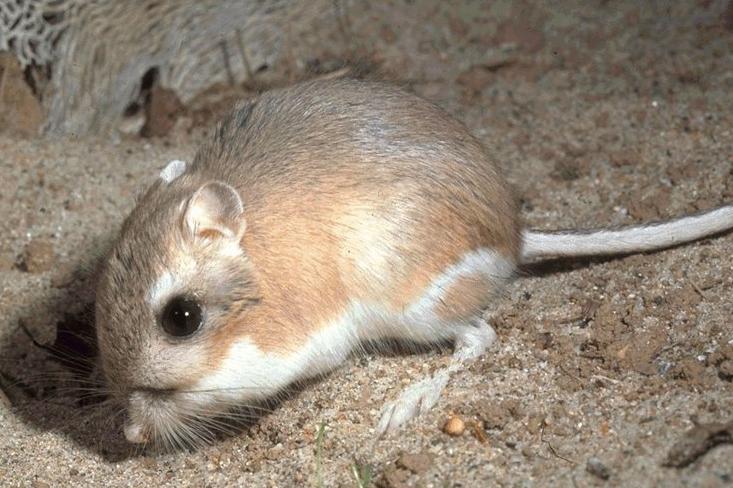


Physical characteristics and key adaptations
Typical kangaroo rats have powerful hind legs for bounding locomotion, relatively short forelimbs, large hind feet, and long tails used for balance. Their pelage usually matches the sandy or gravelly color of their terrain, ranging from pale tan to reddish brown, which provides camouflage. Several physiological traits enable survival where free water is scarce: highly efficient kidneys that concentrate urine, metabolic pathways that extract water from seeds and plant material, and behaviors that minimize water loss.
Behavior, diet and burrows
These rodents are primarily nocturnal, emerging after dusk to forage for seeds, grasses, leaves, and occasionally insects. Many species are scatter‑hoarders: they collect seeds and store them in cheek pouches for transport to burrows or surface caches. Burrow systems provide shelter from daytime heat and predators, and often include food storage chambers. Their hopping gait and ability to make quick directional changes are defenses against predators such as owls, foxes and snakes.
Taxonomy, distribution and convergent forms
Dipodomys is restricted to the New World, with ranges that include deserts, scrublands and dry grasslands of the western United States and parts of Mexico. Although kangaroo rats evolved in isolation from Old World hopping rodents, they display convergent similarities to jerboas and Australian hopping mice: enlarged hind limbs for saltatory movement and life in open, dry habitats. These similarities illustrate how similar ecological pressures produce comparable forms across unrelated lineages.
Ecological role and conservation
Kangaroo rats play important roles in dryland ecosystems. By harvesting and caching seeds they influence plant community dynamics and aid in seed dispersal; their burrowing activities modify soil structure and create microhabitats used by other organisms. Conservation status varies by species: some are widespread, while others are vulnerable to habitat loss, invasive plants, and altered fire regimes. Research on their physiology and behavior continues to inform desert ecology and conservation planning.
Further reading and resources
- Rodent overview and classification
- North American mammal distribution
- Central American habitats
- Comparison to kangaroos (marsupials)
- Mammalian characteristics
- Genus Dipodomys details
- Species list and diversity
- Jerboa (convergent form)
- Desert ecosystems overview
- African deserts and fauna
- Asian arid zone rodents
- Australian hopping mice comparison
- Outback ecology
- Burrow architecture and behavior
- Desert metabolism and water balance
- Kidney adaptations in small mammals
- Comparative physiology (humans vs rodents)
- United States range maps
- Mexican species and distribution
- Grassland and shrubland interactions
- Vegetation of arid regions
- Seed‑based diet and caching
- Foraging on leaves and green matter
- Use of nuts and fruit when available
- Fruit and seasonal resources
- Insectivory and opportunistic feeding
Questions and answers
Q: What is the genus of kangaroo rats?
A: The genus of kangaroo rats is called Dipodomys.
Q: How much do adult kangaroo rats weigh?
A: Adult kangaroo rats typically weigh between 35 and 180 grams.
Q: Where can kangaroo rats be found?
A: Kangaroo rats are found in North and Central America, as well as areas with dry climates like deserts and the Australian Outback.
Q: What type of environment do they live in?
A: Kangaroo rats live in arid and semi-arid environments with some grass or vegetation left.
Q: How do they get their water?
A: Kangaroo rats rarely need to drink water because they have a very efficient metabolism, highly developed kidneys, and can chemically split off water from the food they eat.
Q: What color are they usually?
A: Most often, kangaroo mice are a tone of dark yellow to deep brown so that it blends in nicely with their sandy surroundings.
Q: When are these animals active? A: Kangaroo mice are nocturnal which means that they are active during the night.
Related articles
Author
AlegsaOnline.com Kangaroo rat (Dipodomys): desert‑adapted North American rodents Leandro Alegsa
URL: https://en.alegsaonline.com/art/52102