
Araucaria: ancient conifer genus and its natural history
Araucaria is a small genus of evergreen conifer trees with a Mesozoic origin; species occur in the southern Pacific, South America and Brazil and include notable trees like the monkey puzzle.
Overview
Araucaria is a distinctive genus of mostly large, long-lived, evergreen coniferous trees in the family Araucariaceae. Nineteen species are generally recognised, with a scattered southern-hemisphere distribution. Many species are striking in appearance, with symmetrical crowns, whorled branches and conspicuous seed cones. Several are widely cultivated as ornamentals while others survive only as small, isolated populations in remote habitats.
Image gallery
10 Images




Physical characteristics
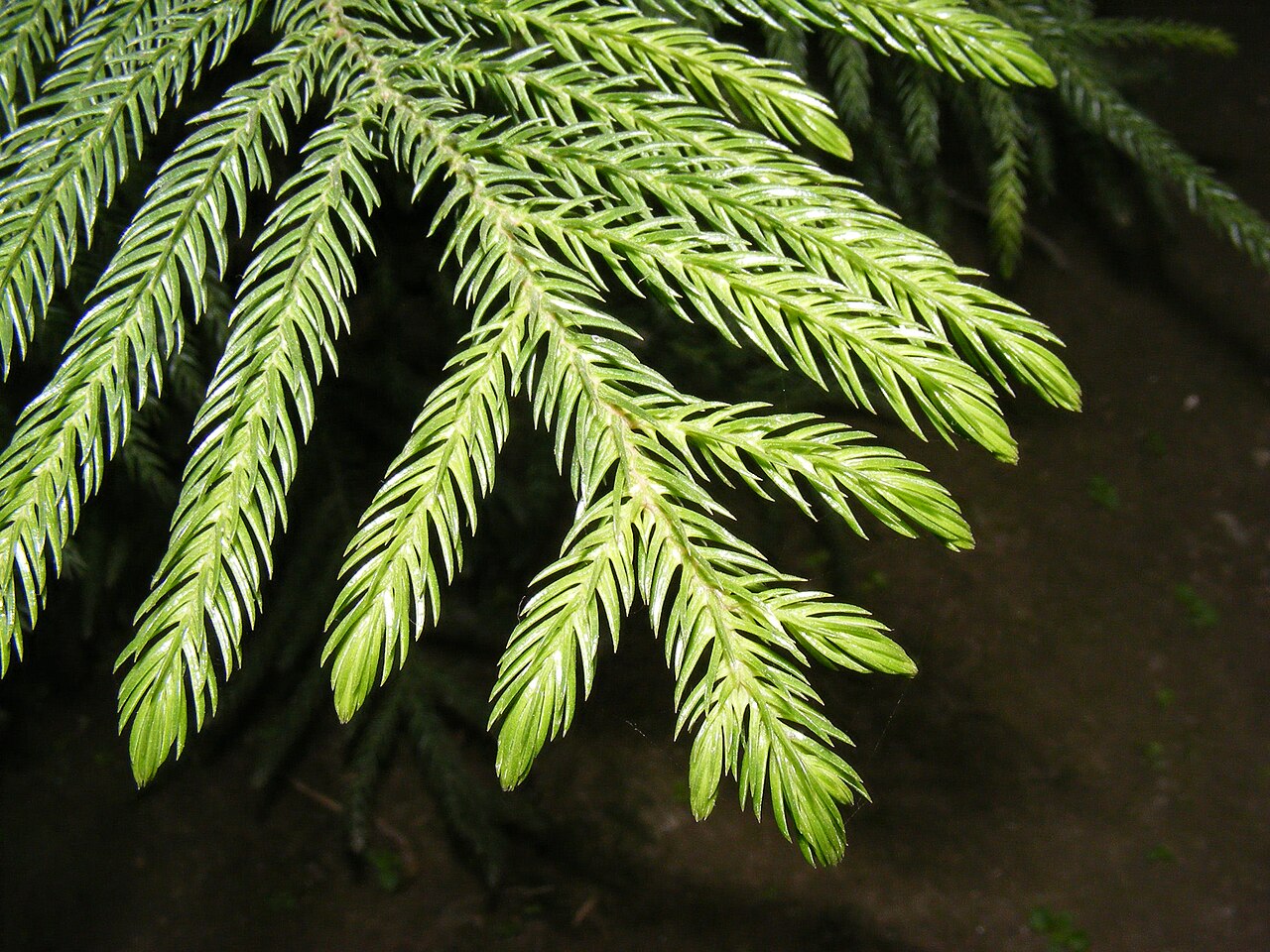
Araucarias vary from columnar to broadly conical trees and range from medium-sized to very tall. Leaves can be needle-like, awl-shaped or broad and overlapping, depending on species. Reproductive structures are large cones that may persist on the tree for extended periods; seeds of some species are sizeable and edible. Bark tends to be thick and furrowed on mature trunks, helping many species withstand wind and fire.
Distribution and species
There are about 19 species recorded. The greatest diversity is concentrated on the island of New Caledonia, where roughly 13 species are endemic. Other native ranges include Norfolk Island, parts of eastern Australia, New Guinea, and areas of South America such as Argentina, Chile and southern Brazil. Many Araucaria species grow in forest and shrubland, often occupying exposed ridges or coastal sites where their wind-resistant forms are an advantage.
Origins and fossil record
Araucaria lineages are ancient. Fossil evidence shows close relatives were widespread by the early Mesozoic era and the group persisted through major geological and climatic changes. Populations once extended into the northern hemisphere but became much reduced after the end of the Cretaceous period, leaving the modern relict distribution. Because of their antiquity and conservative morphology, Araucarias are often described as living fossils.
Uses, cultural importance and ecology
- Several species are important as ornamental trees in parks and gardens worldwide; well known examples include the monkey puzzle (Araucaria araucana) and the Norfolk Island pine (Araucaria heterophylla).
- Some trees provide timber, resin and large edible seeds that have been used as food by indigenous peoples.
- Ecologically, Araucarias can form dominant forest stands and support specialised wildlife; their large cones and seeds are an important resource for animals in some regions.
Conservation and notable facts
Many Araucaria species have restricted ranges and face threats from habitat loss, logging, invasive species and land conversion. Conservation attention is greatest in island systems such as New Caledonia and small island populations like Norfolk Island. Their deep evolutionary history and distinctive form make Araucarias significant both scientifically and culturally. For further reading and species lists see resources linked here: genus overview, species catalogue and regional floras for eastern Australia, New Guinea, Argentina, Chile and southern Brazil.
Questions and answers
Q: What is Araucaria?
A: Araucaria is a genus of evergreen coniferous trees in the family Araucariaceae.
Q: How many species are in the Araucaria genus?
A: There are 19 species in the Araucaria genus.
Q: Where are Araucaria trees found?
A: Araucaria trees are found in New Caledonia (where 13 species are endemic), Norfolk Island, eastern Australia, New Guinea, Argentina, Chile, and southern Brazil.
Q: In what type of environment are Araucaria trees typically found?
A: Araucaria trees are typically found in forest and shrubland, in exposed sites.
Q: How old are Araucaria trees?
A: Araucaria trees are living fossils, dating back to early in the Mesozoic era.
Q: Where did Araucaria trees formerly occur?
A: The genus also formerly occurred in the northern hemisphere until the end of the Cretaceous period.
Q: Why does the greatest diversity of Araucaria trees exist in New Caledonia?
A: The greatest diversity of Araucaria trees exists in New Caledonia due to the island's long isolation and stability.
Related articles
Author
AlegsaOnline.com Araucaria: ancient conifer genus and its natural history Leandro Alegsa
URL: https://en.alegsaonline.com/art/5203
Sources
- rchn.biologiachile.cl : "Leaf life spans of some conifers of the temperate forests of South America"