
Jordan River
A river of Southwest Asia flowing from tributaries near Mount Hermon through the Sea of Galilee into the Dead Sea; culturally significant and subject to intense hydrological and political pressures.
Overview
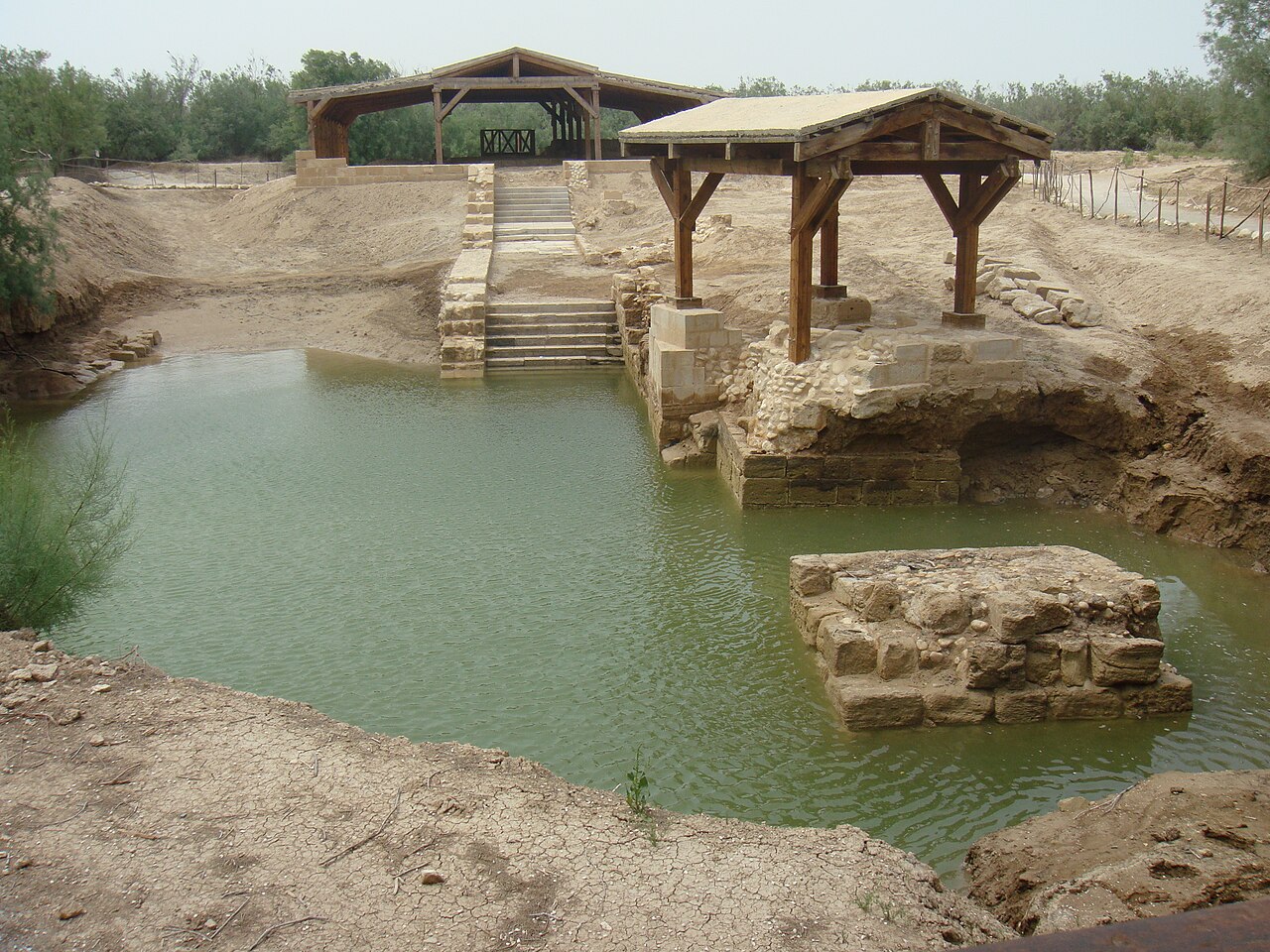
The Jordan River is a relatively short but historically and religiously prominent watercourse in Southwest Asia. In local languages it is known by Hebrew and Arabic names, for example nehār hayarden in Hebrew and nahr al-urdun in Arabic. It runs within the larger context of the Great Rift Valley and empties into the Dead Sea. Scholars, pilgrims and communities across religions frequently refer to the Jordan as one of the region’s most sacred rivers.
Image gallery
9 Images



Physical characteristics and tributaries
The Jordan River has a modest length compared with major world rivers; its course measures roughly 251 kilometres. Its upper reaches are formed by several mountain-fed streams and springs. The principal tributaries include:
- Hasbani — a stream that rises in southern Lebanon and contributes significant flow to the northern system.
- Banias — fed by a spring at the archaeological site of Banias on the slopes of Mount Hermon.
- Dan — a substantial spring also originating at the foot of Mount Hermon.
- Ayoun — another headwater stream with sources in Lebanon and adjacent highlands.
These headwaters converge in the north of the basin, joining to form the main stem of the Jordan near the area of northern Israel, close to the kibbutz Sede Nehemya. From its sources the river descends through a sequence of basins and escarpments before reaching lower elevations.
Course and hydrology
After formation the Jordan drops relatively rapidly into the Lake Hula basin and then into the Sea of Galilee (also called Lake Tiberias), which is a major regulating reservoir for the river; the Sea of Galilee is commonly referred to as the Sea of Galilee. Much further downstream the river flows into the hypersaline Dead Sea, which lies far below mean sea level. The lower reaches receive additional eastern tributaries such as the Yarmouk and the Jabbok, which historically contributed important seasonal flows.
Human use, engineering and environmental consequences
Since the mid-20th century the Jordan’s waters have been heavily exploited for municipal supply, irrigation and industrial uses. Major hydraulic works altered the natural regime: in the 1960s a diversion and storage program redirected water from the Sea of Galilee to national supply systems, and neighboring states developed canals, channels and reservoirs on key tributaries. For example, infrastructure built in the 1960s took water from the Yarmouk catchment and other sources; reservoirs and retention works were also constructed upstream. These modifications, together with intensive withdrawals, mean that a large proportion of the river’s original flow is now used for human purposes. High rates of evaporation at the Dead Sea, combined with reduced inflow, have contributed to a marked decline in the Dead Sea’s surface area and the conversion of shallow shorelines into salt flats.
Political, ecological and cultural dimensions
Water from the Jordan basin is a strategic resource shared by multiple states and communities. Competing demands link the river to political relations among Lebanon, Syria, Jordan, Israel and the Palestinian territories (Palestine). Cooperative management has been challenging, and periodic disputes over allocations and infrastructure have occurred. Ecologically, reductions in flow have harmed wetland habitats, freshwater species and the health of riparian zones, prompting conservationists and some governments to pursue restoration projects, demand reductions, and more integrated basin planning.
Significance and contemporary issues
Beyond its environmental and political importance, the Jordan River retains deep cultural and religious significance. It is a focal point for historic narratives, pilgrimage and contemporary ritual acts, especially within Christian traditions that associate the river with baptismal events. Today the river’s future depends on balancing human needs, ecological restoration and transboundary cooperation. Efforts to improve wastewater treatment, manage withdrawals more sustainably and rehabilitate wetlands reflect a growing recognition that the Jordan’s limited waters must be stewarded collectively to support both communities and ecosystems.
For further reading on specific features and place names related to the basin use these reference points: Hebrew names, Arabic names, the notion of a river in regional geography, the Great Rift Valley, the Dead Sea, its religious status, the list of tributaries, links to Lebanon, Israel and the kibbutz Sede Nehemya, information about sea level contexts, the Sea of Galilee, engineering works like the dam, regional reservoirs, processes such as evaporation, and the roles of Syria, Jordan and Palestine in basin affairs.
Questions and answers
Q: What is the Jordan River?
A: The Jordan River is a river in Southwest Asia that flows through the Great Rift Valley into the Dead Sea. It is 251 kilometres (156 mi) long and many people think it is one of the world's most sacred rivers.
Q: What are some of its tributaries?
A: The Jordan River has several tributaries, including the Hasbani (Hebrew: שנירsenir, Arabic: الحاصباني hasbani), which flows from Lebanon; The Banias (Hebrew: חרמון hermon, Arabic: بانياس banias), which comes from a spring at Banias at the foot of Mount Hermon; The Dan (Hebrew: דן dan, Arabic: اللدان leddan), with its source at the foot of Mount Hermon; and The Ayoun (Hebrew: עיון ayoun, Arabic: عيون ayoun), which also flows from Lebanon.
Q: Where does it join together?
A: All these tributaries join to form the Jordan in northern Israel, near kibbutz Sede Nehemya.
Q:What happens to it after this point?
A:The Jordan then drops quickly in a 75 kilometer run to Lake Hula, which is a little below sea level in the Galilee sea. Then it drops much more in about 25 kilometers to reach the Sea of Galilee before twisting and entering into Dead Sea, which is about 400 meters below sea level and has no outlet. Two major tributaries enter this last section from east - Yarmouk River and Jabbok River.
Q:How have humans impacted on its water resources?
A:In 1964, Israel began operating a dam that takes water from Sea of Galilee for national water carrier while Jordan built channel that takes water from Yarmouk River - main tributary of Jordan river causing great damage to ecosystem. Syria also built reservoirs that catch Yarmouk's waters leading to 70% - 90% human usage resulting in smaller flow & high evaporation rate shrinking Dead Sea & draining shallow waters making them salt flats now.
Q:Why does this resource cause conflict between countries ?
A:The water from Jordan river being an important resource for dry lands causes conflict between Lebanon , Syria ,Jordan ,Israel & Palestine as each country wants access to it .
Related articles
Author
AlegsaOnline.com Jordan River Leandro Alegsa
URL: https://en.alegsaonline.com/art/51077
Sources
- next.bible.org : "Jordan"
- abibleconcordance.com : "Jordanes"