
Joint Direct Attack Munition (JDAM)
JDAM is a modular guidance kit that converts unguided bombs into accurate, all-weather precision weapons using INS/GPS guidance and a standardized GBU designation.
The Joint Direct Attack Munition (JDAM) is a guidance kit that transforms conventional unguided aerial bombs into precision, all-weather weapons. By fitting a tail section containing control surfaces, an inertial navigation system and a Global Positioning System receiver, JDAM converts legacy munitions into guided bombs with meter-class accuracy under normal GPS conditions. The program is a joint initiative of the United States Air Force and the United States Navy that emphasizes low per-round cost, retrofit capability and rapid integration with existing aircraft.
Image gallery
10 Images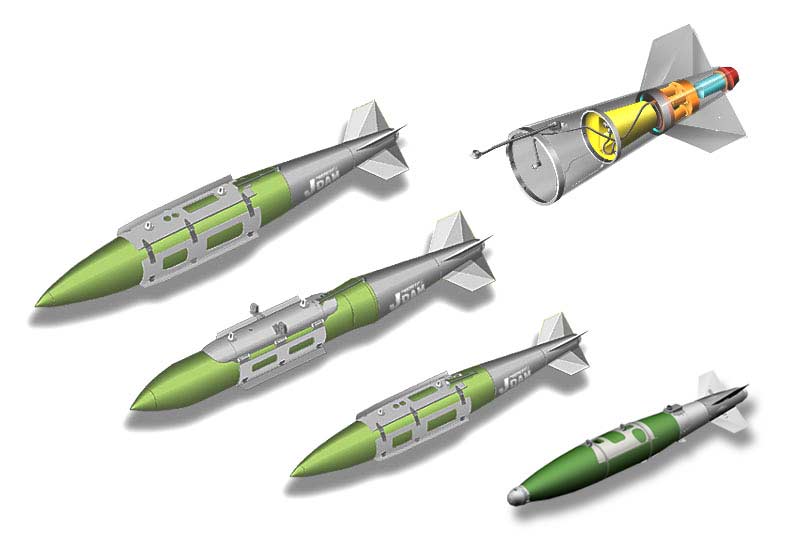


Characteristics and components
A typical JDAM kit replaces the bomb's tail and adds an onboard guidance computer. Key elements include:
- Tail assembly and control fins: Provide aerodynamic guidance and steering after release.
- Inertial navigation system (INS): Gives a self-contained reference that supports guidance if GPS signals are degraded.
- GPS receiver: Updates the INS and refines the weapon's trajectory to achieve high accuracy.
- Guidance computer: Computes flight controls and target coordinates; allows pre-programmed attack profiles.
When fitted to a bomb, the kit changes that weapon's designation to a Guided Bomb Unit (GBU) nomenclature, for example the GBU-31, GBU-32 or GBU-38, depending on the bomb body and weight class. For more on naming conventions see GBU (Guided Bomb Unit) nomenclature. Typical JDAM-equipped bombs range from 500 to 2,000 pounds, matching common free-fall bomb bodies.
History and development
JDAM was developed in the 1990s to provide a cost-effective way to give accuracy to large inventories of conventional bombs without designing new warheads. The approach favored modularity: adding a common guidance kit to many bomb types rather than manufacturing an entirely new guided munition for each warhead size. The kits were later produced and supported by major aerospace contractors and quickly became a standard capability on many U.S. and allied aircraft.
Operational use and advantages
JDAM-equipped bombs are valued for their all-weather performance, simplicity of integration and relatively low cost compared with some precision-guided alternatives. Aircraft crews program the weapon with target coordinates before release; after separation the JDAM steers the bomb to the programmed point. Because the system relies on both INS and GPS, it can continue to function with reduced GPS availability, albeit with degraded accuracy. The effective standoff distance depends on release altitude and speed, with some operational profiles enabling ranges measured in tens of kilometers.
Variants and related systems
- Laser JDAM (LJDAM): Adds a laser seeker to engage moving targets or improve terminal guidance in GPS-denied conditions.
- Extended-range kits: Incorporate winglets or glide bodies to increase stand-off distance.
- Anti-jam and navigation resilience: Enhanced INS and alternative sensors help maintain capability when GPS is jammed or spoofed.
JDAM’s modular concept also allowed international sales and adaptation by allied air forces. The kit is commonly paired with legacy unguided bombs (often called "dumb bombs") and has been used in numerous operations since its introduction. For users seeking technical context, the role of satellite navigation in JDAM performance is central; see Global Positioning System resources for background on the positioning system JDAM uses.
Notable points: JDAM converted mass inventories of unguided ordnance into accurate munitions at modest cost per round, changed air-to-ground tactics by enabling precision strikes in adverse weather, and spawned several follow-on variants to address moving targets and extended ranges. The program remains an example of upgrading existing weapons through modular guidance technology.
Questions and answers
Q: What is the Joint Direct Attack Munition (JDAM)?
A: Joint Direct Attack Munition or JDAM is a guidance kit that can convert "dumb" or unguided bombs into all-weather "smart" bombs.
Q: How does JDAM work?
A: JDAM works by using an inertial guidance system that communicates with a GPS receiver, which enables the guided bombs to be highly accurate and have a range of up to 15 nautical miles.
Q: What is the range of JDAM-equipped bombs?
A: JDAM-equipped bombs have a range of up to 15 nautical miles, which is approximately 28 kilometers.
Q: What weight range do JDAM-equipped bombs fall under?
A: The weight of JDAM-equipped bombs ranges from 500 to 2,000 pounds.
Q: What is the GBU?
A: The GBU stands for Guided Bomb Unit, which is a nomenclature for the JDAM kit attached to the normal "dumb bomb" nomenclature.
Q: Who developed JDAM?
A: JDAM is a joint project of the US Air Force and US Navy.
Q: What is the aim of developing JDAM?
A: JDAM was developed to enhance the accuracy and effectiveness of unguided or dumb bombs and make them all-weather smart bombs that can be used in a wide range of weather conditions making them more effective by being more accurate.
Related articles
Author
AlegsaOnline.com Joint Direct Attack Munition (JDAM) Leandro Alegsa
URL: https://en.alegsaonline.com/art/50950
Sources
- commons.wikimedia.org : Joint Direct Attack Munition
- ausairpower.net : "JDAM Matures; Parts 1 and 2" · archive.is
- af.mil : af.mil/news/story.asp?storyID=123017613
- military.com : "JOINT DIRECT ATTACK MUNITION JDAM"