
John and Priscilla Alden Family Sites (Duxbury, Massachusetts)
A National Historic Landmark comprising two linked Duxbury properties associated with Mayflower descendants John Alden and Priscilla Mullins, noted for Longfellow's poem and landmark archaeological investigations.
Overview
The John and Priscilla Alden Family Sites in Duxbury, Massachusetts, are a National Historic Landmark district that includes two closely related properties associated with one of the earliest English settler families in New England. The designation recognizes both cultural and scientific values: the later Alden house, commonly dated to about 1700, and the identified location of the original Alden homestead, believed to date to the early 1630s. The site is interpreted through documentary evidence, architectural study, and archaeological investigation. See the National Historic Landmark listing for background at National Historic Landmark and the town context at Duxbury, Massachusetts in the United States.
Image gallery
7 Images


Historic context
John Alden and Priscilla Mullins are figures from the Mayflower community whose names became widely known through the nineteenth century. Their story was popularized by the poem The Courtship of Miles Standish, written by Henry Wadsworth Longfellow, who was an Alden descendant. Longfellow's treatment helped turn a family narrative into a broadly shared element of American folklore and increased public interest in preserving sites connected to the Mayflower generation.
Components and material remains
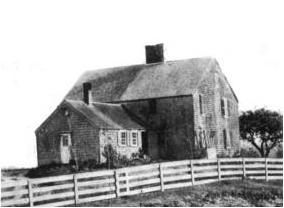
The landmarked property consists of two principal elements. The later house, commonly referred to as the Alden House and traditionally dated to c.1700, retains architectural fabric that illustrates domestic life in colonial New England. Nearby is the archaeological footprint of the original Alden homestead, attributed to the early seventeenth century and documented through fieldwork. Together these components provide an extended sequence of occupation and change on a single family property.
Archaeology and scholarship
In 1960 Roland Wells Robbins undertook fieldwork that identified and excavated the foundation of the earliest Alden dwelling. Robbins's investigations combined documentary research with controlled excavation and produced stratified deposits and artifacts—such as ceramic sherds, nails, and household items—that yielded evidence about building practices, domestic economy, and daily life among early English settlers. This work is often cited in discussions of the emergence of historical archaeology in the United States.
Significance and interpretation
The Alden sites are significant for multiple reasons: they are tangible links to Mayflower-era settlers; they demonstrate how literary reception can shape public memory and preservation priorities; and they served as a locus for methodological advances in archaeological practice. Interpretive materials and scholarly reports discuss both the family story and the technical findings of excavations led by Robbins and subsequent researchers.
Preservation, ownership, and public access
Ownership and management of historic properties can involve local historical organizations, private owners, and public agencies. Some portions of the Alden properties are maintained for preservation and public education, while archaeological deposits require careful protection. Visitors interested in the site should consult local resources and organizations for current access and interpretive opportunities; further historical context may be found through materials related to John Alden and biographical resources on Henry Wadsworth Longfellow.
Notable facts
- The landmark recognizes both cultural storytelling and scientific research conducted at the property.
- Longfellow's poem played a key role in popularizing the Alden narrative in the nineteenth century.
- Excavations attributed to Roland W. Robbins in 1960 contributed to the development of historical archaeology as a professional field.
Together, the literary associations, architectural remains, and archaeological findings at the John and Priscilla Alden Family Sites provide multiple lines of evidence about early colonial life, the ways communities remember their origins, and how investigative methods can recover everyday details of the past. For readers and researchers, the site offers a case study in how material culture, documentary history, and popular memory interact in American historic preservation.
Questions and answers
Q: What is the John and Priscilla Alden Family Sites?
A: The John and Priscilla Alden Family Sites is a National Historic Landmark consisting of two properties in Duxbury, Massachusetts, United States.
Q: What does the property owe its significance to?
A: The property owes it significance to the cultural impact of The Courtship of Miles Standish, a poem about the courtship of John Alden and Priscilla Mullins, written by Alden descendant Henry Wadsworth Longfellow and published in 1858.
Q: How popular was this poem?
A: The public embraced the poem. It became one of the most popular national origin stories in American folklore.
Q: Who conducted important archeological fieldwork at this site?
A: Roland Wells Robbins (1908-1987) conducted important archeological fieldwork and analysis at this site. He was a pioneer in the field of historical archeology, making the site of national significance in the development in this field.
Q: What did Robbins locate and excavate at this site?
A: Robbins located and excavated a foundation of the original Alden home in 1960.
Q: What data did his excavation yield?
A: His excavation yielded nationally significant data that shed light on the lifeways of the first English settlers in North America.
Q: What impact did Robbins' work have on historical archeology? A: His work made this site nationally significant for its contribution to development within historical archeology as a whole.
Related articles
Author
AlegsaOnline.com John and Priscilla Alden Family Sites (Duxbury, Massachusetts) Leandro Alegsa
URL: https://en.alegsaonline.com/art/50536
Sources
- alden.org : Alden House and Kindred Website